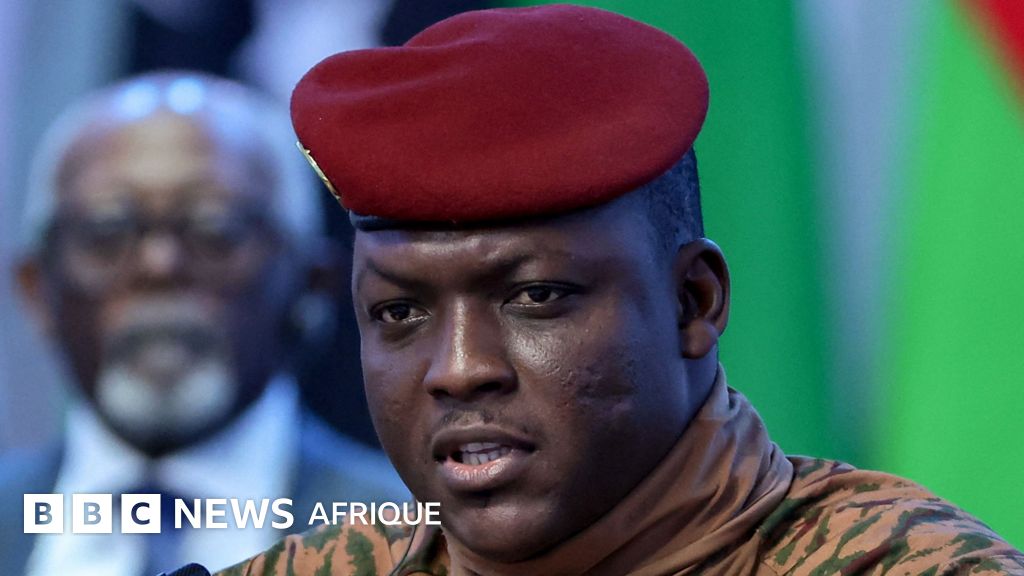
The military leader of Burkina Faso has declared that the nation must abandon democracy, calling the system outdated for the country’s needs during a state television interview.

Rejection of democratic governance
Captain Ibrahim Traoré, who seized power in a coup three years ago, stated that Burkinabè citizens must “forget the question of democracy,” arguing that the system “is not for us.” This bold declaration comes despite a previous pledge to restore democratic rule by July 2024—a deadline the junta has since extended by five years.
The military leader suggested that most Africans reject democracy, though he offered no concrete details about the alternative system he envisions for Burkina Faso. In January, authorities banned all political parties under a state reconstruction plan, consolidating power under the military administration.
Comparisons to Libya’s instability
Traoré drew parallels with Libya, warning that Western-imposed democracy has led to chaos. He pointed to the 2011 fall of Muammar Gaddafi—whose authoritarian regime once provided social services—as an example of democracy’s failures. Since Gaddafi’s overthrow, Libya has remained divided between rival governments and armed factions, failing to hold elections despite promises.
“Wherever Western powers attempt to impose democracy, it always results in bloodshed,” Traoré asserted during the interview, criticizing the West’s historical interventions.
Vision for a new political order
The Burkinabè leader dismissed political parties as divisive and incompatible with his revolutionary project. “In Africa, or at least in Burkina Faso, a true politician embodies all vices: a liar, a flatterer, a charlatan,” he claimed. While he did not outline a formal replacement system, Traoré emphasized building a new order based on sovereignty, patriotism, and revolutionary mobilization, with traditional leaders and grassroots structures playing central roles.
He also stressed the need for economic and military self-reliance, arguing that Burkina Faso cannot progress with standard six- or eight-hour workdays. The junta has suppressed dissent by targeting opposition figures, media outlets, and civil society groups, even reportedly deploying critics to frontline positions in the fight against Islamist militants.
Regional shifts and ongoing conflicts
Traoré’s rhetoric has resonated across Africa, particularly among those critical of Western influence. Since taking power, he has aligned Burkina Faso with other military-led neighbors—Mali and Niger—all of which have severed ties with former colonial power France and turned to Russia for military support amid a decade-long Islamist insurgency. Despite these alliances, violence in the region continues unabated.
A recent report by Human Rights Watch (HRW) documented over 1,800 civilian deaths in Burkina Faso since Traoré’s 2023 takeover, attributing two-thirds of the killings to the military and allied militias. The remaining deaths were linked to Islamist militants.