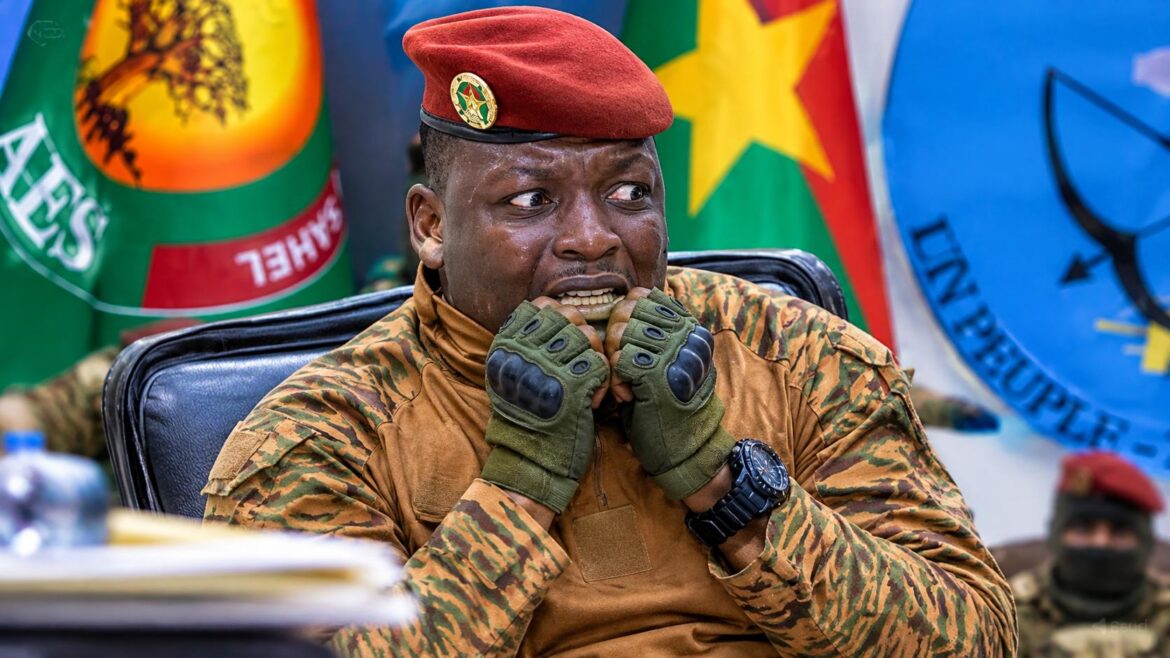
The absence of Burkina Faso’s transitional leader, Captain Ibrahim Traoré, from the Russia-Africa summit in Moscow is more than a diplomatic footnote it may expose the hidden fault lines within his own administration. While Traoré has cultivated an image of unyielding sovereignty through his strategic alignment with Moscow, whispers of internal dissent suggest that the stability of his regime is far from guaranteed.
Diplomacy as a shield: How Moscow became central to Traoré’s narrative
Since assuming power following Burkina Faso’s 2022 coup, Traoré has strategically positioned himself as a counterweight to Western influence, forging a partnership with Russia that extends beyond traditional diplomacy. This realignment has been meticulously framed as a push for national autonomy, with each public gesture from joint statements to symbolic meetings reinforcing the perception of a leader resolute in his vision for the country.
Yet this deliberate cultivation of a ‘strongman’ persona belies the precariousness of power in a nation still grappling with entrenched instability. The Burkina Faso of today is a country where security challenges and institutional fragility coexist with a leadership that prioritizes symbolic messaging over transparent governance. The question now arises: does Traoré’s calculated projection of authority mask an administration increasingly divided against itself?
When propaganda meets reality: The widening gap in Burkina Faso’s power narrative
Traoré’s political communication strategy has been relentless, leveraging social media and state-aligned narratives to project strength and resolve. The narrative emphasizes a break from the past, a rejection of foreign interference, and a pledge to restore national pride. However, critics argue that this carefully constructed image has overshadowed the realities on the ground persistent violence, economic strain, and humanitarian crises that demand urgent solutions.
The risk for any regime that relies heavily on propaganda is that the gap between promise and performance may eventually erode even the loyalty of its most trusted allies. If the leadership’s messaging outpaces its ability to deliver tangible improvements, even those within the inner circle may begin to question the sustainability of the current course. Such doubts, if they exist, are not merely rhetorical they can threaten the very foundations of the power structure Traoré has worked to build.
The silent fractures: Military alliances and the burden of transition
In Burkina Faso’s political landscape, where the military remains the bedrock of state authority, loyalty is as much a matter of personal allegiance as it is of shared objectives. Traoré’s rise was predicated on the support of key military figures, many of whom played pivotal roles in the 2022 coup. Over time, however, the interests of these actors may diverge from those of the transitional leader, particularly if they perceive their own influence or security is at risk.
Rivalries within the security apparatus are not uncommon in post-coup regimes. Control over strategic institutions, access to decision-making circles, and the distribution of resources can become flashpoints. For Traoré, whose legitimacy is still fragile, the specter of internal betrayal whether real or perceived poses a grave danger. The decision to skip the Moscow summit, while officially attributed to security concerns, may instead signal a deeper unease: the fear that his absence could be exploited by those within his ranks who seek to challenge, or even replace, him.
Reading between the lines: What Traoré’s absence could reveal
To interpret this event solely through the lens of geopolitical strategy would be to overlook the internal dynamics that shape Burkina Faso’s present. Traoré’s absence from a high-profile international forum is not, in itself, proof of imminent collapse. Yet it injects a layer of uncertainty into an already fragile transition. Is this a calculated risk, a defensive maneuver, or an admission of vulnerability?
What is certain is that the episode forces observers to reconsider the foundations of Traoré’s authority. A leader whose power rests on the perception of invincibility both domestically and abroad cannot afford prolonged signs of weakness. Yet the decision to stay away from Moscow, whatever its true motivation, sends a message: Burkina Faso’s internal stability may now be as critical to the regime’s survival as its external partnerships.
Key takeaways: Three scenarios worth considering
Scenario One – Tactical Absence: Traoré’s absence could be a pragmatic choice, designed to avoid leaving an opening for dissent to take root during his absence from Burkina Faso.
Scenario Two – Internal Anxiety: The withdrawal may reflect genuine concerns about potential instability within his administration, particularly among those who question his leadership.
Scenario Three – Strategic Delay: It could also signal a calculated pause, allowing tensions to subside before making any high-stakes diplomatic moves.
Conclusion: The summit’s message is not in Moscow, but in Ouagadougou
Ibrahim Traoré arrived in power promising transformation. His alignment with Russia has been framed as a bold step toward reclaiming national sovereignty. But sovereignty, ultimately, is not just about breaking old alliances it is about maintaining control over the institutions and people who help govern the state.
The Burkina Faso of today is navigating a delicate balance between external ambition and internal cohesion. As the Russia-Africa summit concludes, the most consequential developments may not be the agreements signed in Moscow, but the conversations and power struggles unfolding back in Ouagadougou. The question is no longer whether Traoré can project strength globally, but whether he can hold his own regime together as rivalries within his camp grow louder.
One thing is clear: the absence in Moscow may be a turning point, but its significance will only be fully understood in the corridors of power in Burkina Faso’s capital.
By Pierre Tchuente — Journalist