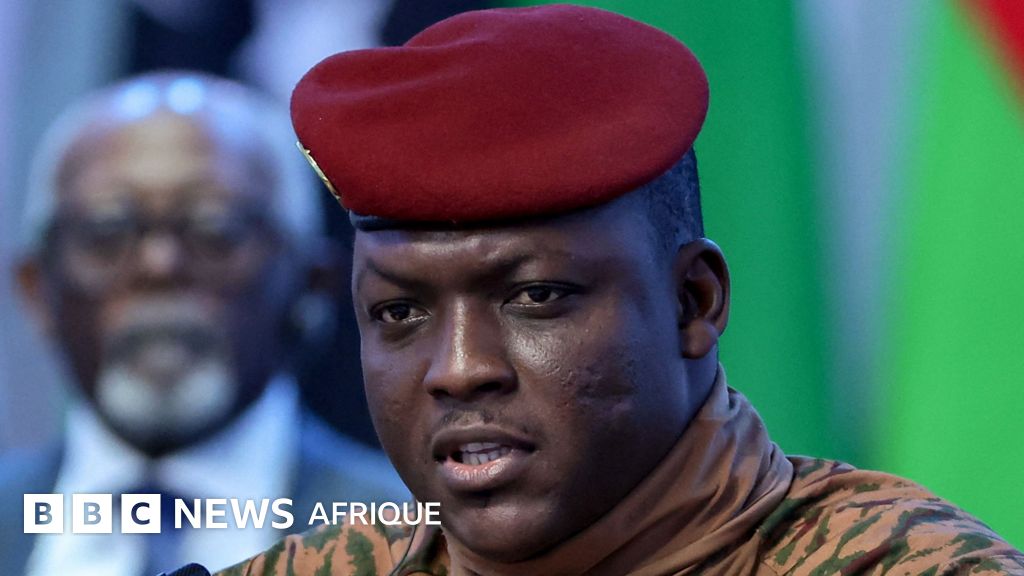
Burkina Faso’s military leader Ibrahim Traoré declares democracy incompatible with local needs

- Reading time: 5 min
Burkina Faso’s military ruler Captain Ibrahim Traoré has called on citizens to “forget” democracy, declaring it fundamentally unsuited to the nation’s realities during a televised address. In a sweeping rebuke of Western-style governance, the 38-year-old leader argued that conventional democracy has brought only instability, citing the Libyan model as a cautionary tale.
“People must abandon the idea of democracy,” Traoré asserted. “It is not for us. Democracy kills.” His remarks came during a rare prime-time interview aired on national television, where he laid out his vision for a revolutionary alternative to Burkina Faso’s political system.
The captain, who seized power in a 2022 coup, had previously pledged to restore civilian rule by July 2024. Yet with just two months remaining before that deadline, his transitional government announced a five-year extension of military rule. This move followed January’s controversial ban on all political parties, justified as part of a broader state reconstruction plan.
Traoré framed the dissolution of political parties as essential to national unity, describing them as divisive institutions that foster corruption and demagoguery. “In Burkina Faso—and much of Africa—politicians are liars, flatterers, and charlatans,” he stated. “They embody every vice imaginable.”
He emphasized building a new governance model rooted in sovereignty, patriotism, and grassroots mobilization, with traditional leaders and community structures playing pivotal roles. Economic and military self-reliance emerged as central pillars of this strategy, with Traoré insisting that Burkina Faso cannot progress with traditional work schedules. “Working six or eight hours a day won’t help us catch up with richer nations,” he warned.
The military leader condemned Western interference in African affairs, asserting: “Wherever Western powers impose democracy, it always ends in bloodshed.” His anti-imperialist rhetoric has resonated across the continent, bolstering his reputation as a bold advocate for African sovereignty. Alongside neighboring juntas in Mali and Niger, Burkina Faso has severed military ties with former colonial power France, opting instead for cooperation with Russia in combating Islamist insurgencies that have ravaged the Sahel region for over a decade.
Despite these shifts, violence continues unabated. According to recent findings by Human Rights Watch, over 1,800 civilians have lost their lives in Burkina Faso since Traoré’s 2023 takeover. The report attributes two-thirds of these deaths to state forces and allied militias, with the remainder linked to Islamist extremists. Traoré’s government has faced criticism for suppressing dissent, including accusations of punishing critics by sending them to frontline combat positions.
The leader’s panafricanist stance and uncompromising opposition to Western influence have earned him significant support across Africa, even as domestic challenges mount. Whether his revolutionary vision can deliver stability and prosperity remains an open question for Burkina Faso’s 22 million citizens.