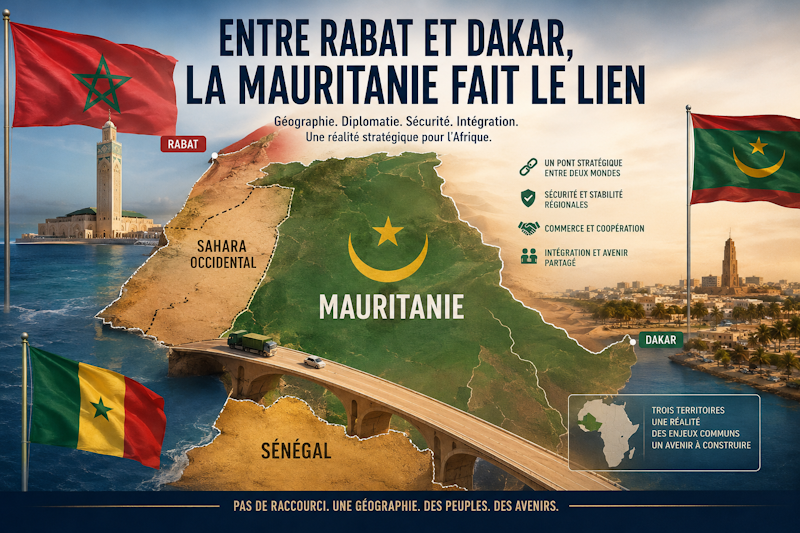

The vast stretch of land separating Morocco and Senegal is often reduced to a mere geographical blank on the map. Yet, this space is far from empty. At its heart lies the disputed territory of Western Sahara, while to its east stretches the Islamic Republic of Mauritania, a nation whose role in regional affairs is both pivotal and frequently overlooked.
Journalist Ahmed Ould Bettar of Mauritania has long emphasized this geographical reality, warning against the dangers of oversimplifying the intricate web of relationships between these three nations. His insights serve as a reminder that Mauritania is not just a transit zone but a sovereign state with a voice in continental diplomacy.
Mauritania: A bridge between North and West Africa
To overlook Mauritania in discussions about Maghreb-West Africa relations is to ignore a critical piece of the puzzle. As a nation recognized by its peers, Mauritania acts as a vital link, connecting the economic and security interests of its northern and southern neighbors.
Its strategic position is underscored by its active role in regional integration efforts, cross-border trade, and security collaborations. From stabilizing the Sahel to facilitating dialogue between conflicting parties, Mauritania’s contributions are indispensable. Yet, its significance is often sidelined in favor of more prominent actors like Morocco and Senegal.
Why geographical shortcuts fail in geopolitics
When analysts and commentators reduce complex geopolitical landscapes to oversimplified narratives, they risk distorting the very realities they aim to explain. The case of Morocco, Mauritania, and Senegal is a prime example. The distance between Rabat and Dakar is not just a matter of kilometers; it is a journey through histories, cultures, and sovereign decisions.
The status of Western Sahara remains a contentious issue, but it is not the only factor shaping these nations’ interactions. Mauritania, with its unique blend of Arab, Berber, and African influences, offers a nuanced perspective that cannot be dismissed. Its policies on migration, trade, and security have far-reaching implications for the entire region.
Simplifying this dynamic to a straight line on a map ignores the layers of diplomacy, trade agreements, and security partnerships that define these countries’ relationships. It also overlooks the human element—the millions of people who call this region home and whose lives are shaped by these geopolitical realities.
The cost of ignoring Mauritania’s role
When Mauritania is excluded from regional discussions, the resulting narrative becomes incomplete. This exclusion can lead to miscalculations in policy-making, missed opportunities for collaboration, and a failure to address pressing challenges such as terrorism, smuggling, and economic inequality.
For instance, Mauritania’s efforts to combat terrorism in the Sahel have been instrumental in maintaining regional stability. Its participation in economic blocs like the Economic Community of West African States (ECOWAS) further highlights its importance as a stabilizing force. Ignoring these contributions weakens the foundation of any meaningful geopolitical analysis.
In the end, geography is not just about lines on a map; it is about the lived experiences of people and the decisions made by sovereign states. Mauritania stands as a testament to this reality—a nation whose role in the region is too significant to be reduced to a mere footnote in geopolitical discussions.