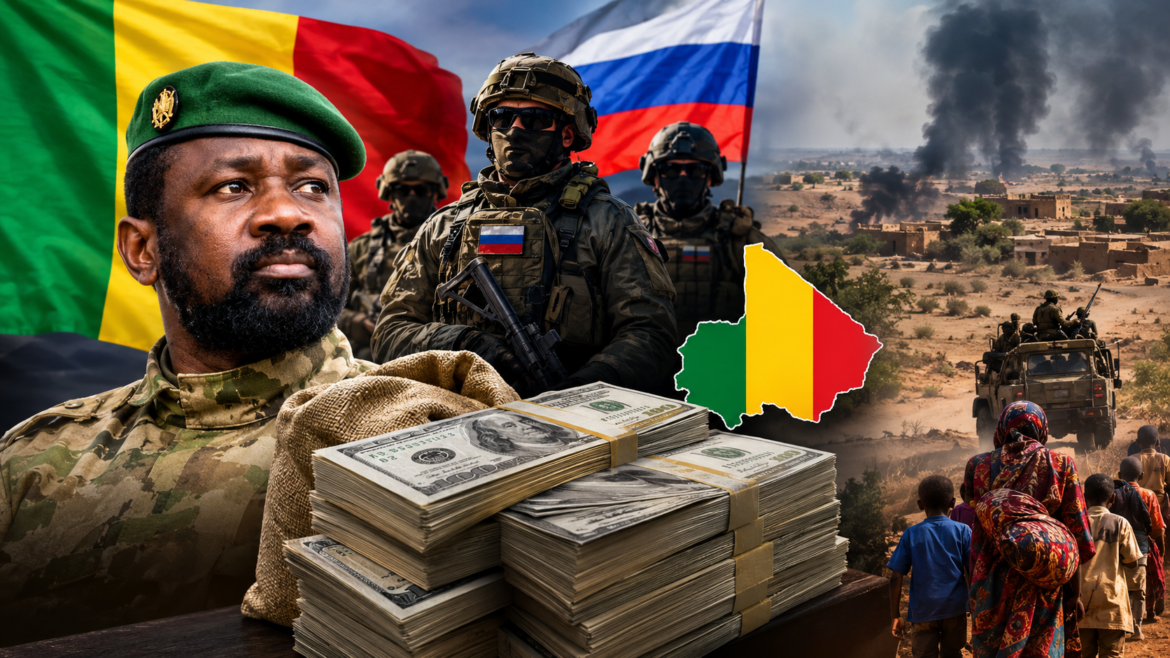
Nearly one billion dollars. That is the staggering amount Mali’s transitional government has committed to its military partnership with Russian forces, first through Wagner Group operatives and later under the restructured Africa Corps. With each fighter costing approximately $10,000 per month, Bamako’s investment in external security support has reached unprecedented financial heights. But beyond the formidable price tag, a pressing question looms over the Malian capital: what tangible outcomes can be cited to justify this strategic pivot away from Western partners?
From strategic shift to fiscal burden: the hidden costs of turning to Moscow
Mali’s decision to end decades of cooperation with European and North American allies in favor of a closer military bond with Russia was framed as a bold assertion of sovereignty. The promise was clear: regain control over national security through an alliance that would restore state authority across the territory and place Mali firmly back in the driver’s seat of its defense policy.
Yet, the true cost of this realignment extends far beyond diplomatic rhetoric. The billion-dollar figure is not merely a line item in the national budget; it is a reflection of national priorities, siphoning resources that could have addressed pressing civilian needs such as education, healthcare, infrastructure, and economic revitalization in conflict-affected regions. While military investment is essential, the scale of this commitment demands rigorous scrutiny. Citizens and analysts alike demand to know: what concrete improvements in security have been achieved in proportion to this monumental financial outlay?
The paradox of outsourced security: sovereignty in name, dependency in practice
The transition from Wagner Group to the Africa Corps represents a formal restructuring, not necessarily an operational one. A change in branding does not, by itself, guarantee enhanced coordination with Malian armed forces, improved intelligence capabilities, or a stronger defense of populated areas. External combatants may bring specialized operational skills, but they cannot substitute for a robust, autonomous national army capable of holding and securing recovered territories over the long term.
Sovereignty, as touted by Malian authorities, involves more than the freedom to choose international partners. It includes the ability to assess costs honestly, define objectives transparently, and evaluate performance critically. If security remains critically dependent on foreign forces, then the very premise of sovereign decision-making must be reevaluated. The true test of independence lies not in declarations, but in measurable results on the ground.
A billion-dollar question: what security dividends has Mali received?
Critics are not challenging the legitimacy of Mali’s partnership with Russia on ideological grounds. Rather, they are questioning the government’s accountability in reporting progress. How many areas are now secure that were previously under jihadist control? How many routes are now safely accessible to civilians and commercial traffic? How many families have been able to return home because violence has actually decreased?
Persistent attacks on military outposts, ongoing threats to civilians, and the continued presence of armed groups in large swaths of the country suggest that the partnership has yet to yield the expected dividends. A $1 billion investment should not be justified by political slogans alone. It must be paired with verifiable evidence of reduced violence, restored state presence, and sustained protection for vulnerable populations.
The burden of proof rests with Bamako
Mali’s transitional authorities have tied their political credibility to the success of this new military alignment. When such a high-profile strategic choice is made, the public has a legitimate right to demand transparency regarding expenditures, objectives, timelines, and outcomes. The burden of proof is on the government to demonstrate that every dollar spent has contributed to tangible improvements in public safety and national stability.
Failure to provide clear, auditable evidence only fuels skepticism. It risks transforming a bold diplomatic gamble into a credibility crisis one in which financial extravagance overshadows actual security achievements. In a nation grappling with prolonged conflict, sovereignty cannot be reduced to a slogan. Cooperation with foreign military entities must be evaluated not by intent, but by impact.
Beyond rhetoric: what do Malians truly need from their government?
For the citizens of Mali farmers hesitant to till their fields, teachers unable to reach schools, displaced families longing for homecoming, and traders forced to abandon their routes the most urgent measure of success is not geopolitical allegiance, but daily security. They are not concerned with the nationality of their protectors; they care about consistent safety, predictable access to essential services, and the restoration of state authority where it has been absent for years.
Until those conditions are met, the billion-dollar question will continue to haunt Mali’s government: has this costly realignment delivered real security, or has it only redefined the terms of external dependence under a new flag?
To answer with integrity, Mali must do more than change its alliances. It must change the narrative from one of financial magnitude to one of measurable protection. Only then can the true cost of this gamble be weighed against the safety it provides.
By Pierre Tchuente — Journalist