The Sahel is witnessing a quiet but decisive reshuffling of alliances, and Niger has unexpectedly become its epicenter. Over the span of a single week, diplomatic and military moves from Benghazi to Paris have exposed the fragility of old balances and the emergence of new power dynamics—ones that could redefine security, trade, and influence across an entire region.
The Libyan gateway: when Benghazi reaches out to Niamey
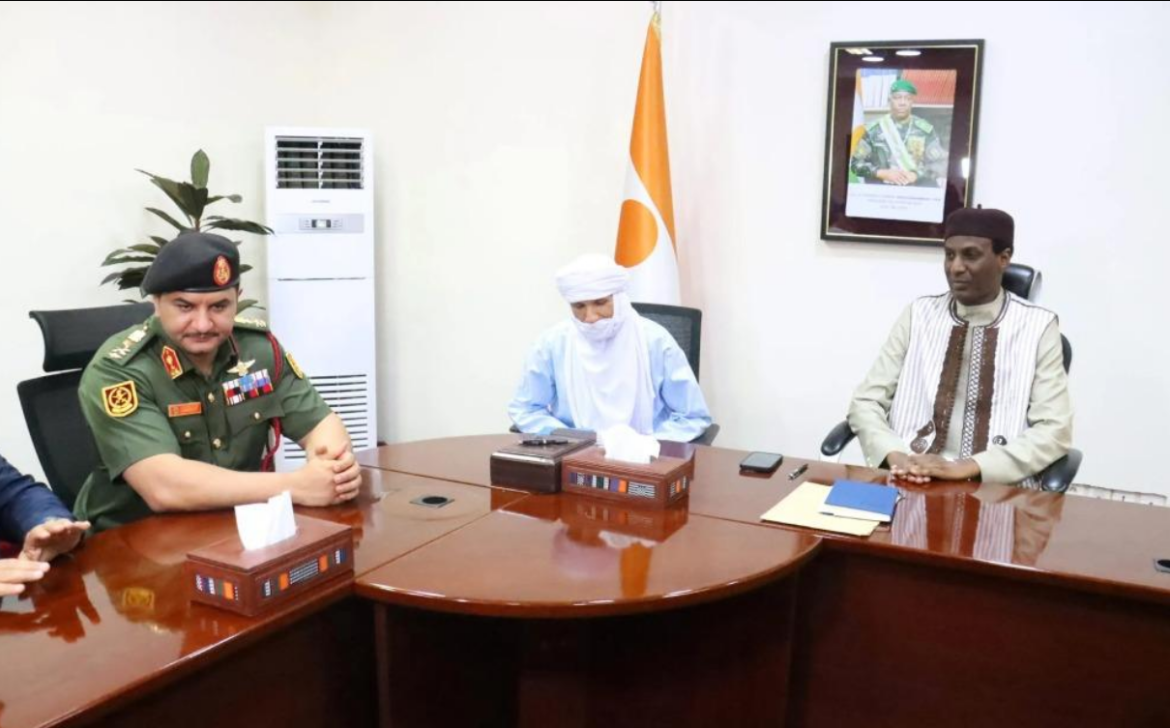
On November 1, 2026, Niger’s Prime Minister Ali Mahaman Lamine Zeine landed in Benghazi, where he met with Saddam Haftar, the second-in-command of the Libyan National Army under Marshal Khalifa Haftar. The visit culminated in a new strategic cooperation agreement, the details of which remain undisclosed—but the message is clear. Niamey is no longer waiting for direction; it is actively building alternative partnerships to secure its immediate environment.
Two days later, Khaled Haftar, Chief of Staff of Libya’s eastern forces, arrived in Paris for talks with France’s top military leadership. Defense cooperation, intelligence-sharing, and joint training were reportedly on the table. The timing was too precise to be coincidental: Benghazi strengthens ties with Niamey while eastern Libya’s military brass engages Paris. Whether this signals a coordinated strategy remains uncertain, but it confirms that the Sahel is now governed by parallel diplomatic channels—each pursuing its own agenda.
Why Algeria is racing to secure its southern flank
It is in this fluid context that Algeria has dramatically re-entered the Sahel game. On November 3, Algerian Foreign Minister Ahmed Attaf, acting as special envoy to President Abdelmadjid Tebboune, landed in N’Djamena. He delivered a personal message to Chadian President Mahamat Idriss Déby Itno and reaffirmed the 27 bilateral agreements signed between the two countries—especially those tied to counterterrorism, border security, and cross-border trade.
But the real significance lies elsewhere. Algiers is not merely strengthening relations with N’Djamena; it is trying to prevent Niamey from drifting further into other spheres of influence. Recent tensions between Niger and Chad—including Niger’s unproven accusations of destabilization—have weakened trust between the two neighbors. By deepening its collaboration with Chad, Algeria is seeking to re-establish itself as the region’s indispensable mediator, especially as Libya’s southern advance risks redrawing the map of Sahelian alliances.
The UAE factor: a shadow over Algerian strategy
Abou Dhabi’s long-standing support for Khalifa Haftar’s forces in eastern Libya is no secret. What is less clear is how this backing is evolving—and how it affects Algeria’s own interests. For Algiers, Libya’s stabilization is not an abstract concern; it is a national security imperative. Any shift in military presence or political loyalty near the Algerian border—especially in the Fezzan region, a gateway to Niger and Chad—directly impacts Algerian interests.
Niger’s warming ties with Benghazi may be interpreted as a pragmatic step by Niamey to diversify partners. But for Algeria, it also signals a potential expansion of Haftar’s influence southward—one that could challenge Algiers’ control over regional corridors used for energy transit, migration flows, and illicit trafficking. The message is unmistakable: Algiers must respond, and it is doing so through deeper engagement in Niamey.
Algiers vs. Rabat: the rivalry that shapes Sahelian outcomes
The historic rivalry between Algeria and Morocco extends far beyond the Maghreb. Since diplomatic ties were severed in 2021, the two countries have adopted opposing positions on key issues, including the Western Sahara conflict. This divide has seeped into Africa, where both nations compete for influence through economic projects, energy deals, and security partnerships.
Observers note the convergence between Morocco, the UAE, and the Benghazi camp. In mid-October, Khaled Haftar visited Rabat, where he met Morocco’s Inspector General of the Royal Armed Forces. Though no formal alliances were announced, the timing raised eyebrows in Algiers. From energy corridors to border security, any alignment involving Rabat and Benghazi risks tilting the regional balance in ways that could sideline Algeria’s traditional role.
Niger: from crisis zone to geopolitical pivot
Once viewed solely as a frontline state in the fight against armed groups, Niger has quietly transformed into a strategic crossroads. Its location bridges the Maghreb and sub-Saharan Africa; its energy reserves attract global interest; and its borders connect Libya, Algeria, Mali, and Chad. The Algerian Parliament’s October 25 vote to approve troop deployment in Niger underscores this shift: Algiers is no longer content to watch from the sidelines.
The military cooperation agreement between Algeria and Niger, combined with Niamey’s outreach to Benghazi, shows a deliberate strategy of not relying on a single external power. Even France, whose military presence in the Sahel has declined, maintains dialogue with multiple actors—including Haftar’s forces in Libya. But these contacts do not yet amount to a unified French plan focused on Niger.
The broader pattern is undeniable: the Sahel is no longer just a battleground against insurgency. It has become a high-stakes arena where nations compete for control of trade routes, energy corridors, and political allegiances—with Niger at the center of the board.