Double assault leaves 15 soldiers dead as insecurity spreads in Niger
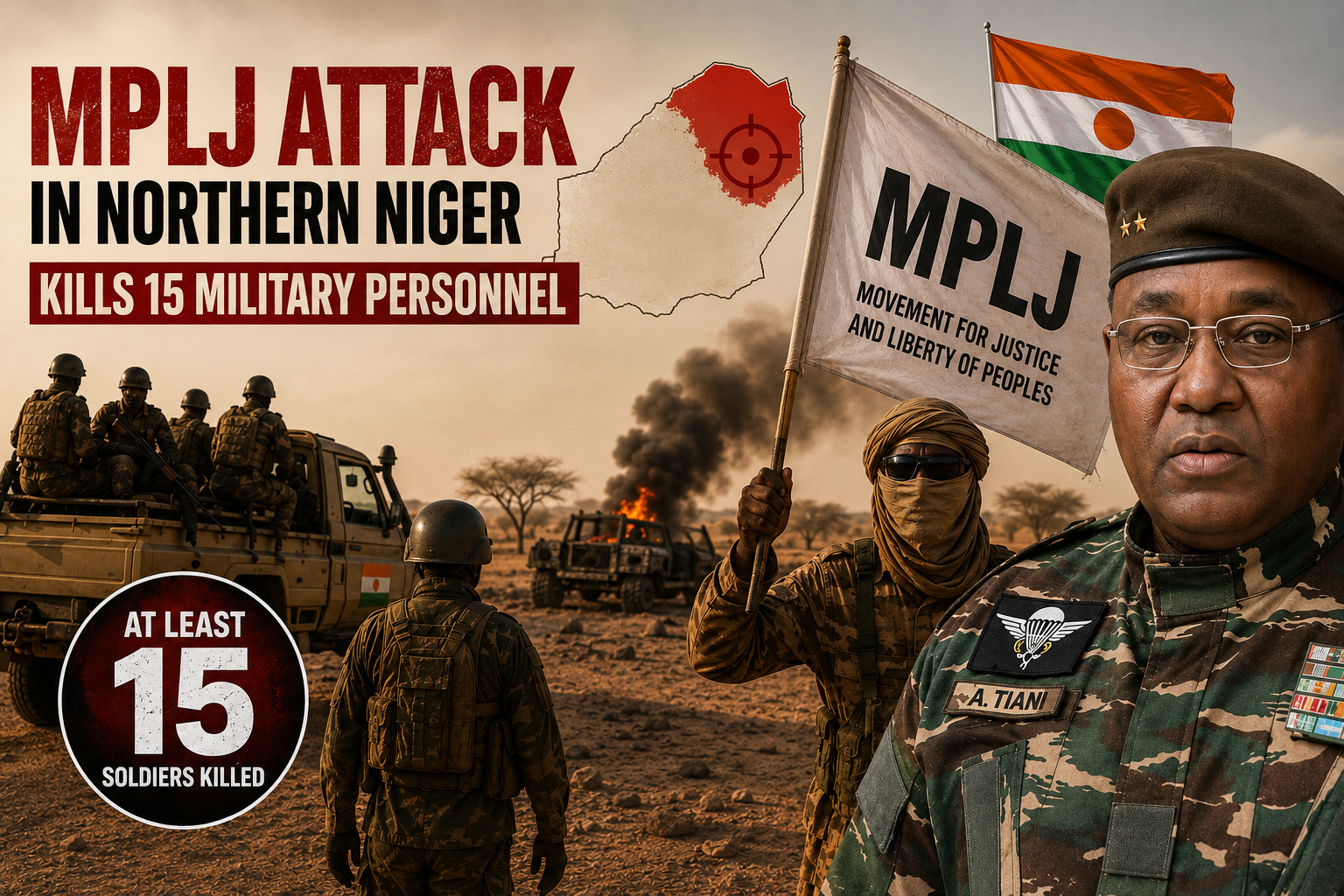
In Niger, the escalation of violence is straining the military leadership’s claims of restored security sovereignty. A recent dual assault in the northern region, claimed by the Movement for the Justice and Liberty of the Peoples (MPLJ), resulted in the deaths of at least 15 soldiers, underscoring a harsh reality: the junta led by General Abdourahamane Tiani is struggling to fulfill a fundamental state duty—ensuring the safety of its citizens and asserting control over its territory.
Military struggles in vast and vulnerable borderlands
The attack highlights not only the human cost but also the operational limitations of Niger’s armed forces in managing the country’s expansive desert and frontier regions. Niger’s vast territory, difficult to monitor, borders several nations also grappling with armed threats. These unchecked zones provide fertile ground for armed groups to move freely, regroup, and launch strikes before vanishing into the terrain.
The issue extends beyond a single incident. It exposes flaws in a security strategy that remains largely reactive, focusing on immediate military responses while neglecting critical components such as intelligence gathering, sustained administrative presence, cross-border cooperation, and long-term prevention of militant infiltration.
Diplomatic dead-ends and shifting blame
Each new security setback raises a pressing question: who will the government in Niamey blame this time? After criticizing France, severing ties with ECOWAS, and pointing fingers at regional neighbors, official rhetoric seems to have run out of scapegoats. Will Algeria, a crucial neighbor and partner, be targeted next? Or will the regime reconsider its newfound alliances? The strategy of deflection is reaching its structural limits.
Since the July 2023 coup, the military leadership has built much of its legitimacy on a pledge to break from previous security policies. Sovereignty, rejection of foreign interference, and the pursuit of new partnerships have dominated official discourse. Yet for the civilians living under threat, the true measure of success is far more tangible: the ability to live, travel, work, and sleep without fear of sudden violence.
A widening gap between words and reality
There is a striking disconnect in Niamey: a confident grasp of global geopolitical issues contrasts sharply with a troubling disconnect from local security realities. While sovereignty is championed on international stages, border regions and desert expanses are slipping into a dangerous void—one exploited by armed groups to consolidate their presence and launch attacks.
This paradox reveals a fundamental contradiction. Sovereignty cannot be measured solely by denunciations of foreign influence or shifts in diplomatic alliances. It is, above all, the state’s capacity to exert effective authority over its land, secure its borders, and protect its people.
Testing the junta’s promises of stability
The growing frequency of attacks in remote areas far from the capital serves as a crucial test for military governance. The longer violence persists, the more urgent it becomes for the regime to demonstrate that its diplomatic and military shifts since 2023 are yielding tangible results on the ground. For Niger’s population, political announcements offer little comfort when human losses continue to mount.
The limits of partnership shifts in security strategy
The pursuit of new alliances is not inherently flawed. It can, in fact, be a legitimate strategy if it enhances national defense capabilities. However, changing partners does not automatically translate into a new security doctrine. The true benchmark is performance: effective intelligence, attack prevention, civilian protection, road security, and a consistent state presence in vulnerable zones.Additionally, Niger’s diplomatic isolation from some regional partners may prove counterproductive. Armed threats do not respect political borders. Militant groups operating in the Sahel thrive precisely in transnational spaces, making cooperation, intelligence sharing, and coordinated action essential. Diplomatic tensions can weaken these crucial mechanisms.
It would be shortsighted to attribute each military setback solely to the soldiers on the front lines. The armed forces operate in an exceptionally complex environment. Their effectiveness hinges on intelligence quality, logistics, command structure, air and ground capabilities, and the political will to implement a coherent long-term strategy. Losses must prompt a thorough evaluation of the entire security apparatus—not a hasty search for external culprits.
The imperative of constitutional order
In a context where institutional disruption has not delivered on the promise of improved security, national stakeholders—both military and civil society—must confront the current trajectory. A prompt return to constitutional rule offers the only viable framework for restoring democratic legitimacy and forging robust alliances to counter the terrorist challenge.
Security cannot be sustained indefinitely on the popularity of nationalist rhetoric alone. It requires strong institutions, a clear national strategy, pragmatic regional cooperation, and an administration capable of reaching even the most remote territories.
The MPLJ’s attack is more than another violent episode in the Sahel conflict. It is a stark reminder that true sovereignty begins when a state can effectively protect those living under its authority—and that no amount of political slogans can fill the void left by absent governance.