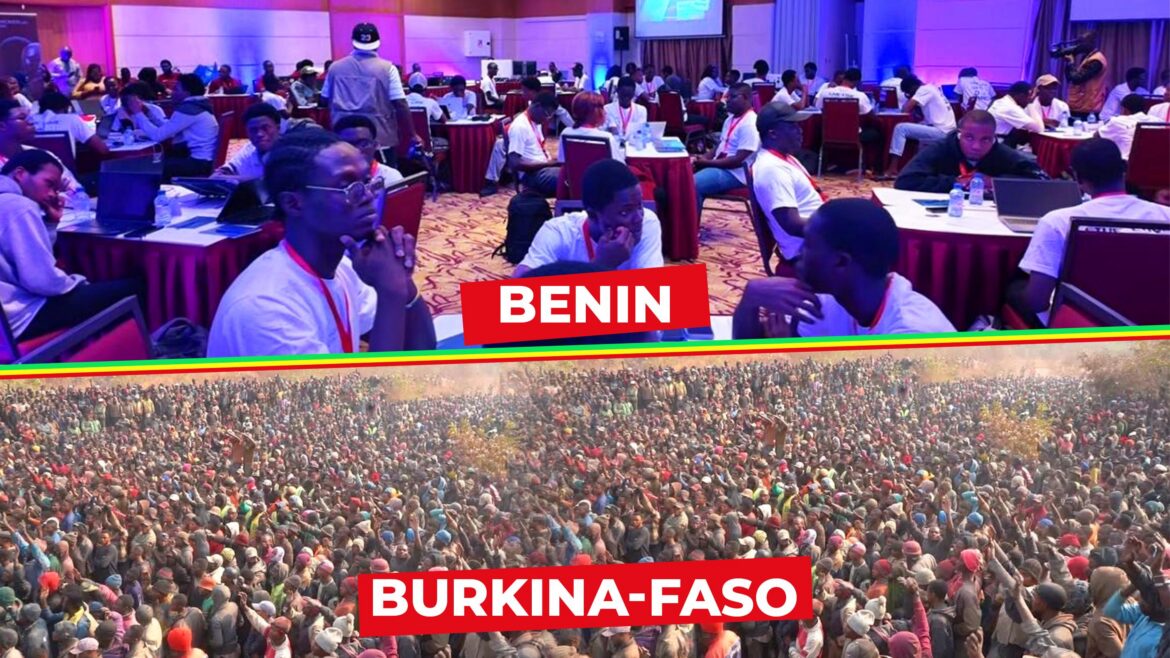
Contrasting priorities shaping two West African futures
In an era where national success hinges on both immediate stability and long-term capacity-building, the divergent trajectories of Benin and Burkina Faso offer a revealing case study. While one nation cultivates its human capital through structured innovation, the other confronts pressing social crises that demand urgent attention. This behind-the-scenes analysis uncovers the root causes and strategic choices that may determine the economic and demographic futures of both countries.
The making of a digital ecosystem in Benin
The Cyber Africa Forum held in Cotonou on 16–17 November was far more than a high-profile tech competition; it represented the culmination of a meticulous talent development pipeline that had been building for over three months. What began as daily tech challenges and team formations emerged as a calculated strategy to identify, nurture, and elevate the most promising young innovators in Benin’s digital landscape.
The selection process was rigorous: after a month of daily assignments, just twenty teams advanced to the final stage. Their performance was evaluated not only on technical execution but on adaptability, creativity, and problem-solving under pressure competencies essential for tomorrow’s economy. This method transcends traditional competitive formats by embedding talent spotting within a structured learning environment, aligning individual potential with national skills development goals.
More than a competition: seeding an innovation ecosystem
Benin’s approach reflects a broader shift in development thinking: economic sovereignty is increasingly defined not by military or political might alone, but by the ability to produce, retain, and deploy skilled human resources. By investing early in technical education, fostering peer learning, and creating platforms for real-world application, the country is laying the groundwork for a self-sustaining digital sector one that can attract investment, retain talent, and respond to global demand for tech solutions.
This strategy acknowledges a fundamental truth: young people are not passive beneficiaries of development, but active constructors of it. When given structured opportunities, mentorship, and competitive platforms, they become engines of progress generating ideas, launching startups, and solving local challenges with global relevance.
The human cost of political inertia in Burkina Faso
Meanwhile, across the border, thousands of Burkinabè artisanal miners many forcibly expelled from Guinea are facing an existential crisis. Deprived of their livelihoods and uprooted from communities they have sustained for generations, these workers and their families confront immediate threats to their survival. The absence of clear resettlement programs, professional retraining initiatives, or economic safety nets has left a vacuum where opportunity should be.
This is not a matter of political rhetoric or media optics; it is a humanitarian and economic emergency. The questions that follow are stark and practical: How many individuals and households are affected? What concrete measures have been implemented to support their return and reintegration? Are there vocational training programs tailored to their skills? Are public funds being mobilized for job creation in affected regions?
In a climate where governance often defaults to symbolic gestures arrest warrants, patriotic speeches, or carefully staged media events these vulnerable populations face the harsh reality that visibility in the news cycle does not equate to access to opportunity.
The governance paradox: visibility versus impact
Effective leadership requires more than occupying the public agenda or crafting compelling narratives. It demands anticipating crises, identifying systemic gaps, and delivering measurable solutions. While political actors may thrive in the arena of public discourse, citizens measure success by practical outcomes: employment, security, and sustainable livelihoods.
This distinction between performative governance and functional governance could not be clearer. A nation’s resilience is not built on headlines or hashtags, but on investments in education, infrastructure, and inclusive economic programs that uplift the most marginalized.
The long-term question: what are we building for future generations?
Both Benin and Burkina Faso are at pivotal moments. One is planting seeds for a digital and entrepreneurial future through structured talent development; the other is struggling with immediate social fractures that undermine stability and cohesion.
Yet both cases underscore a shared truth: Africa’s future will not be shaped by short-term political maneuvering alone. It will be forged in classrooms, tech hubs, vocational centers, and on the ground where citizens young and old build daily lives of purpose and possibility.
Benin’s model suggests a path forward: one that values human capital as a strategic asset, nurtures innovation as a public good, and integrates young people into the national project. Burkina Faso’s challenges remind us that no amount of visionary rhetoric can substitute for tangible support systems that protect livelihoods and restore dignity.
As both nations navigate their paths, one fundamental question remains: will African leadership prioritize the investments in people and infrastructure that lay the foundation for tomorrow or will it remain trapped in the cycle of addressing today’s crises while neglecting the foundations of tomorrow’s prosperity?
By Pierre Tchuente — Journalist