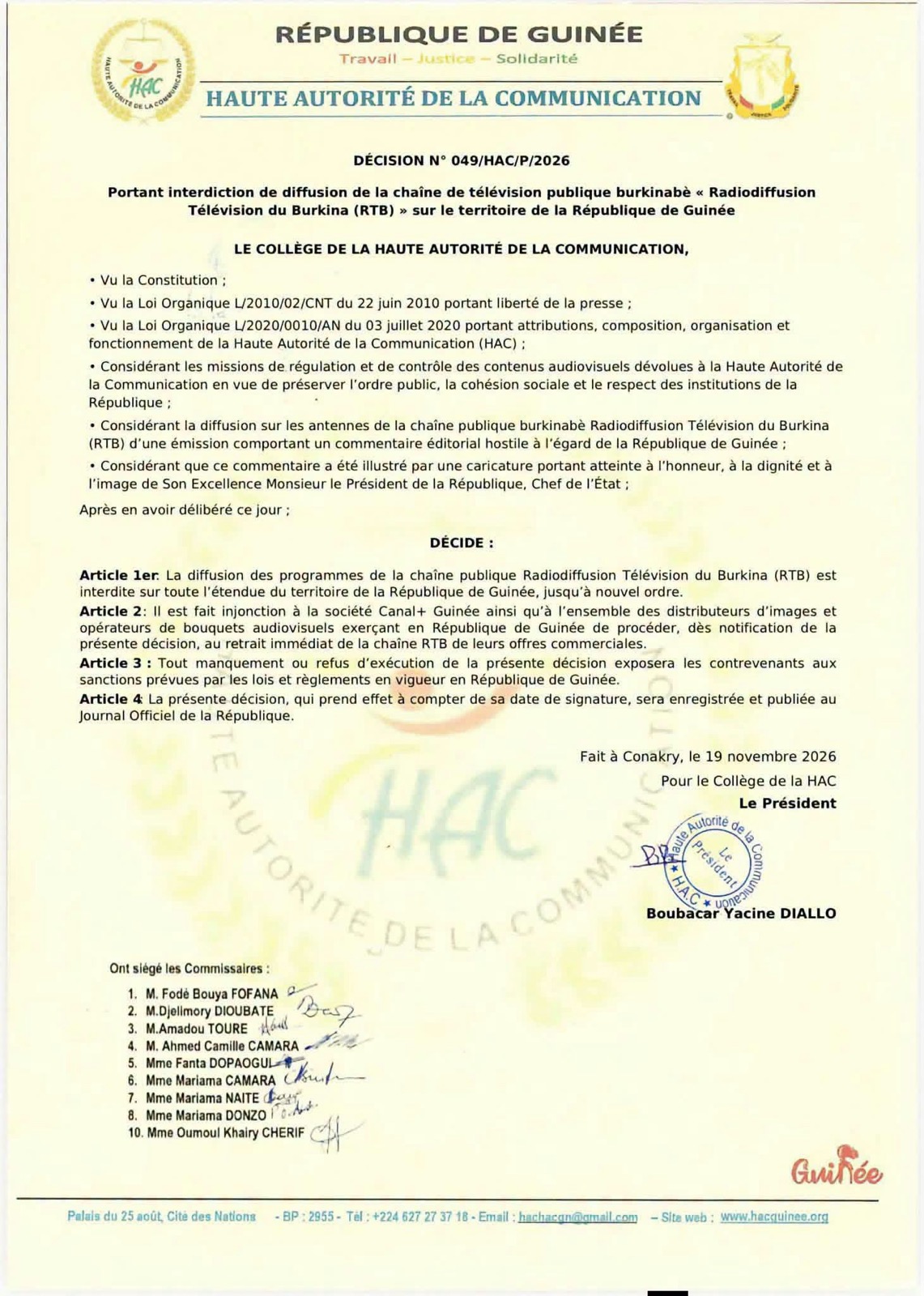
The suspension of Burkina Faso’s Radiodiffusion Télévision du Burkina (RTB) by Guinea’s High Authority of Communication (HAC) is not merely a regulatory measure it is a symptom of a deeper institutional tension. When a public broadcaster’s editorial choices consistently reflect the political agenda of a neighboring regime rather than the public interest, the very foundation of its mission comes under scrutiny.
When media serves politics instead of citizens
A public broadcaster exists to inform, not to align with power. Yet under the leadership associated with Ibrahim Traoré, the RTB’s programming increasingly blurred the line between journalism and state-approved messaging. The systematic sidelining of dissenting voices, the prioritization of government narratives over verified facts, and the use of airtime for political endorsements fundamentally contradict the principles of a service dedicated to the people.
Such practices are neither sustainable nor defensible. A television channel funded by public resources cannot operate as an extension of a political apparatus without eroding public trust and compromising its own legitimacy. The HAC’s intervention in Guinea should therefore be seen as a necessary response not an isolated incident, but a reflection of systemic challenges facing public broadcasters across West Africa.
The unseen costs of politically driven journalism
Eroding credibility, distorting perception
When a public broadcaster abandons its role as a neutral arbiter of facts, the consequences extend beyond national borders. The RTB’s coverage, perceived as partisan, has fueled perceptions of institutional bias not only domestically but throughout the region. This erosion of credibility is particularly damaging for a medium whose primary mandate is to uphold democratic values through transparent reporting.
Beyond the immediate diplomatic strain, the deeper cost is the normalization of media as a tool of influence rather than a pillar of public service. Citizens rely on public broadcasters for truthful, contextualized information especially in times of political turbulence. When that trust is betrayed, the entire ecosystem of media integrity is weakened.
When governance meets media governance
The conflation of political strategy and journalistic duty reveals a troubling governance paradox. A public broadcaster, by definition, is not a state propaganda arm. Yet when editorial decisions are dictated by short-term political interests whether through direct censorship, implicit pressure, or self-censorship the institution fails its primary stakeholders: the public.
This dynamic is not unique to Burkina Faso. Across the continent, public media outlets face growing pressure to align with ruling parties, often rationalized as national unity or stability. However, such rationales only serve to mask a dangerous conflation of institutional purpose and political loyalty.
Sovereignty without accountability: the contradiction in public media
The argument that public broadcasters must ‘defend national sovereignty’ cannot justify the suppression of dissent or the distortion of news. Sovereignty in media is not achieved through uncritical support of government policy; it is earned through rigorous, independent journalism that holds power to account.
Guinea’s decision to suspend RTB transmissions is a reminder that public broadcasters do not operate in a vacuum. Their actions reverberate across borders, shaping regional media culture. When a channel like RTB prioritizes regime preservation over truth, it undermines the very idea of a free and pluralistic public sphere.
Accountability starts at home. The RTB and every public broadcaster facing similar pressures must recognize that its survival depends not on political favor, but on restoring faith in its editorial independence. Until then, the question remains: can a public broadcaster that abandons its core mission ever truly serve the public?
What should public media prioritize?
As the debate over RTB’s future unfolds, three principles must be upheld:
Editorial independence: Separate journalism from political messaging. A public broadcaster’s role is to present multiple perspectives, not to amplify a single narrative.
Fact-based reporting: Replace speculation and innuendo with verified information. Citizens deserve accuracy, not political spin.
Public accountability: Be transparent about editorial guidelines and ownership of content. The public’s right to know begins with the broadcaster’s own integrity.
The suspension of RTB in Guinea is not just a regulatory footnote. It is a call for introspection and reform within public broadcasting institutions across the region. The legitimacy of these media depends on one simple truth: they exist for the people, not for the powerful.
By Pierre Tchuente — Journalist