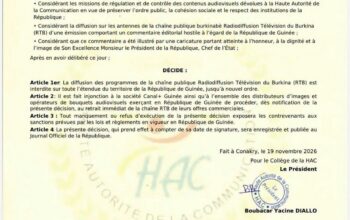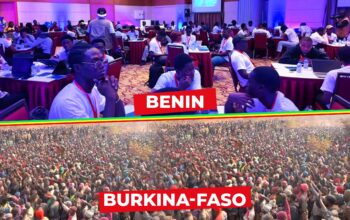
In a recent and widely discussed media campaign, Burkina Faso’s state broadcaster reignited a long-standing debate about natural resource governance in West Africa. Through a critical documentary, Ouagadougou’s official media accused the Guinean government of prioritizing foreign mining interests at the expense of local populations. While the narrative of ensuring African mining wealth benefits Africans is widely accepted, it raises a crucial question: Is Burkina Faso holding Guinea accountable for practices it itself employs within its own borders?
The duality of state-led mining crackdowns
Burkina Faso’s critique of Guinea’s mining sector centers on the use of forced evictions and heavy-handed enforcement around artisanal gold sites. Yet an examination of recent actions by Burkina Faso reveals an identical enforcement strategy. In early July 2024, the Burkinabe government ordered an immediate halt to operations on several gold sites deemed illegal in the Hauts-Bassins and Cascades regions. Days later, the Ministry of Mines announced the results: the removal of unauthorized miners, revocation of thousands of artisan mining permits, and the seizure of over 60 hydraulic excavators.
The inconsistency is glaring. Why is the public use of coercive force to regulate gold mining seen as a legitimate assertion of sovereignty in Burkina Faso, yet viewed as a surrender to foreign interests when applied in Guinea? This double standard exposes deeper contradictions in the region’s mining governance.
Foreign investment: a double-edged sword
The hypocrisy grows sharper when examining foreign involvement in the gold sector. While Burkina Faso’s official stance condemns the role of multinational corporations in Guinea’s mining industry, the Burkinabe gold economy remains deeply reliant on international operators.
Official data from the 2024 Extractive Industries Transparency Initiative (EITI) report shows that of the 60.77 tonnes of gold produced in Burkina Faso, over 87% (53.38 tonnes) came from industrial mines—compared to just 7.13 tonnes from artisanal sources. These industrial operations are predominantly controlled by foreign firms. Industry data from 2026 indicates that Russian mining giant Nordgold alone operates three major mining companies in Burkina Faso (Bissa Gold, Nordgold Yimiougou, and Nordgold Niou), representing about 20% of the country’s industrial mining output.
While foreign investment brings essential capital, employment, and technology, it becomes intellectually inconsistent to denounce foreign dominance in Guinea while embracing it as a pillar of economic sovereignty in Burkina Faso.
Sovereignty discourse with shifting standards
This episode underscores a troubling pattern in Sahelian political discourse: a sovereignty narrative applied selectively based on diplomatic convenience rather than consistent principle. The result? A panafricanist rhetoric that risks being reduced to a political tool—one that can be directed inward against domestic actors or outward toward regional neighbors, depending on the need of the moment.
True protection of African mining interests demands universal application of key principles: transparent mining contracts, fair revenue sharing, environmental stewardship, and respect for local communities. These standards cannot be applied selectively—whether in Conakry or Ouagadougou. To do otherwise undermines not only the credibility of governance but the rights and livelihoods of the very people such policies claim to defend.