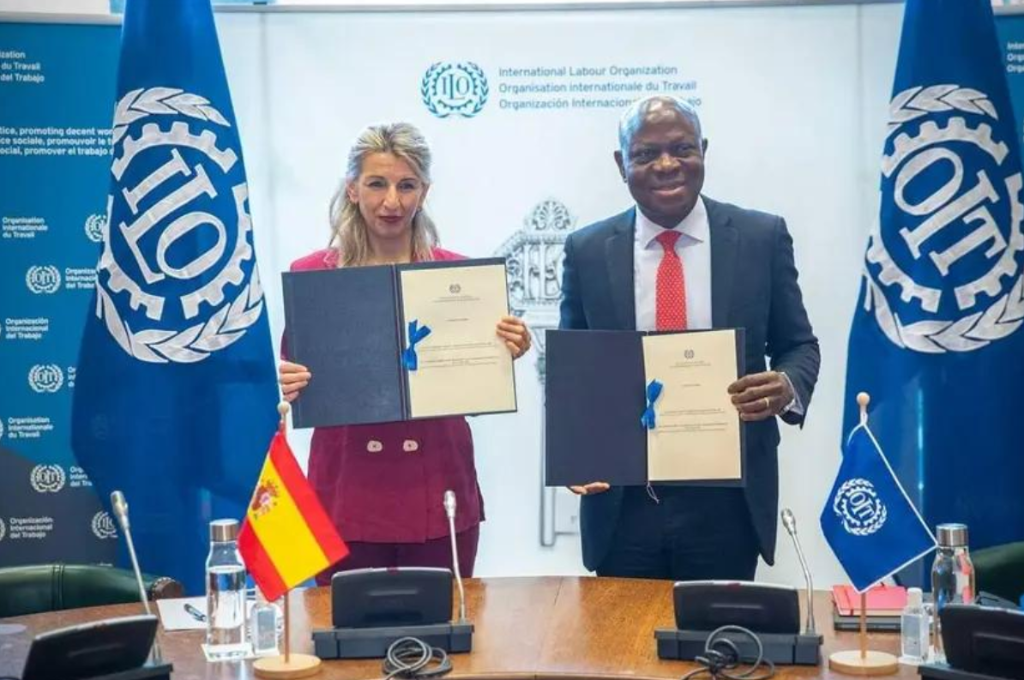
The re-election of Togolese diplomat Gilbert Houngbo as Director-General of the International Labour Organization (ILO) on 16 November 2026 did not unfold as anticipated. What began as a competitive contest suddenly shifted when Spain’s Labour Minister Yolanda Díaz stepped aside just hours before ballots were cast. Her withdrawal left Houngbo running unopposed—yet it did little to silence the growing chorus of criticism leveled against his outgoing administration’s handling of one of the agency’s most turbulent eras.
The hidden forces behind Yolanda Díaz’s last-minute withdrawal
On the surface, Díaz cited a desire to protect the unity of the global labour movement. In reality, her decision reflected deeper tensions within the international trade union movement. Key factions, including the International Trade Union Confederation (ITUC), had already aligned behind Houngbo, tipping the scales in his favour. Díaz argued that this endorsement overlooked the concerns of a substantial bloc of workers’ representatives who viewed Houngbo’s leadership as increasingly disconnected from grassroots priorities. Her withdrawal, she asserted, was a strategic move to prevent further schism within the labour movement rather than an admission of defeat.
Financial meltdown: the silent crisis reshaping ILO governance
The most explosive critique came from Díaz herself, who accused the ILO’s outgoing leadership of steering the organization into the worst financial crisis in its century-long history. She pointed to chronic arrears from major contributors, particularly the United States, whose unpaid dues now exceed hundreds of millions. With budgets slashed and job cuts looming, Díaz warned that ordinary staff—those tasked with upholding worker rights globally—were bearing the brunt of austerity measures that compromised the organization’s core mission. “An institution built to defend social justice,” she stated, “cannot sustain itself by dismantling the very protections it promotes.”
Internal memos reviewed by insiders describe an administration struggling to balance belt-tightening with mission-critical programmes. Reductions in travel, training, and outreach threatened to erode the ILO’s influence just as global supply chains and labour standards face unprecedented pressure.
When dialogue falters: the erosion of trust within the house of labour
The ILO’s raison d’être is tripartite dialogue—collaboration between governments, employers, and workers. Yet Díaz’s allegations suggest this foundation has cracked under Houngbo’s stewardship. Staff unions have accused management of bypassing consultation mechanisms and imposing restructuring plans unilaterally. Annual reports reveal a sharp decline in staff satisfaction scores, with many citing deteriorating morale and a perceived erosion of worker representation within the agency’s corridors.
These tensions came to a head in late 2025 when the ILO staff committee publicly challenged a proposed severance package, arguing it prioritized budgetary savings over employment security. The standoff underscored a disturbing paradox: an agency charged with advocating for labour rights worldwide appears increasingly unable to practice what it preaches internally.
What Houngbo’s second term means for the world’s workers
With no electoral mandate to challenge, Houngbo begins his new five-year term under a cloud of unanswered questions. Can an organization facing structural deficits and internal dissent retain its moral authority? Will surviving members scale up contributions, or will further austerity measures deepen disillusionment among staff? Most critically, how can the ILO restore its reputation as a beacon of social justice when its own workforce feels marginalized?
The answers may determine whether the ILO remains a relevant force in global labour governance—or whether its current trajectory risks turning it into a cautionary tale of institutional decline.
Key challenges awaiting Houngbo’s next administration
- Financial sustainability: Restoring contributions from major donors while avoiding further staff reductions.
- Staff morale & dialogue: Rebuilding trust with employees through transparent reforms and meaningful consultation.
- Global credibility: Demonstrating that austerity will not undermine the ILO’s ability to advocate for workers’ rights worldwide.
A leadership test that extends beyond the ballot
Gilbert Houngbo’s second term begins with a paradox: he has been re-elected unopposed, yet his legitimacy remains contested. The absence of electoral challenge does not equate to consensus. The criticisms voiced by Yolanda Díaz—and the silent discontent simmering among staff—signal that the ILO’s future hinges not on who leads it, but on how it addresses the fractures threatening to tear it apart.