Recent accusations linking the United Arab Emirates (UAE) to industrial-scale psychotropic drug production facilities in eastern Libya have intensified diplomatic tensions with Algeria, but beneath the headlines lie complex regional dynamics that demand closer examination. The allegations, amplified by Algerian journalist Mehdi Ghezzar, suggest a deliberate strategy to destabilize North Africa’s largest nation by flooding its youth with synthetic narcotics. Yet the evidence remains fragmented, raising critical questions about the true drivers of this shadow economy.
Diplomatic friction overshadows evolving drug trade realities
Algeria’s diplomatic rupture with Abu Dhabi in late 2026 coincided with explosive claims that UAE-backed entities were operating clandestine pharmaceutical facilities in Libya’s eastern territories controlled by Khalifa Haftar’s forces. According to Mehdi Ghezzar’s televised remarks, these installations were allegedly designed not merely for local distribution but for large-scale export into Algeria via sophisticated cross-border trafficking routes. The journalist went so far as to assert: « These factories belong to the Emirates. »
While such statements introduce serious geopolitical implications, they exist within a documented reality of Libya’s fractured security landscape, where ungoverned spaces have allowed narcotics production to flourish. Yet without verifiable financial trails, ownership documentation, or third-party audits of industrial equipment, the UAE’s direct involvement remains an unproven hypothesis rather than a juridical fact.
The Libyan hinterland: a breeding ground for synthetic drug networks
The eastern Libyan city of Qubbah provided concrete evidence of domestic production in November 2026, when a local court sentenced six individuals for operating a Captagon tablet manufacturing operation. The principal defendant received a 25-year sentence, while five others—tried in absentia—were given life imprisonment. Courtroom footage revealed industrial equipment and finished product, confirming that Libya is no longer merely a transit hub but a key node in the region’s synthetic drug supply chain.
Military deployments under Haftar’s command compounded these concerns in October 2026, when a Libyan National Army brigade intercepted over 1.3 million Captagon tablets in the southern city of Kufra. Such seizures underscore the operational scale of trans-Saharan trafficking arteries that now intersect with Libya’s porous eastern borders.
The convergence of criminal networks and fragmented governance has transformed Libya’s eastern basins into a low-cost production zone, where precursor chemicals are reportedly imported via maritime routes from the Indian Ocean and overland corridors through Chad and Niger. Local armed factions, exempt from central enforcement, reportedly tax production facilities in exchange for « protection ». This extortion economy provides a plausible funding mechanism that does not necessarily require external state sponsorship to remain profitable.
Regional alliances and the Haftar factor: a fragile equation
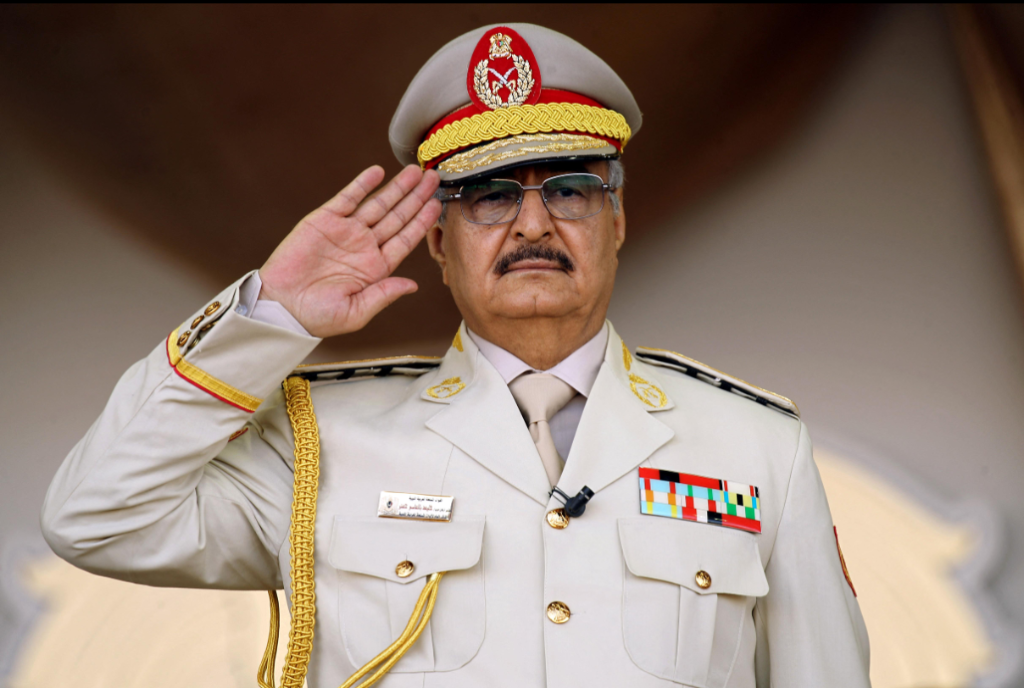
Since 2014, the UAE has openly supported Khalifa Haftar’s Libyan National Army (LNA), providing military hardware, financial assistance, and diplomatic cover at international forums. Abu Dhabi’s strategic calculus in Libya aligns with its broader regional competition against Turkey and Qatar, positioning Haftar as a bulwark against Islamist movements advancing toward North Africa’s coastal strip.
Yet the alliance does not automatically implicate the Emirates in illicit drug manufacturing. Western intelligence assessments, while acknowledging UAE-LNA cooperation, have thus far failed to link Abu Dhabi to the financing of psychotropic laboratories. Instead, they point to opportunistic regional actors—including Gulf-based private investors, African militia financiers, and European or Asian chemical suppliers—who exploit Libya’s stateless terrain to bypass international restrictions on precursor shipments.
In the absence of audit trails or intercepted financial transfers, the narrative of a UAE-directed « war on Algeria’s youth »—as described by Libyan prosecutors—remains speculative. Military and judicial officials in Tripoli have declined to attribute ownership of seized facilities to specific foreign governments, citing ongoing investigations into regional money laundering networks orchestrated through Tunisian and Egyptian front companies.
Algeria’s existential stakes and the Tebboune doctrine
Against this backdrop, Algeria’s leadership has framed the psychotropic threat as a matter of national survival. Speaking at the launch of the 2026–2027 judicial year, President Abdelmadjid Tebboune explicitly labeled drug trafficking « a full-scale war against our people and our youth. » He signaled readiness to deploy military force against production sources in neighboring countries, invoking a doctrine of « legitimate defense » outlined in Article 51 of the United Nations Charter.
This rhetorical escalation reflects deep strategic anxiety. Over the past eighteen months, Algerian security services have recorded a 470% increase in Captagon confiscations along the southeastern borders, with street prices dropping by 60% as supply outstrips demand. Public health data reveal a corresponding rise in youth addiction cases, particularly in southern provinces where unemployment exceeds 35%. The social cost, authorities argue, threatens to destabilize the country’s social cohesion and economic reforms.
Yet Tebboune’s rhetoric stops short of naming governments as antagonists. Instead, Algiers has prioritized bilateral security coordination with neighboring states—including Tunisia and Mauritania—to disrupt trafficking networks before they reach urban centers. A high-level inter-ministerial task force has been deployed to map precursor import routes, freeze suspicious bank accounts, and dismantle distribution cells operating under the guise of pharmaceutical distributors.
Cracking the code: what evidence would change the calculus?
To substantiate the claims implicating the UAE, investigators would need to establish four critical links:
- Legal ownership and due diligence records: Proving that Abu Dhabi-based entities hold title to the Libyan facilities, either directly or through shell companies incorporated in tax havens.
- Financial provenance: Demonstrating that capital flows originated in UAE financial institutions and were purpose-dedicated to psychotropic production.
- Equipment origin: Matching seized industrial presses, filters, and chemical precursors to suppliers registered in Dubai or Abu Dhabi free zones.
- Operational command structure: Identifying UAE nationals or proxies exercising managerial control over production schedules, quality control, and export logistics.
Without such evidence, the current accusations resemble earlier allegations—levelled during the Sahel insurgency—that GCC states funded terrorist groups in Mali. In both cases, geopolitical rivalry has outpaced forensic verification.
The broader threat: a silent public health emergency
Regardless of foreign sponsorship, the rise of psychotropic production in Libya poses an immediate domestic challenge for Algeria. Synthetic drugs—particularly Captagon and tramadol—are now more accessible than cocaine or heroin, with prices under $2 per tablet in southern border markets. Emergency rooms in Djanet, Tamanrasset, and Illizi report growing numbers of adolescents presenting with acute psychosis, seizures, and violent behavior linked to synthetic stimulants.
Social workers warn that recruitment tactics have shifted from coercion to economic incentives. Young men aged 16 to 24 are offered up to $300 per month as delivery drivers, with bonuses for new recruits. In a region where youth unemployment hovers near 50%, such inducements create a self-sustaining drug economy that transcends national borders.
The Algerian government has responded with a three-pronged strategy: increased surveillance along the Libyan and Tunisian frontiers, expanded rehabilitation centers in southern wilayas, and a public awareness campaign featuring testimonies from recovered addicts. However, the efficacy of these measures hinges on disrupting upstream supply chains—an objective that remains elusive without regional cooperation.
What lies ahead: beyond the headlines and hypotheses
As diplomats trade accusations and journalists chase sound bites, the core issue remains obscured: the normalization of synthetic drug production in Libya’s eastern territories. Whether financed by UAE entities, African warlords, or opportunistic entrepreneurs, these facilities are already remodeling North Africa’s security landscape.
For Algeria, the challenge extends beyond counter-narcotics. It demands a reassessment of border policies, regional alliances, and the balance between sovereignty and cooperation in an era where stateless actors exploit globalization’s vulnerabilities. Until forensic evidence ties specific governments to these networks, the debate will remain locked in the realm of conjecture—useful for political score-settling but insufficient for real-world enforcement.
The question Algeria must answer is not merely « Who benefits? » but « Who will act? » To prevent Libya’s hinterlands from becoming a permanent production base for Africa’s next drug epidemic, coordinated intelligence, stringent precursor controls, and cross-border judicial mechanisms are urgently needed. Otherwise, the silent war on Algeria’s youth may soon escalate into a regional catastrophe.