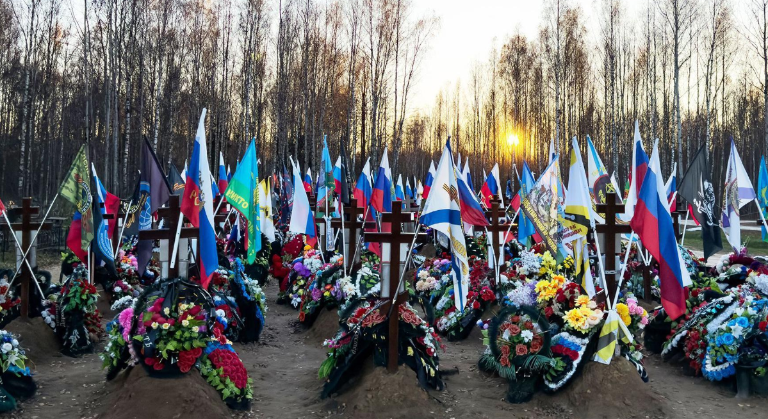
The Russian invasion of Ukraine has long been shrouded in official secrecy, but a recent cyber breach may have exposed the starkest truth yet. Hackers claim to have infiltrated Rosstat—the federal agency responsible for compiling Russia’s demographic and military statistics—and extracted a trove of confidential documents, including death certificates that list 412,576 Russian military personnel as deceased since the war began in February 2022. This figure dwarfs any casualty estimates Moscow has ever acknowledged, raising urgent questions about the true human toll of the conflict.
The cyber intrusion that sparked a controversy
A coordinated cyberattack, allegedly carried out by the Belarusian groups Silent Crow and Cyberpartisans, targeted Rosstat’s databases in what could be one of the most significant data breaches in modern Russian military history. The hackers assert that the leaked files contain verified records of soldier fatalities, complete with administrative documentation typically reserved for internal state use. While Rosstat has acknowledged the cyber intrusion, the agency disputes the authenticity and scope of the exposed data, further fueling skepticism over the numbers.
What makes these documents particularly compelling is their specificity. Unlike anonymous leaks or unverified claims, the files allegedly include death certificates, each representing a life lost—whether in combat, due to injuries sustained during the war, or under circumstances still classified. Yet, without independent verification, the credibility of these revelations remains under scrutiny. Could this be a calculated disinformation campaign, or does it reveal an inconvenient truth Moscow has long suppressed?
Why Moscow’s opaqueness fuels suspicion
From the war’s outset, the Kremlin has maintained an unprecedented level of secrecy regarding military casualties. In the early days of the invasion, Russia claimed just 5,937 fatalities—a figure met with widespread disbelief even then. Since then, officials have provided no further updates, leaving families, analysts, and international observers to rely on fragmentary intelligence, satellite imagery, and casualty estimations from Western sources. The absence of an official, comprehensive report has done little to quell speculation about the war’s true human cost.
If the leaked Rosstat files are genuine, they could dismantle decades of state-controlled narrative. The data suggests Russia’s military losses are not merely substantial, but catastrophic—exceeding even the most pessimistic projections. This raises critical questions: What mechanisms of accountability, if any, exist within the Russian military command? How has the state justified the prolonged conscription necessary to sustain such losses? And perhaps most importantly, what are the long-term societal implications of tens of thousands of unreported deaths?
Demographic and social ripple effects
The impact of 412,576 deaths extends far beyond the battlefield. Russia’s working-age male population—particularly in remote regions like Siberia and the Far East—has borne the brunt of the war’s demographic drain. These areas, already depopulated by decades of emigration and economic decline, are now facing a critical shortage of men in their most productive years. The loss of so many lives not only weakens the labor force but also disrupts family structures, strains social services, and risks destabilizing regional economies that depend on young workers.
For the families of the deceased, the consequences are emotionally and economically devastating. In a nation where state censors restrict public mourning and where the government downplays the war’s human toll, many loved ones receive limited information about their relatives’ fate. Some families are left without closure, their grief compounded by silence from authorities who continue to frame the conflict in vague terms of “special military operations.”
The unverified truth: what the numbers might—or might not—mean
While the scale of these alleged losses is staggering, they must be interpreted with caution. The leaked documents have not been independently authenticated, and their methodology remains unclear. Are these figures cumulative, reflecting only combat deaths, or do they include deaths from injuries, disappearances, or suicides linked to the war? Without transparent access to the raw data, the true nature of these losses remains speculative.
Even so, the revelation challenges the Russian government’s credibility. If proven accurate, it would represent one of the most damning indictments of the war’s human cost since its inception. Conversely, if the data is fabricated or manipulated, it underscores the Kremlin’s determination to control the narrative—and its willingness to weaponize information in the digital age.
One thing is certain: the war in Ukraine continues to extract a devastating human price. Whether the figure is 50,000 or half a million, the absence of an official, truthful accounting speaks volumes about the priorities of a regime that prioritizes secrecy over accountability—and survival over transparency.