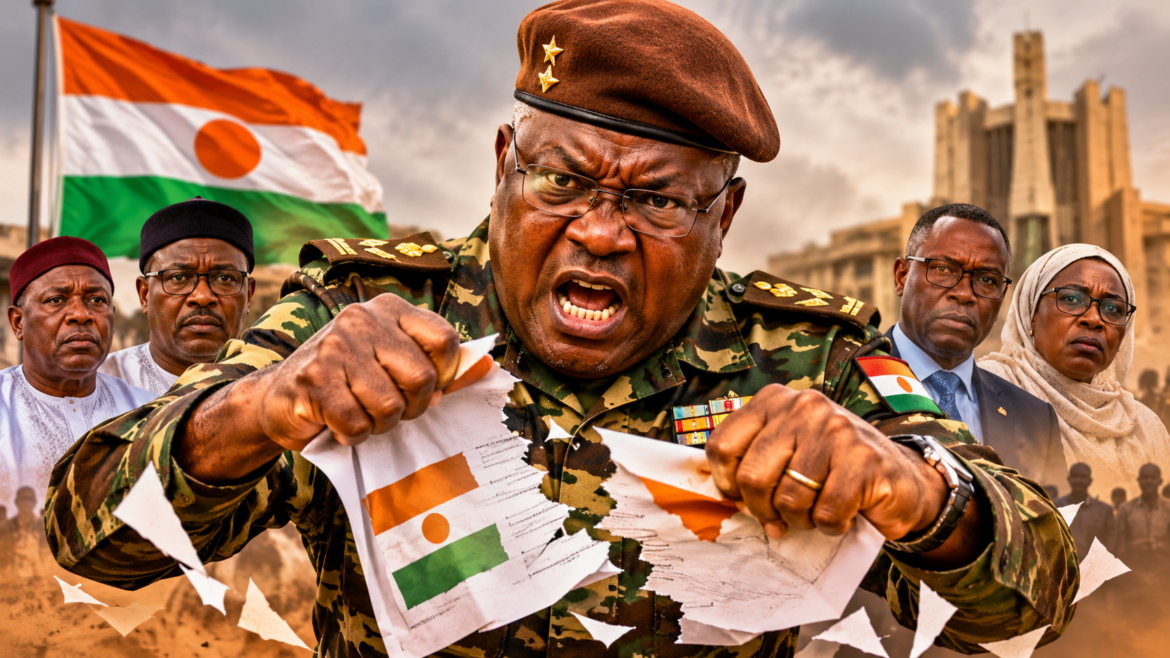
Since seizing power in July 2023, Niger’s military rulers have recast the legal framework of nationality, unveiling a controversial policy that extends far beyond mere administrative measures. At the heart of this transformation lies a question that cuts to the very core of governance: are these revocations a genuine attempt to safeguard the nation’s security, or do they signal an ongoing campaign to dismantle the remnants of the overthrown Bazoum administration?
Decoding the jigsaw: who stands behind the curtains of Tiani’s decrees?
On September 17, 2026, the Nigerien authorities issued another wave of provisional nationality revocations targeting five high-profile individuals, including former prime minister Ouhoumoudou Mahamadou and several close confidants of ousted president Mohamed Bazoum. This brings the total number of individuals impacted by the policy since its inception in October 2024 to 25. Behind the legal language of national interests and security threats, a more intricate political puzzle begins to emerge.
The names selected for revocation are not drawn at random. They represent a cross-section of the ancien régime’s political class, suggesting a deliberate attempt to curtail the influence and reach of figures once closely aligned with Bazoum’s leadership. This pattern points to a calculated strategy rather than a merely reactive legal response.
A dual-purpose weapon: security rhetoric meets political score-settling
Military authorities have framed the revocations as essential to protecting state security, citing violations such as dissemination of data capable of disturbing public order, electronic defamation, and acts against state safety. Yet the repeated targeting of political figures raises a critical doubt: are the accusations grounded in verifiable evidence, or do they serve as a thin veneer over a broader campaign to neutralize opposition voices?
Public order and national security: The charges hinge on communications and publications that the regime deems destabilizing. However, the subjective interpretation of what constitutes a threat risks conflating legitimate criticism with criminal behavior.
Electronic defamation and state safety: Many of the cases involve online activity, where the line between political dissent and legal transgression is blurred without transparent judicial scrutiny.
Presumption of innocence: The provisional nature of the revocations denies individuals the chance to present a defense or challenge the allegations in court, undermining fundamental due process rights.
The silent exile: how revocation erodes lives beyond borders
For those living outside Niger, the loss of nationality is not just a legal formality it reverberates through their daily lives. Deprived of consular protection, renewal of travel documents becomes an ordeal, and the prospect of returning to the country grows increasingly uncertain. For political figures in exile, this erosion of legal ties can amount to a form of administrative exile, severing their connection to the nation they once governed.
Moreover, the specter of statelessness looms large. When an individual holds only Nigerien citizenship, a provisional revocation can leave them in a bureaucratic and legal limbo, unable to access services, employment, or protection from another state. Human rights advocates warn that this precarious status can extend far beyond the temporary phase, leaving long-term scars on families, careers, and personal stability.
From accusation to deprivation: the erosion of procedural safeguards
The legal framework undergirding these revocations rooted in 2024 ordinances is broad and malleable. It grants authorities sweeping discretion to interpret what constitutes a threat to national interests, without imposing strict evidentiary standards or robust judicial oversight. Critics argue that this latitude invites abuse, allowing the regime to sidestep due process under the guise of safeguarding stability.
A key concern lies in the asymmetry of power: authorities possess full access to evidence and legal channels, while individuals targeted often receive only vague or generalized charges. This imbalance undermines the possibility of a fair hearing and transforms the revocation into a punitive measure rather than a judicial one.
The long shadow of Bazoum: why naming matters in political confrontations
The inclusion of figures like Ouhoumoudou Mahamadou in the latest round of revocations is no coincidence. As a central figure in Bazoum’s administration, his presence underscores a deliberate signal: the military-led government is prepared to wield even the most severe legal instruments against those associated with the previous regime. This symbolic targeting suggests that the revocations transcend mere legal procedures and enter the realm of political messaging.
Under such circumstances, the revocation of nationality risks becoming a tool not only to punish perceived infractions but to erode the political capital of the old guard, including those in exile. It transforms a legal sanction into a broader weapon of political control, one that extends the post-coup confrontation well into the administrative and civic spheres.
Reconciliation or rupture: the broader stakes for Niger’s future
Niger’s journey toward stability will be measured not only by its ability to neutralize real threats but by its willingness to uphold equitable treatment for all citizens, regardless of political affiliation. The cumulative effect of 25 provisional revocations each with its own human cost is beginning to reshape the political landscape. Rather than fostering national unity, these measures appear to entrench divisions and deepen mistrust between the military government and the remnants of the Bazoum era.
If the revocations are perceived as politically motivated, they risk undermining public confidence in the legal system and fueling further instability. Conversely, if the authorities can demonstrate that each case rests on concrete evidence and respects due process, they may begin to restore credibility and lay the groundwork for reconciliation. At stake is not only the fate of 25 individuals, but the very legitimacy of the post-coup order and the future cohesion of Nigerien society.
The heart of the matter: security or vengeance?
The critical question now is whether Niger’s nationality revocations serve the goal of national security or represent a calculated extension of political vendetta. The optics suggest a convergence of both motives: the regime invokes legitimate security concerns while systematically targeting figures tied to the previous administration. Such duality does not negate the possibility of real threats, but it does raise concerns about the motives behind the policy.
In a country still grappling with the aftermath of a coup and rising regional tensions, clarity is essential. Citizens and international observers alike need to see that legal measures adhere to objective standards, not political expediency. Otherwise, the cost may not be limited to the lives of those revoked it may extend to the very fabric of Niger’s democratic aspirations and its ability to emerge from instability with its institutions intact.
By Claire Mvondo — Journalist