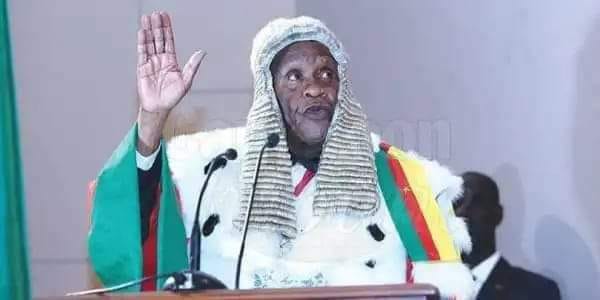
Clément Atangana, the long-serving president of Cameroon’s constitutional council, passed away on October 4, 2026, in Paris after a prolonged illness. His death does not merely mark the end of a life but the conclusion of an era—one defined by the consolidation of a judicial institution that became both a pillar of the political landscape and a lightning rod for criticism. The man behind the gavel left behind a legacy that few in Cameroon’s history can match, his name synonymous with the constitutional council’s rulings during two pivotal presidential elections in 2018 and 2025.
The voice that shaped electoral outcomes
With a deep, resonant tone, Clément Atangana’s voice entered the public consciousness whenever he pronounced the word “irrecevable” (unacceptable) during electoral disputes. That single word, delivered with authority, often sealed the fate of petitions filed by opposition parties and other political actors during Cameroon’s most contentious elections. It was more than a legal ruling—it carried symbolic weight, reinforcing the perception of a constitutional council operating under the shadow of political influence. The gavel’s decisive strike became a defining image of his tenure, one that left an indelible mark on the nation’s electoral justice system.
The making of a judicial heavyweight
Clément Atangana was not merely a figurehead; he was a product of Cameroon’s legal system. Born on December 20, 1941, in Ekoumeyeck, Ngomedzap, in the Nyong and So’o region, his journey through the judiciary spanned nearly five decades. His career began in earnest on December 20, 1968, after completing training at the National School of Administration and Magistracy (ENAM) and the International Institute of Public Administration in Paris. His rise through the ranks was steady and unrelenting, marked by leadership roles in some of the country’s most critical judicial institutions.
Among his positions were judge of instruction in Nkongsamba, president of tribunals in Eséka, Bafia, Sangmélima, and Mora, as well as prosecutor general in Maroua. He later served as president of the Court of Appeal of the Centre region, councilor at the Supreme Court, and president of the Administrative Chamber of the Supreme Court—a role from which he retired in 2014. His expertise and reliability were undeniable, which explains why he was recalled from retirement in 2018 to lead the constitutional council.
The constitutional council under scrutiny
Atangana’s tenure at the helm of the constitutional council was a period of intense scrutiny. The council faced criticism from opposition figures and civil society, who accused it of a lack of independence and impartiality. Two presidential elections—2018 and 2025—put the institution to the test. In both instances, opposition candidates Maurice Kamto (2018) and Issa Tchiroma Bakary (2025) contested the results, alleging irregularities. Yet, despite these challenges, the constitutional council upheld the official outcomes, reinforcing perceptions of its alignment with the ruling establishment.
In a video that circulated widely after the 2025 election, Atangana was heard remarking, “I am pleased that you are celebrating both the victory of your candidate and the work of your father.” The remark, though delivered in a personal context, amplified debates about the council’s neutrality and the broader role of political actors within the judiciary.
What comes next for Cameroon’s top court?
The vacancy left by Clément Atangana’s death places the constitutional council at a crossroads. As the highest electoral judicial body in Cameroon, its future leadership will determine whether the institution can reclaim its credibility or if it will continue to be perceived as a tool of political control. The president of the Republic now holds the responsibility of appointing a successor, a decision that will be closely watched by domestic and international observers alike. The council’s ability to navigate this transition without further eroding public trust will be critical in shaping the nation’s democratic future.