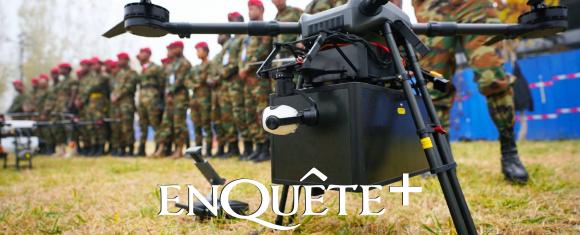
The rapid integration of drone technology is reshaping Africa’s military landscape, offering both strategic advantages and new vulnerabilities. In a groundbreaking analysis, researcher Djenabou Cissé examines how this transformation is altering conflict dynamics across the continent, where unmanned systems now play a pivotal role in security operations.
From surveillance to combat: the evolving role of drones in African conflicts
Once limited to intelligence gathering, drones have become central to security strategies in African nations. Their adoption reflects a fundamental shift in warfare, with both state actors and non-state groups increasingly wielding these systems. The pace of acquisition has surged dramatically, with over 1,500 military drones procured by 31 African countries between 1980 and 2024—a trend that accelerated sharply between 2020 and 2023.
North Africa accounts for more than half of these acquisitions, while Nigeria stands out as one of the continent’s top buyers. The technology’s appeal lies in its ability to enhance surveillance, intelligence, and precision strikes while minimizing risks to ground troops—a critical advantage amid escalating internal conflicts and insurgencies.
Conflict zones such as Sudan, Mali, Burkina Faso, Niger, Somalia, and Ethiopia exemplify this shift. Drones now serve as both military tools and instruments of propaganda, deployed by regular armies and armed groups alike to shape narratives and project power.
Armed groups seize the skies: the democratization of drone warfare
One of the most concerning developments is the weaponization of civilian drones by militant organizations. Groups like Boko Haram, Al-Shabaab, and the Group for Support of Islam and Muslims (JNIM) have repurposed commercially available drones, turning them into instruments of targeted attacks, coordinated ground operations, and psychological warfare through video propaganda.
This proliferation has fundamentally altered power dynamics in regional conflicts. No longer confined to observation, drones now enable precise strikes, real-time battlefield coordination, and the amplification of military actions’ psychological impact.
Foreign dependence: the hidden cost of drone militarization
Despite their growing presence, African states remain heavily reliant on external suppliers. China, Israel, the United States, and more recently Turkey dominate the continent’s drone market, providing not just hardware but also training, maintenance, software updates, and spare parts. This creates a long-term strategic dependency that extends beyond mere technological acquisition.
The reliance raises critical questions about digital sovereignty and the security of data collected by these systems. As African nations integrate drones into their security frameworks, the lack of local control over technology and data flows emerges as a pressing concern.
Building domestic capacity: Africa’s push for self-reliance
In response to these challenges, several African countries are investing in local drone production. South Africa leads the continent’s industrial efforts, while Morocco combines domestic manufacturing with international partnerships. Other nations, including Nigeria, Egypt, Ethiopia, Tunisia, and Algeria, are rapidly expanding their capabilities in this sector.
The Senegalese company Ndobine is also making strides, developing drones for maritime surveillance, precision agriculture, and mapping. However, local production still represents only about 12% of the African market, highlighting the scale of the challenge ahead.
Tactical gains, unresolved crises: the limits of drone warfare
While drones offer tactical advantages, they do not address the root causes of Africa’s conflicts. Their proliferation has sometimes intensified violence rather than resolving it. In 2024 alone, 484 drone strikes resulted in 1,176 civilian deaths across 13 African countries. In Sudan, nearly 700 civilians were reportedly killed in the first three months of 2026 by drone attacks.
Researcher Djenabou Cissé emphasizes that drones are not a strategic solution to Africa’s security challenges. Their use must be carefully regulated to prevent further civilian harm and to align with international humanitarian law. She calls for comprehensive public policies that include clear employment doctrines, enhanced operator training, transparent acquisition processes, and the development of local industries.
The path forward: sovereignty through responsible innovation
The future of drone technology in Africa hinges on the continent’s ability to balance its growing reliance on these systems with the need for self-determination. Without robust governance frameworks, the ‘dronization’ of African militaries risks deepening dependencies and fueling violence rather than fostering lasting security.
For African states, the challenge is no longer merely accessing drone technology but mastering its ethical and strategic deployment. Failure to do so could undermine the continent’s long-term stability and sovereignty.
You may also like
Niger : l’écart entre le discours sécuritaire du CNSP et la réalité des zones exposées
Niger: the double silence at the heart of power
Niger: Tiani’s purge and the hidden fractures within the junta
Civilians killed in Bandiagara: rights body urges Mali to uphold its duties
In northern Togo, geopolitical rivalries overshadow the urgent needs of the population