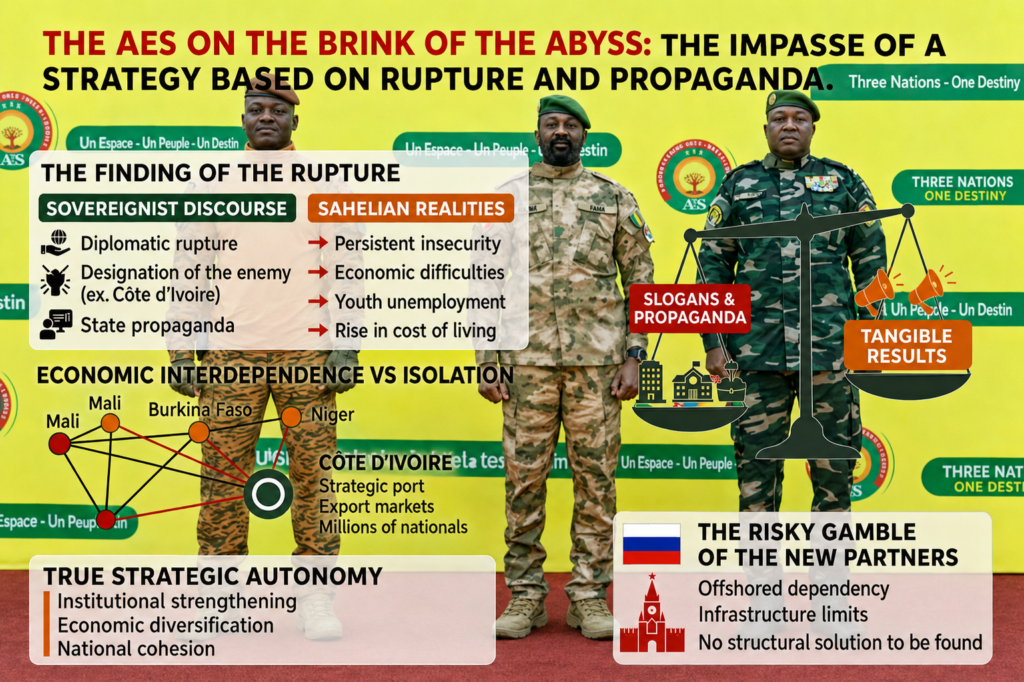
Since seizing power, military authorities in Mali, Burkina Faso, and Niger have built their political narrative around severing ties with regional norms and rejecting traditional partners. The formation of the Alliance of Sahel States (AES) reflects this push for a radical redefinition of alliances and a bold assertion of sovereignty.
Three Years On: Promises Unmet
Three years after the first coups reshaped the political landscape of the Sahel, a clear pattern has emerged: persistent insecurity, strained economies, and unmet public expectations. Rather than delivering tangible improvements in governance or public services, the ruling regimes increasingly rely on external adversaries as scapegoats to deflect criticism and rally support.
A Sovereignty Built on Symbols, Not Substance
The sovereignist rhetoric of the AES has resonated with many in the Sahel, particularly those disillusioned by years of unaddressed security threats and perceived ineffectiveness of international cooperation. The idea of reclaiming full control over diplomatic and military decisions has struck a chord. Yet sovereignty extends far beyond rejecting agreements or replacing allies—it demands tangible outcomes: security for citizens, job creation, investment attraction, efficient public services, and sustainable improvements in living standards.
On these fronts, the challenges remain daunting.
The Cost of Externalizing Blame
When governments struggle to deliver visible results, political communication often becomes a tool to maintain public support. In the case of the AES, criticism of neighboring countries and regional organizations has dominated the discourse. Côte d’Ivoire, in particular, is frequently portrayed as a hostile actor or a proxy for foreign interests.
While this strategy can temporarily unify populations around a common enemy, it carries significant drawbacks. It diverts attention from pressing domestic issues such as youth unemployment, rising living costs, education gaps, and crumbling infrastructure. It also risks inflaming unnecessary diplomatic tensions among deeply interconnected economies. Worst of all, it can stifle dissent by framing internal criticism as complicity with external foes.
Côte d’Ivoire Stands Firm on Dialogue and Stability
Despite verbal attacks from AES leaders, Côte d’Ivoire has maintained a consistent diplomatic stance rooted in dialogue, stability, and economic cooperation. This approach reflects a long-standing tradition inspired by the late President Félix Houphouët-Boigny, who championed mediation, regional economic integration, and consensus-building.
The country’s strategy is not merely idealistic it is pragmatic. Côte d’Ivoire serves as a critical commercial hub for landlocked Sahelian nations, with its port facilitating imports, exports, and trade flows. Millions of Malians, Burkinabè, and Nigeriens live, work, or invest in Côte d’Ivoire. A prolonged deterioration of relations would inflict human and economic damage far exceeding the political gains sought by AES leaders.
Diplomatic Rifts Carry Hidden Economic Costs
The confrontational posture adopted by the AES carries underappreciated economic consequences. Heightened regional tensions can deter investment, disrupt supply chains, inflate operational costs, and erode investor confidence. In economies already weakened by security threats, diplomatic crises compound financing challenges, slow job creation, and undermine growth prospects.
The High-Stakes Gamble on New Alliances
A second pillar of the AES strategy involves diversifying international partnerships, most notably through closer ties with Russia. While countries have the sovereign right to seek new allies, such shifts do not automatically translate into economic or security gains.
Global experience demonstrates that no external partner can single-handedly resolve structural issues such as weak institutions, low productive investment, rural poverty, or territorial governance gaps. The danger lies in exchanging one form of dependency for another without addressing the root causes of instability.
The True Path to Strategic Autonomy
Genuine strategic autonomy requires strengthening national institutions, professionalizing security forces, fostering a business-friendly environment, diversifying economies, and investing in human capital. Without these foundations, sovereignty remains a hollow concept—more about rhetoric than reality.
Communications Over Results: A Fading Strategy?
The AES leadership has placed heavy emphasis on patriotic messaging centered on sovereignty, resistance, and national recovery. While such narratives can bolster short-term morale, they cannot indefinitely substitute for concrete achievements.
Citizens ultimately judge their leaders on measurable outcomes: sustainable security improvements, affordable living costs, youth employment, functional schools and clinics, modern infrastructure, and inclusive economic growth. Over time, these realities will carry more weight than slogans or propaganda campaigns.
West Africa Needs Cooperation, Not Division
The region’s most pressing challenges terrorism, transnational crime, migration, climate change, food security, and economic development—transcend national borders. No single state can address these issues alone. Regional cooperation, whether through existing organizations or new frameworks, remains indispensable.
Treating neighbors like Côte d’Ivoire as perpetual adversaries only weakens an already fragile region. Sustainable progress demands collaboration, not confrontation.
Conclusion: From Rhetoric to Responsibility
The AES was born from a rejection of a model deemed ineffective by its architects. This ambition reflects real frustrations among the populace. Yet opposition to the past is not a policy in itself.
The long-term credibility of the AES will hinge not on sovereignist posturing but on its ability to deliver tangible security, revive economies, protect civil liberties, and restore regional trust. The future of the Sahel will be determined less by assigning blame to external actors than by the capacity of its leaders to produce real results, restore citizen confidence, and transform dialogue into a foundation for stability rather than perpetual strife.
You may also like
Benin’s rating leap to AA-: the moment regional capital started taking Cotonou seriously
Brigitte Tchede’s Cairo surge: Benin’s discus medal breakthrough that changes everything
Burkina Faso’s armored vehicles: the moment of truth arrives on the battlefield
Togo presses pause on press freedom as a reporter’s sidelining marks a decisive shift
Benin-Rwanda breakthrough: Wadagni’s Kigali mission redefines strategic partnership