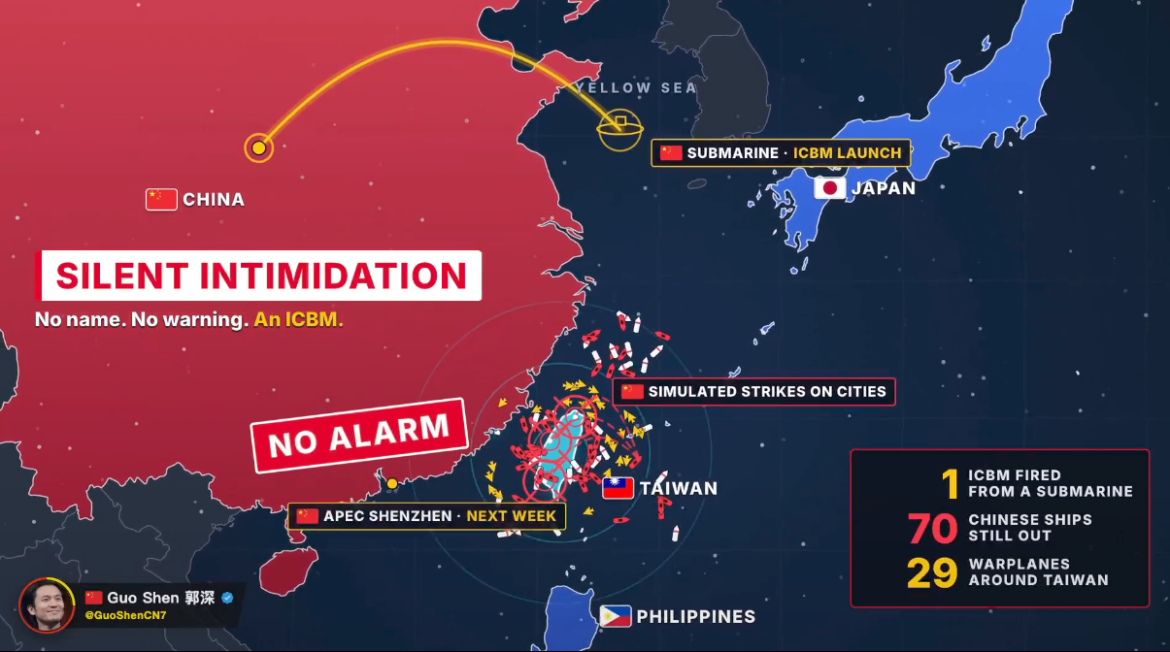
The geopolitical chessboard in the Western Pacific has shifted, revealing deeper motivations behind recent military movements. In early November 2026, China mobilized over 100 naval and coast guard vessels in an unprecedented, large-scale operation near Taiwan. This wasn’t a routine exercise—it was a calculated demonstration of maritime dominance aimed at testing operational readiness for potential blockades or strategic encirclement. But what were the real objectives behind this coordinated fleet deployment?
Why China’s naval surge wasn’t just about numbers
More than 100 warships and coast guard vessels from China’s Eastern, Northern, and Southern fleets were deployed simultaneously across a vast stretch of the Western Pacific, extending well beyond the Taiwan Strait. According to Taiwanese military sources, these maneuvers included simulated strikes on military targets and civilian urban areas. The scale and coordination of this operation were unprecedented, raising questions about Beijing’s long-term strategy.
Analysts suggest that these exercises may have been designed to evaluate China’s ability to enforce a de facto maritime blockade in the event of a crisis. By controlling key shipping lanes and airspace, Beijing could isolate Taiwan economically and militarily without launching a full-scale invasion. Such a strategy would leverage geographic dominance to exert pressure on Taipei while minimizing direct confrontation.
The silent watcher: decoding the US nuclear detection flight
Against this backdrop, a US Air Force WC-135R Constant Phoenix—nicknamed the “Nuclear Sniffer”—was detected over the waters south of Taiwan on November 15. The aircraft, which took off from Okinawa, followed a route that skirted the southern approaches of the Taiwan Strait. Its mission? To detect trace amounts of radioactive particles in the atmosphere. But why now, and what did it reveal?
While the US has not confirmed the flight’s exact purpose, its timing is impossible to ignore. In a region where China has just staged a major naval show of force, the presence of a specialized nuclear detection aircraft suggests heightened US vigilance. Could this be a response to concerns about Chinese nuclear preparedness—or a broader effort to monitor regional military activities?
The WC-135R’s capabilities are highly specialized. It doesn’t merely observe; it samples the air for minute traces of radioactive isotopes, which could indicate nuclear testing or reactor leaks. Its deployment in these waters raises subtle but critical questions: Is Washington preparing for worst-case scenarios? Or is it merely conducting routine monitoring in an increasingly volatile region?
Taiwan caught in the crossfire: the strategic stakes
Taiwan’s position in the Western Pacific is more than geopolitical—it’s economic. The island is the world’s leading manufacturer of advanced semiconductors, a critical component in global technology supply chains. Any disruption in the Taiwan Strait could have cascading effects on industries from smartphones to electric vehicles, sending shockwaves through global markets.
For Beijing, controlling Taiwan would eliminate a perceived threat and secure its maritime perimeter. For Taipei, maintaining autonomy is a matter of survival. And for Washington, preventing Chinese aggression is a strategic imperative. The convergence of these interests makes the region a powder keg of competing ambitions.
The recent naval surge and the US nuclear detection flight are not isolated events. They are symptoms of a deeper, ongoing struggle for influence. As China tests its maritime muscle and the US sharpens its surveillance tools, the question remains: How long can this high-stakes game be played without crossing a red line?
The bigger picture: what’s really driving these maneuvers?
At its core, the situation reflects a fundamental struggle for dominance in the Indo-Pacific. China’s naval surge is not just about demonstrating capability—it’s about reshaping the regional power balance. By asserting control over critical waterways, Beijing aims to erode US influence and solidify its own sphere of influence.
The US, in turn, is not standing idle. The deployment of the WC-135R suggests an effort to gather intelligence on potential nuclear or radiological threats, whether real or perceived. While officials have not confirmed a direct link between the flight and China’s maneuvers, the timing is too precise to ignore. This could signal a shift toward more aggressive monitoring of Chinese military activities.
The risk? A miscalculation in either camp could trigger a crisis with global repercussions. The Western Pacific is no longer just a regional hotspot—it’s the new frontier of great-power competition. And every movement, every flight, and every exercise is a move in a game where the stakes couldn’t be higher.