From peaceful sit-ins to urban warfare: the day the protest line crossed a dangerous threshold
The initial spark of resistance—a coordinated pushback against sweeping educational reforms—quickly morphed into an unprecedented wave of urban upheaval. What began as sporadic high school blockades in major French cities has now escalated into a full-blown security crisis, forcing the government to pivot from dialogue to emergency response.
The anatomy of a descent into chaos: tactics, targets, and turning points
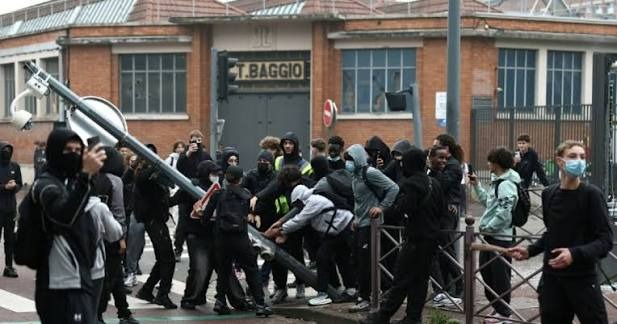
The transformation was both rapid and calculated. Early student-led demonstrations relied on symbolic occupations outside targeted institutions, but within hours, the strategy shifted dramatically. Organized blitzes on school perimeters replaced passive sit-ins, while coordinated attacks on public infrastructure—buses, trams, and subway access points—disrupted daily life for millions.
Key flashpoints emerged in Paris, Lyon, Marseille, and Nantes, where makeshift barricades of burning refuse bins and uprooted street furniture sealed off arterial routes. The attack on a seventh arrondissement high school in Lyon took a more sinister turn when arsonists ignited pyrotechnic devices inside the foyer, forcing firefighters to intervene under heavy police escort. By mid-afternoon, over fifty educational facilities reported significant damage, from shattered windows and graffiti to destroyed classrooms and stolen equipment.
Security forces caught in the crossfire: injuries, arrests, and the state’s escalation
As the sun rose on the city centers, so did the intensity of the confrontations. Law enforcement, deployed en masse around protest hotspots, faced volleys of paving stones, fireworks, and homemade mortars. The response was swift and forceful: repeated riot squad charges, sustained tear gas saturation, and targeted water cannon deployments aimed at breaking up dense crowd formations.
Official tallies now confirm more than a hundred and sixty arrests nationwide, along with dozens of minor injuries among both protesters and security personnel. The unprecedented scope of the unrest led several transit authorities to halt services entirely in crisis zones. Marseille’s bus and tram networks ground to a halt by noon, while Nantes and Bordeaux followed suit, stranding commuters and triggering widespread frustration.
A crisis cell in wartime mode: Lecornu’s emergency playbook
With security collapsing in real time, Prime Minister Sébastien Lecornu convened a high-level interministerial crisis cell at Place Beauvau—a forum typically reserved for national-scale disasters or acute terrorist threats. The gathering brought together the ministers of Interior, Education, and Transport, alongside regional prefects and top law enforcement brass, to synchronize a cohesive counteroffensive.
In a rare televised address from Matignon, Lecornu drew a clear line in the sand: ‘No rationale exists for torching schools or endangering our police officers,’ he stated. ‘We defend the right to demonstrate, but vandalism and disorder have no place in our democracy. The state will respond with absolute firmness.’
The political aftershock: opposition fire and union unease
The crisis has reignited fierce political divisions. Right-wing factions are calling for a targeted curfew and blanket bans on school-adjacent assemblies, framing the unrest as proof of systemic weakness. Meanwhile, left-leaning critics argue that years of neglect toward youth concerns—from underfunded schools to stifling exam reforms—have created the powder keg now detonating on the streets.
Student unions and parent associations, though quick to condemn the violence, find themselves on unstable ground. Spokespersons for the main high school federations have publicly distanced themselves from the rioting, insisting their struggle is rooted in policy, not property destruction. ‘Our classrooms should not be collateral damage,’ noted one inter-union spokesperson. ‘We are fighting for better education, not smashing our own futures.’
Looking ahead: what tomorrow’s orders could mean for France
As dusk settles over the capital and provincial hubs, tensions remain dangerously high. Overnight surveillance and preemptive patrols are expected to intensify, with thousands of additional gendarmes and riot police redeployed for Friday. Whether this surge in force will quell the unrest—or further inflame local grievances—remains the open question hanging over the nation’s capital and beyond.