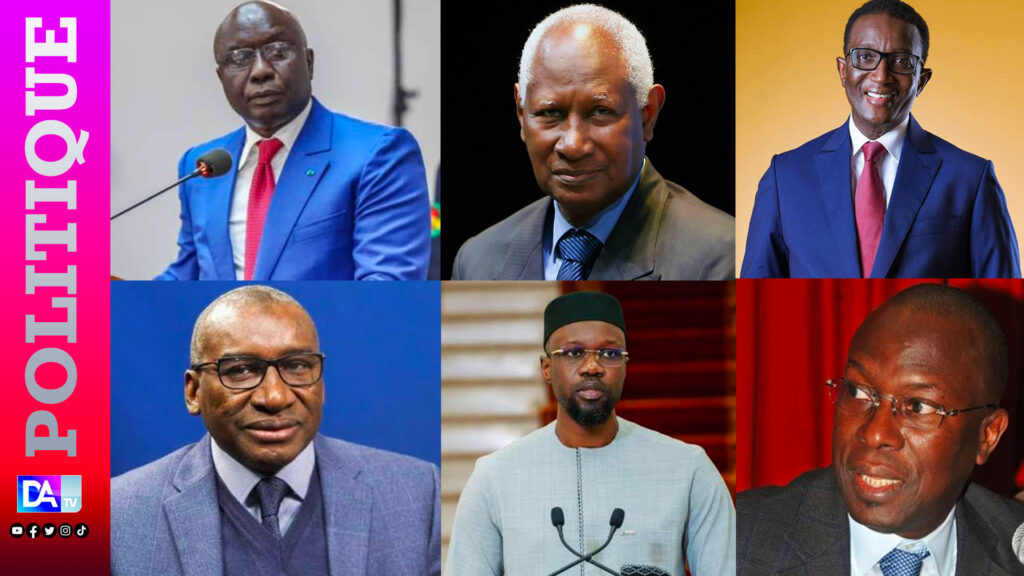
The debate over political funds in Senegal has intensified in recent weeks, sparking heated exchanges among lawmakers, former ministers, and political analysts. At the heart of the controversy is a long-standing system of discretionary funds allocated to the Prime Minister’s office, a practice that has evolved over decades. As the National Assembly convenes for an extraordinary session to examine laws on asset declarations, labor codes, and parliamentary oversight, the question arises: who has benefited from these funds before Ousmane Sonko, and how were they used?
The spark: Aly Ngouille Ndiaye’s explosive claim
Aly Ngouille Ndiaye, former Interior Minister, ignited the debate during a television appearance. He asserted that Ousmane Sonko was the first Senegalese Prime Minister to receive these discretionary funds: « Sonko is the first head of government to have had access to such resources. I never held the position, but many of my predecessors—some still alive—can confirm this was not the case for them. Only Boun Abdallah Dionne, who has passed away, might have had something, but even he did not receive these funds. It started with Sonko. »
Ndiaye also cast doubt on the reported 1.7 billion CFA francs allocated to Sonko, questioning its frequency: « Some say it’s quarterly, others claim it’s annual. If annual, that would total 8 billion francs. But we know the first 1.7 billion was exhausted quickly. If it was annual, spending it in a single quarter would be alarmingly fast. » He echoed the Petroleum Minister’s earlier remarks, suggesting Sonko depleted the entire first tranche before requesting additional funds, leaving his successor with nothing. « This deserves scrutiny in the parliamentary inquiries, » he argued, hinting at undisclosed details.
Counterclaims from former Prime Ministers
The former minister’s remarks triggered a wave of backlash, including viral archival footage featuring Souleymane Ndéné Ndiaye, the last Prime Minister under Abdoulaye Wade. Speaking in 2025, he stated: « Even as Director of the President’s Cabinet, I received political funds every month. » This revelation predates his tenure as Prime Minister, undermining Ndiaye’s claim that Sonko was the first to benefit from the system.
Further contradictions emerged from testimonies attributed to Macky Sall, who served as Prime Minister under Wade, and Idrissa Seck, another former head of government. Social media users recalled Wade’s practice of diverting his own presidential discretionary funds to assist his Prime Minister with expenses. These accounts suggest the practice dates back decades, long before Sonko’s administration.
The Pastef camp fires back: « baseless accusations »
Ousmane Sonko’s supporters dismissed the claims as unfounded. Elimane Pouye, CEO of the State Property Management Company (SOGEPA), argued that the debate should focus on accountability rather than the existence of the funds. He pointed to consistent budget allocations for the Prime Minister’s office across recent years, attributing fluctuations to institutional changes rather than innovation under Sonko. « The issue isn’t whether these funds existed before, but whether predecessors used them transparently, » he stated.
The Pastef party has long criticized the lack of oversight over these funds, with its 2019 electoral program calling for reforms. Sonko’s allies emphasized that the practice was neither new nor unique to his tenure, framing the current scrutiny as politically motivated.
Historical context: a growing financial mystery
To understand the controversy, one must examine the evolution of these discretionary funds. Under Abdou Diouf’s presidency, the allocation stood at approximately 650 million CFA francs. By Wade’s era, it had ballooned to nearly 8 billion francs. A 2008–2012 audit revealed that 108 billion francs were spent during this period, with 48 billion unaccounted for in public records—a figure that has haunted Senegal’s transparency advocates ever since.
A stark example is the National Local Development Program (PNDL), a 100 billion franc fund managed by the Prime Minister’s office. Investigations into former Prime Minister Idrissa Seck in 2004 uncovered irregularities, including allegations of illicit enrichment tied to two properties in Saly and Atlanta. This episode underscored the longstanding challenges of monitoring discretionary spending.
Calls for legal oversight intensify
Lawmakers are pushing for structural reforms. Deputy Guy Marius Sagna submitted a bill in September 2025 to create a « Commission for Verifying Political Fund Credits, » but Sonko reportedly asked him to delay, preferring a government-led initiative. Sagna later amended the proposal to enhance transparency, though he expressed frustration that the President’s approach seemed to perpetuate the status quo.
Deputy Thierno Alassane Sall, a former Energy Minister known for his transparency advocacy, condemned the funds as « theft, » noting they lack parliamentary approval. He distinguished them from presidential intelligence funds, which he argued are legally authorized. Meanwhile, opposition figures like El Hadj Momar Samb accused the majority of hypocrisy, questioning why similar calls for oversight weren’t made when they held power.
Official stance: reform, not abolition
President Bassirou Diomaye Faye and Prime Minister Sonko have both ruled out abolishing the funds, citing their role in intelligence and social solidarity. Sonko, addressing Parliament in May 2026, disclosed the allocation of 1.77 billion francs to the Prime Minister’s office. The National Assembly’s extraordinary session, launched on August 10, 2026, will prioritize laws to regulate special credits and secret funds, alongside constitutional amendments on asset declarations. This debate highlights the tension between entrenched institutional practices and the demand for accountability from Senegal’s new leadership.
You may also like
Will Senegal’s local elections break Bassirou Diomaye Faye’s presidency before it truly begins?
Senegal’s budget: can Ousmane Sonko afford to block Bassirou Diomaye Faye’s 2026 plan?
Senegal electoral reform: Khalidou dit Mbaye Sokoma’s full proportional representation push
Senegal’s local elections: Bassirou Diomaye Faye still won’t set a date
Alain-Georges Moukoko takes over Libreville prosecutor general’s office