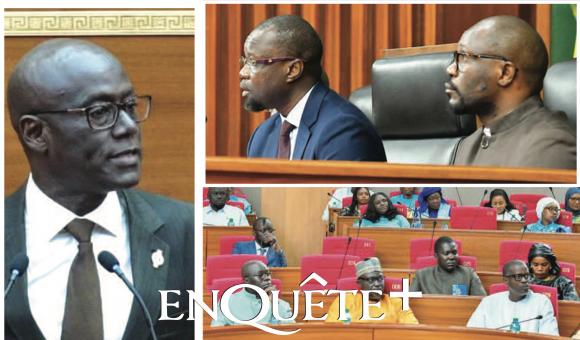
The president of Senegal’s National Assembly, Ousmane Sonko, took center stage to address mounting concerns surrounding the extraordinary session, laying out its legal framework and agenda while dismantling what he termed unfounded claims.
Five key legislative texts take priority
Sonko, presiding over the opening plenary of the first extraordinary session of 2026, emphasized the parliament’s commitment to fulfilling its mandate. The session’s agenda includes five major bills—three government-sponsored and two legislative initiatives. Among these, deputies will deliberate on:
- Bill No. 15-2026 on the Labour Code,
- Bill No. 16-2026 on the Social Security Code,
- Bill No. 25-2026 on critical infrastructure protection and digital security.
The most contentious items include two proposals under urgent procedures: Bill No. 33-2026, which seeks to amend Article 37 of the Constitution, and Bill No. 34-2026 on special credit mechanisms. The detailed work schedule will be determined by the Conference of Presidents.
Six parliamentary inquiry commissions launched
A parallel agenda item is the establishment of six parliamentary inquiry commissions targeting highly sensitive areas:
- Land management irregularities,
- Disposal of state-owned buildings,
- Financial mechanisms like TRS,
- Irregularities in the “One Student, One Laptop” program,
- Revenue shortfalls and tax exemptions,
- Fishing license allocation and renewal conditions.
Six-month mandate for inquiry commissions
Sonko clarified misconceptions about the commissions’ timeline, stressing that each will operate under a strict six-month window. “No commission will conclude its work within fifteen days,” he asserted, citing Article 55 of the Assembly’s rules of procedure. Each commission will comprise a maximum of eleven deputies, proportionally distributed among groups. Upon ratification in plenary by an absolute majority, the commission will elect its leadership—president, two vice-presidents, and a rapporteur.
The speaker underscored that investigations may continue beyond the session, referencing Article 58 of the rules. “I wanted to clarify these points to dispel any misconceptions,” Sonko stated.
Legal basis for the extraordinary session
Addressing critics who questioned the Assembly’s authority to convene the session, Sonko invoked constitutional and procedural grounds. Article 7 of the Assembly’s rules permits a special session based on a Bureau decision, a written request from a majority of deputies, or a presidential initiative. “Those claiming the Bureau lacks this power have misunderstood the rules,” he declared.
Opposition fires back on election transparency
Thierno Alassane Sall, a vocal opposition figure, seized the floor to challenge the government’s stance on local elections. Accusing the ruling party of attempting to manipulate timelines, he demanded transparency in electoral preparations, stating, “Elections must proceed on schedule, and discussions with political actors are essential to address delays.”
Sall criticized the opacity surrounding the Constitutional Council’s advisory opinions, particularly its refusal to publish decisions on the 2024 Assembly dissolution. “The Council must publish its findings. We cannot accept arbitrary decisions,” he argued. He also called for greater transparency in political funding, urging Sonko to lead by example.
Political dissent escalates over parliamentary management
Government adviser Aldiouma Sow amplified criticism, condemning what he described as a “messianic” approach to parliamentary management. In a public statement, he highlighted absenteeism in the Assembly, calling it a sign of deep malaise within the ruling coalition. “The 34% absentee rate reflects a crisis of legitimacy,” Sow alleged, accusing Sonko of orchestrating a power grab and marginalizing dissenting voices.
You may also like
Will Senegal’s local elections break Bassirou Diomaye Faye’s presidency before it truly begins?
Senegal’s budget: can Ousmane Sonko afford to block Bassirou Diomaye Faye’s 2026 plan?
Senegal electoral reform: Khalidou dit Mbaye Sokoma’s full proportional representation push
Senegal’s local elections: Bassirou Diomaye Faye still won’t set a date
Alain-Georges Moukoko takes over Libreville prosecutor general’s office