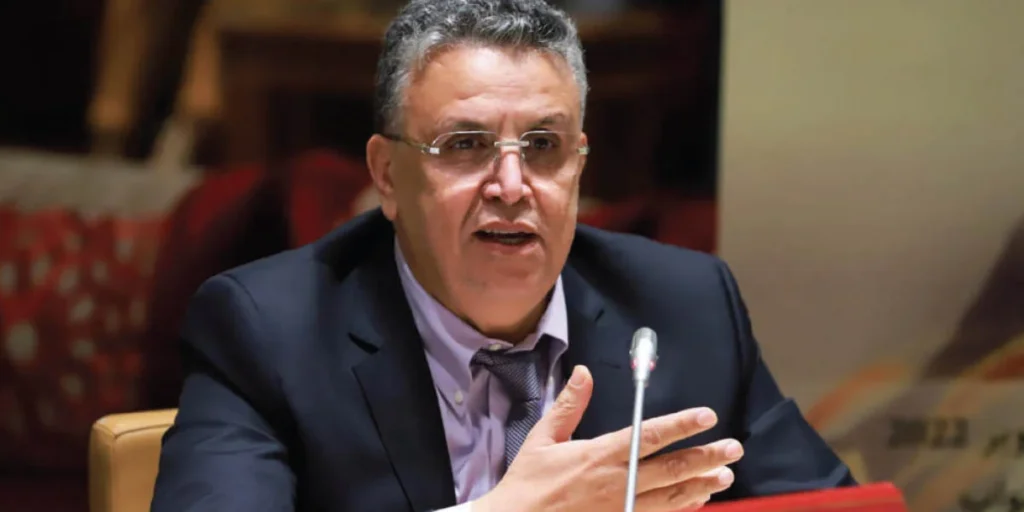
The Moroccan Minister of Justice, Abdellatif Ouahbi, has once again brought up the issue of Ceuta and Melilla, asserting that Morocco seeks dialogue with Spain regarding the status of these cities, which Rabat considers integral parts of its territory. In a recent interview, he emphasized that Morocco’s historical claims remain on the table, framed within a long-term strategy rooted in patience and diplomatic engagement. Such discussions frequently arise during high-level meetings between officials from both nations, he noted.
Addressing the surge in migration flows toward Ceuta on July 30 and 31, Ouahbi underscored the urgent need for Spain to fulfill its obligations by ensuring the safe return of unaccompanied Moroccan minors who crossed into Spanish territory. He also criticized Spain’s approach, which places the burden on Morocco to curb irregular departures while allowing those who successfully reach Spanish soil to pursue legal procedures.
Highlighting the shared responsibility in migration management, Ouahbi stressed that Morocco cannot be expected to act as Europe’s sole enforcer. He called for a collaborative framework, including harmonized legal criteria and operational mechanisms, to tackle irregular migration effectively.
The following day, Spain’s Ministry of Foreign Affairs firmly rejected Morocco’s sovereignty claims over Ceuta and Melilla. Officials stated unequivocally that these territories are, and always will be, an unnegotiable part of Spain’s internationally recognized territorial integrity.
Diplomatic calm vs. political fire
During a visit to Ceuta, Spain’s Foreign Minister, José Manuel Albares, avoided commenting on the sovereignty dispute, instead focusing on the recent migration crisis. He acknowledged Morocco’s willingness to facilitate the repatriation of unaccompanied minors who entered during the influx.
In contrast, the President of Melilla, Juan José Imbroda, from Spain’s opposition party, delivered a sharp rebuke to Morocco’s stance. In a public statement, he questioned the purpose of Ceuta and Melilla if Morocco cannot manage its own challenges and prevent youth from fleeing. Imbroda framed the migration surge as an international embarrassment for Morocco, urging the country to address the crisis with dignity.
Meanwhile, Morocco’s Ministry of the Interior issued a statement emphasizing the shared responsibility between both nations in managing irregular migration toward Ceuta. The ministry warned against online calls for mass crossings on August 15, stressing that combating human trafficking and illegal migration requires a unified effort rather than unilateral action.
You may also like
Senegal’s December 2, 2026: will Diomaye Faye dissolve parliament or play the long game?
Senegal’s 2026 budget revision: can Dakar still rescue its growth and investment agenda?
Senegal’s 2026 revised budget: a trap vote for Pastef or a necessary evil?
Burkina Faso’s armored vehicles: can Faso Armored’s 300-unit claim survive the scrutiny?
Can Senegal and Azerbaijan turn a New York memorandum into a lasting political partnership?