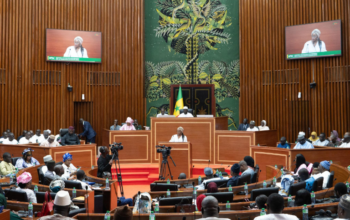
When the National Assembly of Senegal faced a dramatic showdown over the 2026 revised budget late last month, the political standoff exposed a critical vulnerability in West African governance: the fragility of institutional mediation in times of fiscal disagreement. Just one week earlier, on October 28 in Cotonou, Benin’s newly formed Senate convened its first ordinary session with a clear mandate: to act as a stabilizing force against political deadlock—without replicating the Senegalese scenario.
The timing was deliberate. Senegal’s budget crisis illustrated how quickly parliamentary disagreements, even within the same majority coalition, can escalate into legislative paralysis. Meanwhile, Benin’s Senate—officially launched under the 2025 constitutional reform—was positioning itself as a preventive framework, designed to intercept conflicts before they derail governance.
Why the Senate’s Role Matters More Than Ever
The Beninese Senate, composed of 25 members, is more than a ceremonial body. It was conceived as a constitutional safeguard. Its mandate, as articulated by Senate President Patrice Talon, is unambiguous: “to uphold national cohesion and prevent political violence from undermining public policy.” Unlike the National Assembly, the Senate is not elected directly by the public—its members are nominated by municipal councils and approved by the President—giving it a more detached, institutional perspective.
This distance from electoral politics is intentional. The Senate’s role includes reviewing and approving constitutional amendments, election laws, and party regulations—texts that require protection from short-term political manipulation. But perhaps its most potent tool is the second-reading mechanism, which allows the Senate to demand reconsideration of contested laws, except for finance bills, to ensure thorough debate and reduce the risk of rushed or adversarial decisions.
Luxembourg’s Example vs. Senegal’s Lesson: The Arbitration Imperative
While Senegal’s crisis unfolded around a revised finance bill—originally rejected in committee—Benin’s Senate had already signaled its proactive stance. Talon emphasized during the opening session that the chamber would prioritize mediation over confrontation. This is a strategic pivot: rather than waiting for a dispute to escalate, the Senate aims to function as an institutional referee.
The contrast with Senegal’s experience is striking. When the budget bill was rejected in committee on October 23, it triggered a procedural crisis. The government responded by requesting a delay, but the damage was already done. Public trust in the budget process eroded; investors and citizens alike questioned the government’s ability to deliver on its financial commitments. The delay in itself became a symbol of systemic fragility.
In Benin, the Senate is betting on a different approach: institutional dialogue before institutional failure. By allowing a second deliberation on non-budgetary bills, it introduces a cooling-off period—one that could prevent minor disagreements from becoming entrenched political rivalries.
The Limits of Institutional Design: No Magic Wand for Governance
Yet, no chamber—no matter how well-designed—can guarantee harmony. The Senate’s authority is real but bounded. Its decisions must align with constitutional constraints. And its legitimacy depends on how it is perceived by both the executive and the public. If lawmakers view the Senate as an extension of the presidency, its role as a neutral arbiter could be compromised from the start.
Moreover, its absence from the budget process—deliberately excluded, given the sensitivity of fiscal sovereignty—limits its reach. Economic policy remains the domain of the National Assembly and the executive. So while the Senate can mediate political disputes, it cannot directly resolve budgetary conflicts.
This structural limit raises a crucial question: Can Benin’s Senate prevent gridlock, or will it merely shift it elsewhere—possibly to a less visible but equally dangerous terrain?
The Real Test: Will It Build Trust or Become a Bureaucratic Layer?
The answer hinges on execution. If the Senate becomes an echo chamber for political actors, it will fail its purpose. If, instead, it cultivates a culture of reasoned debate and cross-institutional respect, it could redefine Benin’s governance landscape.
Patrice Talon’s framing is bold: “The Senate is an institution of political calming. Nothing more.” This modest ambition is actually strategic. By defining itself narrowly, the chamber avoids overpromising and focuses on what it can deliver: a platform for dialogue, a buffer against impulsive decisions, and a symbol of stability in an era of regional uncertainty.
The ultimate test will come not in rhetoric, but in action. When the next policy dispute arises—inevitably—will Benin’s Senate be seen as a guardian of continuity, or just another layer of government waiting to be ignored?
The lesson from Dakar is clear: political systems that lack built-in mechanisms for conflict resolution are vulnerable. Benin’s response? A Senate designed to mediate, not dominate. The nation is watching.