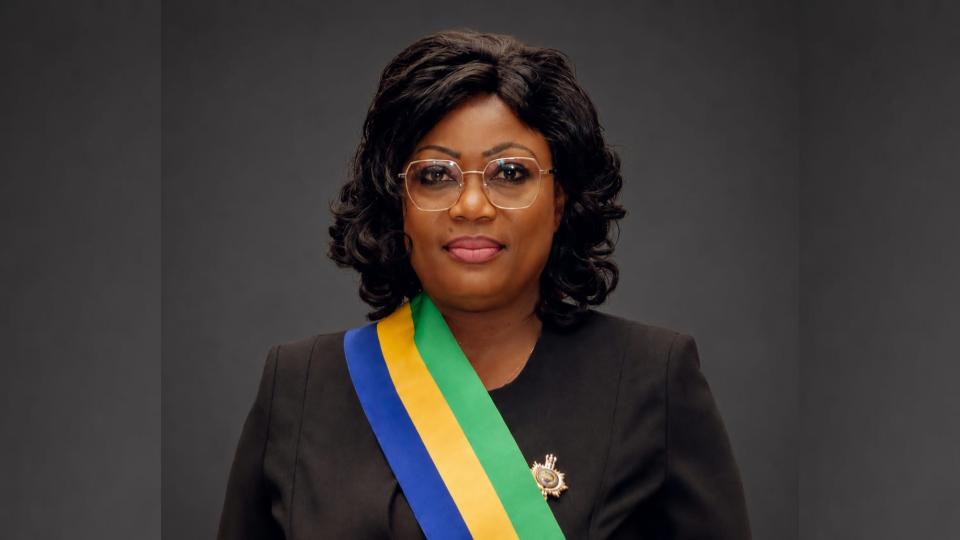
Following harsh remarks attributed to activist Landry Mbeng, widely known as Lanlaire, against President Brice Clotaire Oligui Nguema, his wife, and notably his mother, lawmaker Daisy Léance Akinikoussou has taken a firm stand. In a bold statement titled “Time to say: enough!”, she condemns what she describes as a dangerous slide from political critique into personal attacks that undermine the dignity of women and families alike.
Can public criticism of a leader justify targeting their loved ones? For Daisy Léance Akinikoussou, the answer is a resounding no. As both a deputy representing the Plateaux region and Secretary-General of the National Network of Women Deputies (RENAFED), she argues that a clear line must be drawn between vigorous political debate and attacks on the private lives of officials’ relatives.
Her response comes amid recent remarks attributed to Lanlaire, whose online presence amplifies his controversial statements. The lawmaker views the reported attacks on the President’s mother as a violation of an unspoken moral boundary—one that should never be crossed in public discourse.
Respecting women means defending all women
« A mother remains a mother, regardless of her child’s position in society, » Daisy Léance Akinikoussou asserts. She insists that the President’s mother cannot be treated as a political figure merely because of her familial ties. « We may challenge the President, reject his policies, and oppose his leadership—but his mother is not a political actor simply because she is his mother, » she emphasizes.
Her stance goes beyond defending a public figure. « Defending the President’s mother is not about defending a regime; it is about defending a principle—the right to dignity for every individual, no matter their connection to power, » she explains.
Beyond politics: protecting women from symbolic violence
As Secretary-General of RENAFED, Daisy Léance Akinikoussou frames this controversy through the lens of women’s rights and protection from humiliation. She warns against selective advocacy: « The fight for women’s dignity cannot be conditional. We must defend all women, including those whose views or alliances we do not share, » she states.
Her intervention shifts the debate from partisan conflict to a broader concern: the normalization of insults and personal attacks in online spaces. She argues that society must reject the idea that digital aggression is an acceptable form of political engagement.
Setting a dangerous precedent
« Today, it is the President’s mother. Tomorrow, it could be the mother of an opponent, a journalist, or an ordinary citizen, » Daisy Léance Akinikoussou warns. She frames these attacks as a slippery slope—one that erodes the very foundations of democratic discourse by turning family members into pawns in political battles.
While she fully supports the right to criticize the President’s governance, she insists such criticism must remain focused on policies, actions, and leadership—not on the personal lives of his relatives. Her message is clear: « A determined political opponent does not have to become an enemy of human dignity. »
Restoring the boundaries of democratic debate
Her public intervention arrives at a time when civil society leaders and public figures in Gabon are increasingly alarmed by the deterioration of online discussions. Beyond partisan divides, the core question now is: where do we draw the line in public confrontation? Daisy Léance Akinikoussou’s response is unequivocal: « Enough is enough. »
You may also like
Cameroon’s youth confront social media’s real impact in #PSE debate
Cameroun’s douala-bafoussam highway in critical condition
Chad tackles gender-based violence with new victim support mapping in N’Djamena
Rising cost of living in Chad: economist calls for market price monitoring
Benin traditional leaders: trusted figures but urged to stay out of politics