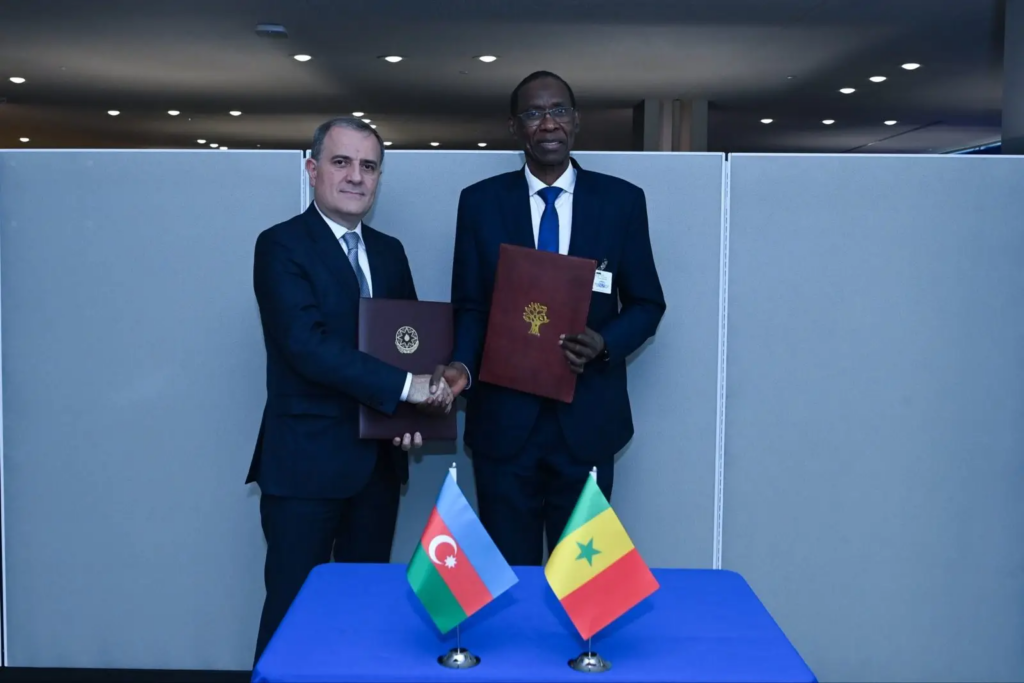
Senegal and Azerbaijan have opened a new chapter in their bilateral relationship, signing a memorandum of understanding in New York to establish regular political consultations. The agreement was sealed on the sidelines of the high-level week of the 81st session of the United Nations General Assembly, according to an announcement from the Senegalese Ministry of African Integration, Foreign Affairs, and Senegalese Abroad on Friday evening.
This political consultation framework is designed, in standard diplomatic practice, to institutionalize exchanges between the two administrations on issues of mutual interest. It would provide both parties with a structured mechanism to regularly discuss the state of their cooperation and the prospects for developing their relations, rather than relying on ad hoc contacts.
The signing comes at a time when major international gatherings, such as the UN General Assembly, are often used by delegations to finalize bilateral texts on the margins of official proceedings. The Senegalese foreign ministry described the signature as a new dynamic in relations between Dakar and Baku.
A cooperation still to be built
The memorandum does not, based on the information released so far, detail the specific areas that future political consultations will cover. Such agreements typically serve as a foundation for later discussions that can span various sectors, from economic issues to multilateral matters and technical cooperation.
The ministry has not yet specified the timeline for implementing the mechanism or how often the political consultations will be held. These details are likely to be clarified in upcoming official communications from both governments.
The signing continues Senegal’s diplomatic trend of multiplying bilateral partnerships with countries in Asia and Eastern Europe in recent years, thereby expanding its network of foreign relations beyond traditional partners.
The UN framework as a diplomatic springboard
The high-level week of the UN General Assembly is traditionally a prime moment for heads of state, heads of government, and foreign ministers from around the world. It offers many countries the chance to hold bilateral meetings on the margins of plenary sessions and sign agreements that would otherwise require dedicated travel.
The Ministry of African Integration, Foreign Affairs, and Senegalese Abroad did not disclose, in its Friday evening announcement, the identity of the signatories or the exact format of the signing ceremony. Further details on how the memorandum will be implemented are expected in the coming days.
You may also like
Senegal’s December 2, 2026: will Diomaye Faye dissolve parliament or play the long game?
Senegal’s 2026 budget revision: can Dakar still rescue its growth and investment agenda?
Senegal’s 2026 revised budget: a trap vote for Pastef or a necessary evil?
Burkina Faso’s armored vehicles: can Faso Armored’s 300-unit claim survive the scrutiny?
Benin’s port training gamble: can Luxembourg’s 9.8 billion FCFA deliver real jobs?