While Captain Ibrahim Traoré’s official communications frequently denounce ECOWAS, often branding it as an instrument manipulated by Western powers, the financial reality presents a starkly different narrative. Beyond political denunciations, the evidence is clear: the Burkinabè government consistently seeks and obtains substantial financial assistance from this very regional body.
This intriguing dichotomy warrants close examination, as it highlights a significant divergence between political rhetoric and the economic imperatives confronting any sovereign state. An organization may face political condemnation while simultaneously functioning as an indispensable financial partner, its mechanisms contributing to the advancement of critical projects.
Significant investments in essential infrastructure
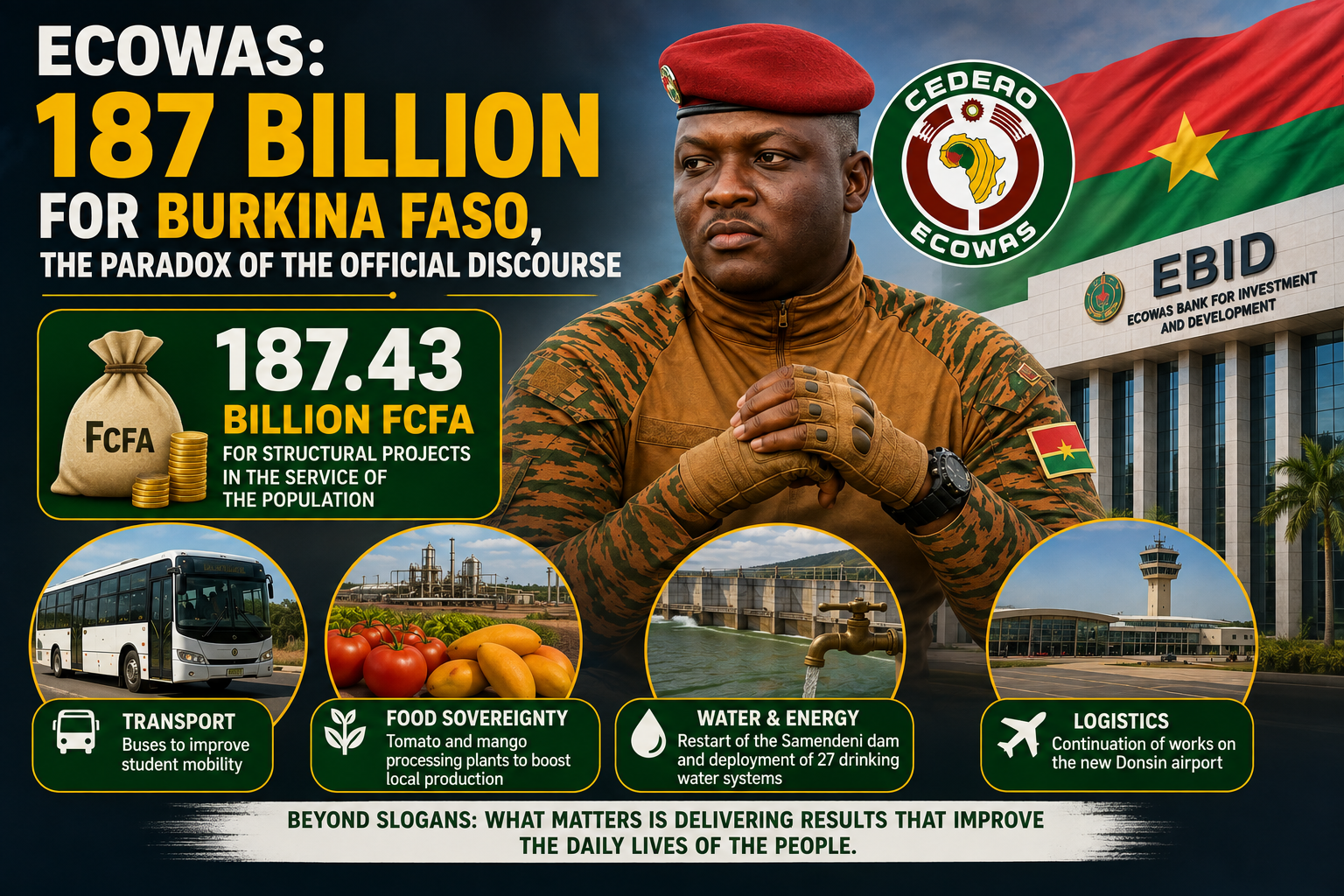
The ECOWAS Bank for Investment and Development (EBID) has recently initiated a substantial financial injection. A total of 187.43 billion CFA francs is being allocated to pivotal initiatives designed to enhance the daily lives of Burkinabè citizens:
- Transportation and Education: The procurement of buses aims to alleviate congestion in student transport. Beyond merely improving mobility, this investment directly impacts access to education and has the potential to mitigate daily challenges faced by students and their families.
- Food Security: The establishment of processing plants for tomatoes and mangoes is intended to enhance the value of local agricultural output. The objective extends beyond increasing production; it involves on-site transformation, generating added value, minimizing agricultural waste, and opening new markets for producers.
- Water and Energy: This initiative includes the revitalization of the Samendeni dam and the implementation of 27 potable water systems in areas experiencing scarcity. In a nation grappling with significant economic, social, and security challenges, access to water is not only a developmental concern but also a fundamental element of population stability.
- Logistics: Construction continues on the new Donsin airport. An infrastructure project of this magnitude can bolster trade, improve national connectivity, and stimulate economic activities, provided that its completion is successful and the investments are judiciously managed.
These financial commitments underscore that regional integration transcends mere political declarations or diplomatic summits. It also encompasses robust financial mechanisms capable of tangibly supporting member states in their developmental aspirations.
The divergence between rhetoric and economic realities
Beneath the surface of confrontational stances and sovereignist pronouncements, this substantial capital injection reveals an inconvenient truth: Burkina Faso remains reliant on the operational and financial backing of the very regional integration mechanisms it publicly criticizes.
Herein lies the core paradox. On one hand, official discourse routinely portrays ECOWAS as an entity hostile to Burkina Faso’s interests and susceptible to foreign influence. Conversely, the financial instruments associated with this identical organization continue to be leveraged to fund essential infrastructure projects benefiting the Burkinabè populace.
This scenario serves as a potent reminder of a fundamental principle in modern governance: interstate relations cannot invariably be simplified to dynamics of political amity or antagonism. Economic imperatives, funding requirements, regional infrastructure needs, and developmental objectives frequently necessitate cooperative frameworks that transcend ideological pronouncements.
A straightforward question thus arises: if ECOWAS mechanisms are genuinely as detrimental to Burkinabè interests as official communications suggest, why persist in utilizing their financial instruments for the funding of strategic national projects?
This inquiry does not imply that a state should abandon its right to defend its interests or critique a regional organization. Rather, it underscores the imperative for consistency between public declarations and economic decisions. One cannot simultaneously characterize an institution as inherently adversarial and yet deem its resources beneficial when they serve to finance critical national infrastructure.
A contradiction challenging the concept of sovereignty
The notion of sovereignty lies at the core of current political discourse in Burkina Faso. However, sovereignty should not be conflated with isolation. A truly sovereign state is capable of asserting its interests, challenging certain regional decisions, and concurrently leveraging available cooperative mechanisms when they demonstrably benefit its populace.
The fundamental challenge, therefore, appears less about whether Burkina Faso should accept or reject all cooperation with ECOWAS, and more about ensuring these funds are deployed efficiently, transparently, and in alignment with national priorities.
Indeed, 187.43 billion CFA francs constitutes a substantial financial allocation. This sum represents potential infrastructure development, job creation, essential equipment, public services, and economic opportunities. Yet, an announced funding package does not automatically equate to tangible outcomes. True efficacy will be contingent upon meticulous project execution, adherence to timelines, the quality of the resulting infrastructure, and the authorities’ ability to ensure stringent resource management.
Consequently, the issue of transparency is paramount. Citizens possess a legitimate right to comprehend how these funds are allocated, under what specific conditions, for which projects, with what timelines, and through which oversight mechanisms. Sovereignty, therefore, should not merely be a rhetorical assertion; it must also manifest as a demonstrable capacity for accountability in the utilization of resources dedicated to national development.
Beyond political contention, populations anticipate results
Ultimately, the discourse surrounding ECOWAS ought not to be confined solely to ideological considerations. For the student requiring transportation, the producer seeking market access for their harvest, the family awaiting reliable potable water, or the entrepreneur needing modern infrastructure, the pivotal question remains consistent: how will these investments genuinely transform daily life?
It is on this practical ground that the authorities will ultimately be evaluated.
An announced factory must become operational. A water supply system must effectively deliver water. Buses must genuinely enhance student mobility. A dam must yield its projected benefits. An airport must evolve into a tangible instrument of development.
The fundamental question now pertains to practical implementation. Will these represent transformative commitments that genuinely alter citizens’ daily realities, or merely another financial package potentially mired in bureaucratic inefficiencies? The populace, for its part, expects pragmatic and concrete outcomes, far surpassing political rivalries.
Ultimately, neither sovereignist slogans nor criticisms directed at ECOWAS will construct roads, supply water to urban centers, support agriculturalists, or enhance transportation. It is the quality of investments, their proficient management, and their tangible impact on citizens’ lives that will determine the true significance of these 187 billion CFA francs.