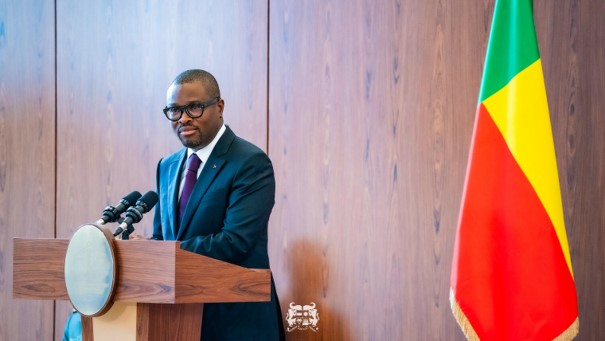
With a single, impactful statement, the tone was set. “Our legal framework must transcend its role as merely an instrument guaranteeing order and justice within society. We must perceive the law as a true catalyst for our development.” These words, spoken by President Romuald Wadagni on Tuesday, July 28, 2026, during the official inauguration of the permanent committee of the Commission for Legal Reform, marked more than just the establishment of a new body. They articulated a profound conviction that has guided his administration since assuming the highest office: a vision for Bénin where legal norms transform from constraints into powerful engines of progress.
A transformative ambition rooted in ongoing reforms
The committee, formally launched by the head of state, did not emerge spontaneously this Tuesday. It was initially established on July 1st, during a Council of Ministers meeting, as a direct continuation of the extensive institutional reform movement initiated in recent years. President Wadagni entrusted its leadership to Professor Noël Gbaguidi, a highly respected figure in Bénin’s legal community, supported by Djidjouè Gboyou as vice-president and Igor Guèdègbè as rapporteur. This team of experts is tasked with a mission whose magnitude underscores the presidential ambition: to meticulously review the entire national legislative corpus, identifying outdated provisions, uncovering legislative gaps, and resolving inherent contradictions.
The fundamental premise for this comprehensive Bénin legal reform is the recognition that existing laws have been outpaced by time. Certain regulations, originally designed for a past Bénin, no longer align with today’s social, economic, and international realities. Conversely, other crucial areas suffer from legislative voids, which contemporary challenges make increasingly urgent. Between these antiquated texts and areas lacking clear legal guidance, the legislative edifice risks incoherence – a subtle weakness that erodes both citizen trust and investor confidence.
“Legal certainty is not an abstract notion; it is a tangible economic asset,” explained a university specialist in public governance. “An entrepreneur, whether local or foreign, will only invest sustainably where they are confident that the rules of engagement are stable and will be applied predictably. By prioritizing legal certainty, Wadagni is addressing both the people of Bénin and global markets.” The expert further noted the consistency of this approach with recent government initiatives, from harmonizing judicial costs to implementing electronic legal processes, all serving as milestones in the modernization of justice.
Crafting the laws for a future world
Yet, the most formidable challenge assigned to the Gbaguidi committee lies in a single word: anticipation. The president explicitly charged the members with developing new legal frameworks capable of embracing the major transformations of the century. This includes adapting to climate change, necessitating a re-evaluation of water rights, land use, and environmental responsibility. It also involves addressing accelerated urbanization, which demands updates to land law and spatial planning. Finally, the committee must confront technological revolutions, from artificial intelligence to data protection, requiring entirely novel legal structures.
“This is an undertaking for which no ready-made model exists,” cautioned a magistrate currently serving in Cotonou. “Even the most advanced legal systems are improvising as they grapple with these issues. Bénin, therefore, has a unique opportunity: to legislate intelligently, without mere replication, while factoring in its specific national context.” This sentiment is echoed by a local business lawyer: “Should this committee succeed, it will provide the country with a considerable competitive advantage – that of a transparent and modern legal environment.”
At the Marina this Tuesday, Romuald Wadagni charted the course. Now, it falls to the committee to translate this intent into living law. Bénin watches as this team embraces a rare responsibility: to write the rules for the world that is to come.
You may also like
Alain-Georges Moukoko takes over Libreville prosecutor general’s office
Bénin : le Sénat tient sa séance inaugurale sous la conduite de Patrice Talon
Gabon : le citoyen au cœur de la nouvelle donne démocratique
Gabon : l’association Force lance sa rentrée citoyenne à Akanda
Is Chad truly entering a period of political easing?