In Benin, traditional leaders hold a pivotal place in the sociocultural fabric, blending deep-rooted traditions with modern governance. They serve as guardians of local values, identity, and moral authority, a role formally acknowledged by the Beninese state. Their influence extends beyond cultural preservation, playing a key part in conflict resolution and community cohesion.
Their legitimacy was further cemented in April 2025 when the National Assembly passed Law No. 2025-09, establishing a legal framework for traditional chieftaincies. This legislation categorizes and recognizes 16 kingdoms and 90 traditional chefferies, formalizing their status while outlining their contributions to socioeconomic development and social harmony. The law underscores their role in preserving cultural identities amidst evolving political landscapes.
Yet, their involvement in national politics has sparked debate. Political parties often seek their endorsement, offering material or financial incentives to sway voter preferences—a practice that has drawn criticism. To curb such interference, Benin’s government enforced strict regulations prohibiting traditional rulers from engaging in partisan politics.
Public perception: trust in traditional leaders vs. political neutrality
Recent insights reveal a complex picture of how citizens view these leaders. Nearly a quarter of respondents reported interacting with traditional leaders in the past year, reflecting their active presence in local governance. A majority expressed trust in their ability to influence community decisions, with many advocating for an even stronger role in local governance.
However, this trust is tempered by growing concerns over integrity. Approximately three-quarters of citizens believe corruption taints the reputation of some traditional leaders, a concern that has intensified since 2022. Confidence in their moral authority has also waned compared to 2020, signaling a shift in public sentiment.
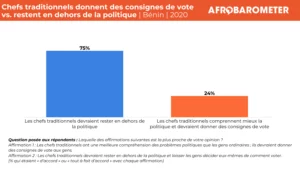
Despite their cultural significance, the overwhelming majority of Beninese citizens insist that traditional leaders should refrain from political involvement. They argue that elections should remain the sole domain of voters, free from external influence.
You may also like
Cameroon’s youth confront social media’s real impact in #PSE debate
Cameroun’s douala-bafoussam highway in critical condition
Gabon debates dignity after attacks on president’s mother
Chad tackles gender-based violence with new victim support mapping in N’Djamena
Rising cost of living in Chad: economist calls for market price monitoring