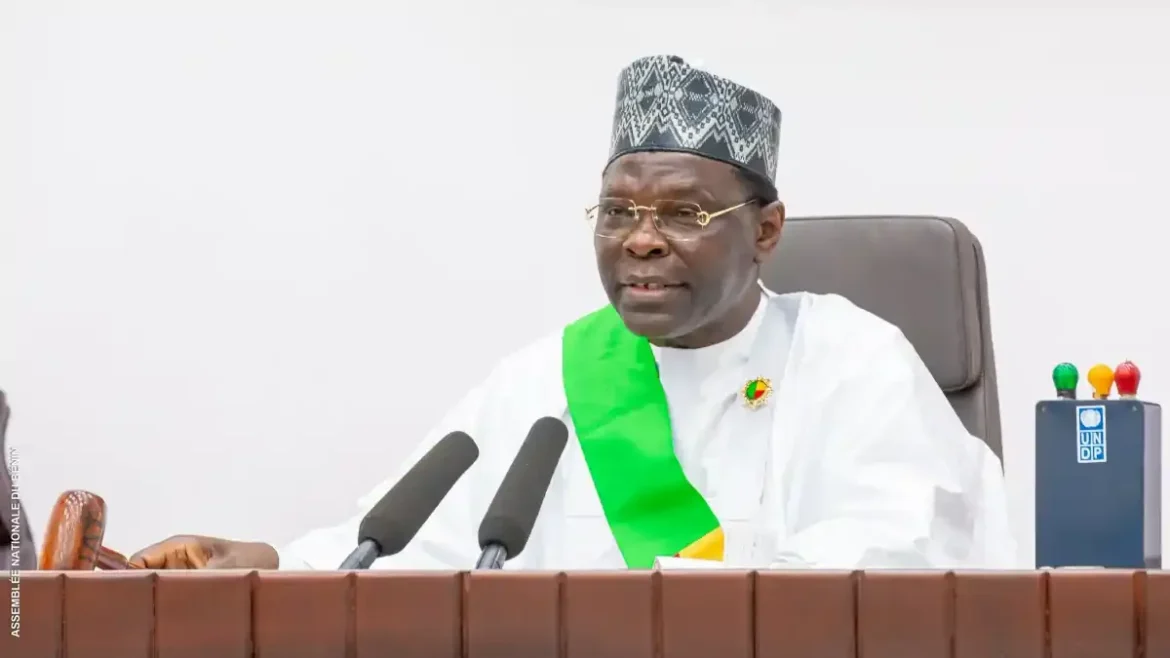
At the recently concluded 86th executive committee session and 48th Conference of Presidents of the African Parliamentary Union (APU) in Lomé, Benin’s National Assembly President, Joseph Fifamè Djogbénou, delivered a quietly powerful message—one that cut through the noise of regional divisions. His speech was not just a diplomatic gesture; it was a calculated, behind-the-scenes maneuver to reignite dialogue with Niger and Burkina Faso, two nations with which Benin shares a complex and strained relationship.
The hidden forces shaping Benin’s diplomatic reset
What drives a nation to persist in its outreach despite prolonged border tensions and diplomatic friction? For Benin, the answer lies in an unshaken belief: regional cohesion is the only viable path forward. Djogbénou’s intervention in Lomé wasn’t merely symbolic—it reflected a strategic pivot in Sahel diplomacy, rooted in the realization that isolation benefits no one. His words carried weight, framed by a deeper understanding of history and necessity:
« As long as the night of discord persists—though I pray it is transient—the dawn of peace will eventually break. »
This wasn’t just rhetoric. It was a deliberate framing of diplomacy as a long-term investment, not a short-term tactic.
Why Burkina Faso’s new role in the APU was the catalyst
The timing of Djogbénou’s outreach was no coincidence. With Burkina Faso assuming the leadership of the APU secretariat in Lomé, the political moment had aligned. Speaking before an audience that included regional parliamentary leaders, Djogbénou framed his initiative not as negotiation, but as a homecoming:
« I am courting Niger and Burkina Faso because I intend to go to Niger and Burkina Faso—together. »
It was a message to diplomats and citizens alike: Benin is not turning away. It is reaching across the divide, not out of weakness, but out of conviction.
A continuity of purpose: how Benin’s diplomacy remains steadfast
In an era where political leadership often fluctuates with elections, Benin’s foreign policy has remained strikingly consistent. From the executive branch to the legislature, the message has been clear: peace is not negotiable. Even as governments change, the commitment to regional stability remains embedded in national policy. This continuity signals a deeper truth: Benin’s destiny is intertwined with that of its neighbors—Niger to the north, Burkina Faso to the northwest. To isolate itself would be to weaken itself.
The recent handover of power in Cotonou did not alter this course. If anything, it reinforced it. Djogbénou’s visit to Lomé was not an anomaly—it was a reinforcement of a long-held principle: diplomacy is the first line of defense against instability.
From borders to people: why shared challenges demand shared solutions
Djogbénou didn’t just appeal to heads of state. He spoke to the people. Highlighting the shared fate of West African communities, he drew a vivid parallel that resonated across linguistic and national lines:
- « In Europe, when borders reject African migrants, they don’t reject Beninese, Malians, Senegalese, or Nigeriens. They reject Africans. »
This profound observation underscored a reality often overlooked in diplomatic meetings: the crises facing the Sahel are not national—they are regional. Insecurity, migration, and economic fragility do not respect borders. They demand collective action. And that action must begin with dialogue.
Parliamentary diplomacy as the new frontline in Sahel peacebuilding
While heads of state negotiate at summits, parliamentary leaders like Djogbénou are quietly building bridges. His call for synergy between Benin’s National Assembly, Niger’s National Assembly, and Burkina Faso’s transitional legislature was not symbolic. It was strategic.
The goal? To use the power of elected officials—closest to the people—to translate policy into practice. To ensure that trade routes reopen, that families are reunited, and that the seeds of trust are sown in fertile ground. Djogbénou’s message was clear: fraternity is the ultimate security policy.
In a region where mistrust has deepened and borders have hardened, Benin’s quiet diplomacy offers a rare light of hope. It’s not about grand declarations—it’s about persistent, principled engagement. And in the shadows of formal summits, it may well be the most effective tool the Sahel has left.