In a Senegal where secularism coexists with the deep-rooted influence of Sufi brotherhoods, religious fervor often intersects with political agendas. The historical figures of Senegalese Islam are now central to discourses promoting sovereignty, as modern leaders draw from their legacies to craft a national identity free from foreign interference.
Political leaders rally behind Sufi heritage
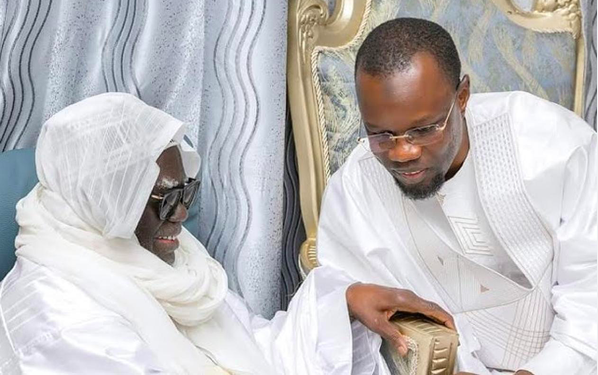
From Bassirou Diomaye Faye to Ousmane Sonko, political elites increasingly invoke the histories of these religious guides to forge a unifying national narrative. Both leaders, despite their recent political rift, share a common strategy: securing the support of senior religious figures. Just days before the Grand Magal pilgrimage on July 26, President Bassirou Diomaye Faye visited Touba to meet Serigne Mountakha Mbacké, the general caliph of the Mouride brotherhood. Ousmane Sonko followed suit four days later, highlighting the enduring influence of these spiritual leaders as pillars of national cohesion amid political turbulence.
Sonko’s visit carried ideological weight, as he explicitly linked his political vision to that of Cheikh Ahmadou Bamba, the founder of the Mouride brotherhood and a symbol of peaceful resistance against French colonial rule. The National Assembly president drew parallels between his policies and the model championed by the marabout, who famously rejected French funding to “preserve the independence of the faithful communities.”
Nationalism through religious revivalism
This revival is no coincidence. It reflects a broader intellectual movement rediscovering the anti-colonial past of Senegal’s religious leaders. Cheikh Gueye, a Mouride scholar and disciple, notes, “More people are revisiting the legacies of Senegalese Islamic figures through an anti-colonial and political lens.”
The movement embraces not only Cheikh Ahmadou Bamba but also El Hadj Oumar Tall of the Tijaniyya brotherhood and Thierno Souleymane Baal, who established a theocratic state in the 18th century. These figures are championed by sovereignty advocates, such as members of the Frapp movement, as “sources of political inspiration without deifying them.”
A complex legacy
Yet this unifying narrative faces historical complexities. Some religious leaders later facilitated the recruitment of tirailleurs (colonial soldiers) for France, a duality that contemporary youth—with their critical mindset—are increasingly willing to acknowledge. Mamadou Fall, editor of the upcoming General History of Senegal, emphasizes the need to integrate these religious figures into school curricula while addressing their contradictions. He reminds us that while some are celebrated as anti-colonial heroes, others are viewed elsewhere as “conquerors who arrived with swords in hand.”
You may also like
Will Senegal’s local elections break Bassirou Diomaye Faye’s presidency before it truly begins?
Senegal’s budget: can Ousmane Sonko afford to block Bassirou Diomaye Faye’s 2026 plan?
Senegal electoral reform: Khalidou dit Mbaye Sokoma’s full proportional representation push
Senegal’s local elections: Bassirou Diomaye Faye still won’t set a date
Alain-Georges Moukoko takes over Libreville prosecutor general’s office