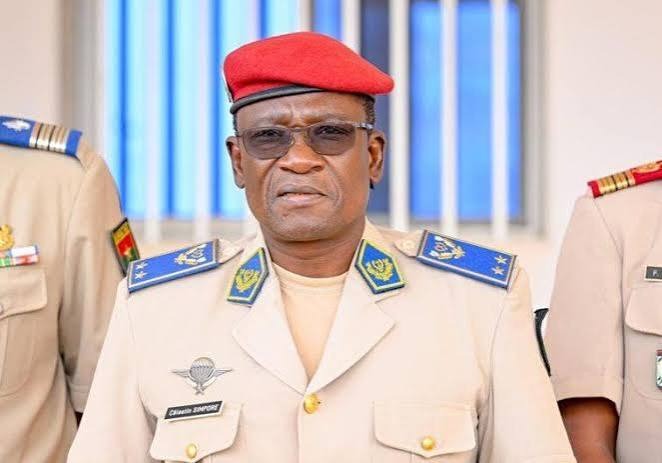
Defense Minister General Célestin Simporé appeared on Radio-Télévision du Burkina (RTB) to praise Captain Ibrahim Traoré’s security record. Instead, he offered a carefully rehearsed justification for the current security stalemate: the Burkinabè army was historically “poorly trained.” This political self-exoneration has been sharply contradicted on the ground. The public is now asking a pointed question: how did yesterday’s supposedly deficient army manage to contain the enemy far more effectively than the “new army” retrained by Moscow and equipped with billions in weaponry?
Rewriting history to hide the present rout
By repeatedly stating on the national channel that the armed forces lacked tactical instruction and operational preparation before the transition, General Simporé is building a simplistic narrative: today’s failures are merely yesterday’s legacy.
But the facts are stubborn. Under previous regimes, despite a glaring lack of material resources and undeniable structural weaknesses, the military apparatus managed to hold the network of provincial capitals and maintain coherent territorial defense lines. Today, while the transition regime boasts of creating more than 30 new battalions and putting military training back at the heart of its action, effective state control has collapsed across more than 65% of the national territory.
The crushing failure of the Russian training doctrine
To replace the old training model, Ibrahim Traoré’s regime threw itself headlong into the arms of Russian Africa Corps soldiers. The result of this “downgrade”? A sharp rise in lethality on the front:
- An appalling human toll: The carnage is endless. From the Mansila tragedy to recent setbacks in the Centre-Nord, the hastily formed new units are paying an unprecedented blood tribute.
- Inability to fight asymmetric warfare: The Russian training method, focused on frontal brutality and blind firepower, is proving completely ineffective against mobile armed terrorist groups (GATs) operating in small motorcycle columns and using improvised explosive devices.
- Breakdown with local populations: By sacrificing contact intelligence and military ethics in favor of a scorched-earth logic, the new doctrine has alienated rural populations, depriving soldiers of the only effective bulwark against terrorist infiltration: citizen information.
An insult to the sacrifice of rank-and-file soldiers
Declaring on a television set that the troops were “poorly trained” is an insult to the memory of the thousands of soldiers and gendarmes who fell in combat over the past decade. With rudimentary means and counted rations, these men held the front against a nascent threat without ever abandoning entire regions as is now the case under the guise of “tactical evacuations” — as seen in the Boussouma drama.
General Simporé’s admission on RTB convinces no one. Two years after Captain Traoré’s absolute seizure of power, blaming yesterday’s training is an admission of powerlessness. It was not yesterday’s weapons that lacked value; it is today’s strategy that is collapsing under the weight of propaganda.
You may also like
Senegal’s December 2, 2026: will Diomaye Faye dissolve parliament or play the long game?
Senegal’s 2026 budget revision: can Dakar still rescue its growth and investment agenda?
Senegal’s 2026 revised budget: a trap vote for Pastef or a necessary evil?
Burkina Faso’s armored vehicles: can Faso Armored’s 300-unit claim survive the scrutiny?
Can Senegal and Azerbaijan turn a New York memorandum into a lasting political partnership?