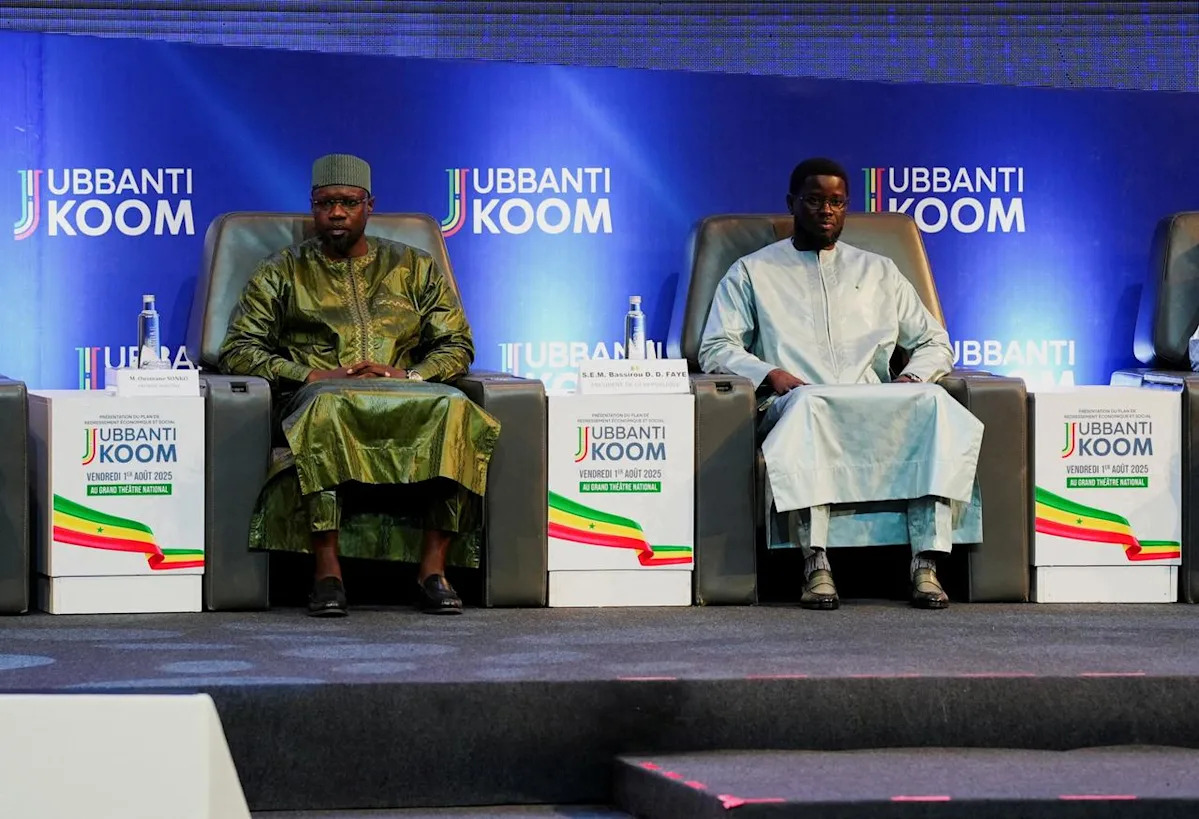
When Bassirou Diomaye Faye dismissed Ousmane Sonko from his post as Prime Minister on May 23, 2026, the move transcended personal disagreements. It marked the collapse of a fragile alliance built on two fundamentally opposing economic visions for Senegal. Nearly two years after Faye’s election victory in April 2024—an outcome that later led to Sonko’s appointment as Prime Minister—the partnership unraveled over three pivotal issues shaping the nation’s financial future: debt management, hydrocarbon development, and the role of foreign capital in domestic policy.
Debt management exposes deep divides
At the heart of the rift lies Senegal’s mounting debt crisis. In September 2024, Ousmane Sonko publicly exposed billions in previously undisclosed debt accumulated under Macky Sall’s administration. By March 2025, an International Monetary Fund (IMF) assessment estimated unrecorded commitments at approximately €7 billion, pushing the country’s total debt to over 100% of GDP. Annual debt servicing costs reached 5.5 trillion West African CFA francs (€8.4 billion), while refinancing needs approached 6 trillion CFA francs (€9.1 billion). The country’s sovereign credit rating was downgraded three times within a year.
These figures set the stage for a stark policy clash. Sonko adopted a confrontational stance, framing debt transparency as a moral imperative and leveraging public denunciations of past corruption to rally supporters. His approach resonated with the diaspora and grassroots activists, positioning him as a champion of accountability rather than a pragmatist willing to negotiate with Western creditors. Faye, however, pursued a different strategy. He prioritized engagement with the IMF, hosting a delegation in November 2025 and launching a national dialogue in May 2026 to address fiscal sustainability.
For Sonko, rejecting debt restructuring was not just an economic decision—it was a political necessity. Any compromise risked undermining his credibility as a reformer and alienating the Patriotes africains du Sénégal pour le Travail, l’Éthique et la Fraternité (PASTEF), the party he founded in 2014. Yet, as international credit markets closed their doors and default risks loomed for 2028, his position became increasingly untenable, both economically and politically.