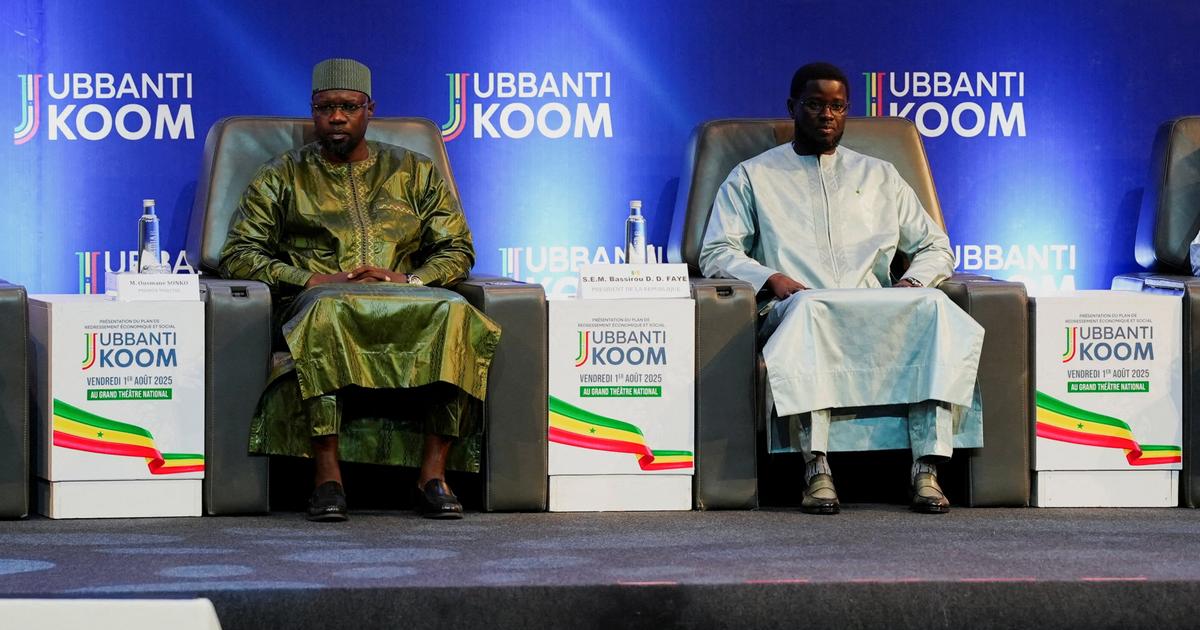
The dismissal of Ousmane Sonko by Bassirou Diomaye Faye on May 23, 2026, signals more than just a clash of personalities—it marks the collision of two fundamentally opposed economic philosophies that have long jostled for dominance under the same national banner. Two years after the April 2024 political transition that brought Faye to power and Sonko to the premiership, their partnership has fractured over the three pillars defining Senegal’s economic future: debt management, hydrocarbon exploitation, and the nature of capital fueling national policy.
Debt management: the visible fracture line
The most glaring point of contention revolves around national debt. In September 2024, Sonko exposed a staggering volume of undisclosed liabilities accumulated during Macky Sall’s administration. By March 2025, an International Monetary Fund assessment identified approximately €7 billion in unrecorded commitments, pushing the country’s debt-to-GDP ratio beyond 100%. Annual debt servicing consumes 5.5 trillion West African CFA francs (€8.4 billion), while annual refinancing needs approach 6 trillion West African CFA francs (€9.1 billion). The country’s sovereign credit rating has been downgraded three times within twelve months.
These figures set the stage for diametrically opposed strategies. Sonko rejected any restructuring proposal outright, framing debt transparency as a moral crusade aimed at public opinion, the diaspora, and his militant base. He refused to be perceived as the figure who would legitimize questionable financial legacies through negotiated settlements with Washington. Faye, conversely, pursued constructive engagement with the IMF, hosting a delegation in November 2025 and launching a national dialogue in May 2026 to address fiscal sustainability.
With a suspended €1.55 billion IMF program, closed international capital markets, and the looming specter of sovereign default by 2028, Sonko’s position became economically untenable—yet politically potent as a rallying cry for the Pastef (Patriotes africains du Sénégal pour le travail, l’éthique et la fraternité), the party he founded in 2014.
Oil and gas contracts: contrasting approaches to national wealth
The second—and perhaps more consequential—divergence centers on the management of Senegal’s burgeoning oil and gas sector. The Sangomar oil field, operated by Australia’s Woodside with an 82% stake, began production in June 2024. The Greater Tortue Ahmeyim (GTA) gas project, operated by BP at the Senegal-Mauritania maritime border, holds estimated reserves of 500 billion cubic meters. Both leaders publicly vowed to renegotiate contracts, with Sonko projecting potential gains of 940 billion West African CFA francs (€1.4 billion) in savings and 1.09 trillion West African CFA francs (€1.6 billion) in additional tax revenue from GTA between 2025 and 2040.
Yet their methods could not have been more different. Sonko adopted a confrontational posture, publicly denouncing BP’s agreements as “unbalanced and unjust” and issuing ultimatums. Faye, since April 2025, described the process as “more than satisfactory,” insisting it was proceeding “according to plan.” The multinational operators remained unmoved—Faye negotiated; Sonko threatened; the companies waited.
This divergence transcends tactics—it represents a philosophical clash over economic sovereignty. Sonko embodies an absolutist sovereignist vision, where rhetorical rupture with multinationals and Bretton Woods institutions alone is believed to generate negotiating power. Faye, in contrast, champions pragmatism, recognizing that the fiscal benefits from GTA and Sangomar will only materialize if operators continue investing and producing. For Faye, hydrocarbon output is the only tangible economic lever available to the state.
Financing political power: two distinct models
The third fault line pertains to the very capital underpinning political power—how each faction finances its existence. Sonko cultivated a financing model rare in Senegalese politics: the Pastef relies on mass micro-contributions from supporters, the diaspora, and emerging entrepreneurs, particularly in digital and trade sectors. This grassroots funding explains the party’s parliamentary dominance—130 out of 165 deputies owe their seats to him, many pledging loyalty to the man, not the presidency.
Faye, meanwhile, engineered a gradual shift. His “Diomaye président” coalition, re-launched in a general assembly on March 7, 2026, unites technocrats, former civil servants, and business networks prioritizing institutional stability over militant rupture. The May 23 dismissal of Sonko formalized this transition. When a state carries debt exceeding 100% of GDP and must refinance nearly €9 billion annually, the luxury of posturing comes at a monthly cost in bond market points. Senegalese euro- and dollar-denominated bonds plummeted at the first public signs of discord—illustrating the price of dual governance when each leader speaks a different language to global markets.
Two visions: truth versus realism
Must we conclude that Faye’s line is correct and Sonko’s flawed? That framing misses the point. Sonko’s line delivered an unprecedented act of financial truth-telling by exposing hidden debt—a risk no post-independence regime had dared take. Without this revelation, the country would have continued borrowing against falsified figures. Yet Faye’s line embraces negotiation within the global financial system, accepting the painful social costs of fiscal consolidation to rebuild credibility. Neither vision is complete without the other—the first shatters illusion; the second restores trust.
The tragedy for Senegal is that the tandem failed to integrate both imperatives within a unified institutional architecture. A presidency designed for vertical authority could not reconcile radical truth-telling with the patience required for economic recovery. The result: two leaders speaking to different constituencies, each undermining the other’s credibility in the eyes of investors.
Institutional realism prevails
There is a more unsettling interpretation: the multinational corporations that remained unfazed during two years of Sonko’s rhetorical confrontation may have been right to wait. They bet on the long-term institutional resilience over short-term political posturing—and they were proven correct. The dismissal of May 23, 2026, is, in its way, their vindication. It underscores that real economic power ultimately trumps the performative power of political rhetoric. This is what I term the ‘real state’—as opposed to the ‘fictive state’ of declarations and ultimatums.
The horizon of 2029 now unfolds with clarity. Sonko returns as a mobile political actor, positioned to transform the Pastef into a robust opposition force, mobilize the diaspora, and campaign across the nation. Faye, now unshackled from internal dissent, can finalize an IMF agreement, restructure debt, and present a platform of stability. Each will play their hand openly. Senegalese citizens will face a stark choice in 2029: between the assertion of sovereign autonomy and the management of sovereign pragmatism. Neither path is fully honest, nor entirely satisfying—but the nation must choose.