A recurring pitfall, as ancient as conflicts and coups d’état, frequently ensnares military commanders who transition into national leaders: the misapprehension of rhetoric’s potency for ground-level realities, and the interpretation of public silence—often born of apprehension or uncertainty—as unequivocal endorsement. Within Burkina Faso, this dynamic is widely believed to be manifesting. Beneath the meticulously choreographed public appearances, the crisp uniforms, the condemnations of a ‘treacherous West,’ and the frequent cautions against ‘anti-revolutionary’ conduct, an alternative reality appears to be taking shape. The perception of an unshakeable authority is gradually yielding to that of a governance grappling with escalating internal pressures.
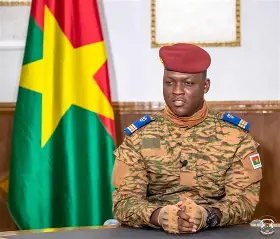
Critics assert that Captain Ibrahim Traoré increasingly appears isolated, presiding over an administration where suspicion has seemingly supplanted trust. This assessment is fueled by pervasive rumors of destabilization attempts, shifts within the military hierarchy, and successive restructurings of the security apparatus. A poignant observation suggests that ‘when a regime begins to fear its own protectors, it safeguards not the nation, but its own shadow.’
The purge of early companions
Political narratives across Africa, mirroring those globally, consistently reveal a pattern: individuals instrumental in facilitating a power seizure often become the initial subjects of suspicion once the new leader solidifies control. Since assuming leadership in September 2022, Ibrahim Traoré has initiated multiple reconfigurations within the military and security command structures. Several influential officers, who were key figures in the initial ascent, have been replaced, reassigned, or removed, prompting queries regarding the true state of cohesion within the armed forces.
The removal of the intelligence services director, a figure deemed pivotal to the security framework, garnered significant notice. Many analysts interpret a head of state’s profound restructuring of the very institutions designed to ensure personal security as a strong indicator of diminishing trust within the inner circle. In essence, when an administration begins to distrust those designated as its protectors, the challenge transcends mere security; it evolves into a political predicament.
The Burkinabè army, once unified by the imperative to combat armed factions, now projects an image of an institution permeated by mistrust. The continuous cycle of promotions, appointments, and replacements reinforces the perception that personal allegiance is increasingly prioritized over operational proficiency.
This trajectory is summarized by various observers as follows:
- 2022: Initial pledge of unity
- ⬇️
- Persistent deterioration of security conditions
- ⬇️
- Extensive reorganization and reshuffling within the high command
- ⬇️
- Escalating distrust and governance under strain
Fear as a mode of governance
In response to ongoing security challenges, the administration appears to have adopted a strategy of political tightening. Critics highlight several alarming developments:
- The detention of individuals vocal in their opposition to the government;
- Documented instances of disappearances or abductions, as reported by human rights advocacy groups;
- A contraction of the media landscape, marked by media outlet suspensions and restrictions placed upon numerous journalists;
- The impressment or conscription of certain civil society figures, viewed by their supporters as retaliatory actions.
These concerns are consistently raised in reports issued by international human rights organizations, which draw attention to the erosion of public freedoms within Burkina Faso.
Furthermore, official communications are heavily centered on the persona of the head of state. State-controlled media and government-aligned communication networks extensively showcase Captain Ibrahim Traoré’s movements, pronouncements, and policy initiatives, fostering among his detractors the perception of an increasing personalization of authority. Critics argue this approach does not signify unchallenged command, but rather an endeavor to offset the regime’s vulnerabilities through stringent information control.
Meanwhile, the security crisis endures
Yet, the paramount concern lies elsewhere. Nearly four years since the transition of power, the fundamental challenges that initially precipitated the coup d’état largely persist. On the ground, state authority remains circumscribed in numerous areas still under the threat or sway of armed factions. The humanitarian crisis also remains deeply alarming, with millions displaced by force and suffering the repercussions of pervasive insecurity. Concurrently, assaults targeting civilians, the Forces de défense et de sécurité (FDS), and the Volontaires pour la défense de la patrie (VDP) continue to be reported with regularity. Ultimately, opponents of the current administration contend that the regime’s political consolidation increasingly dominates governmental efforts, potentially sidelining crucial responses to security and humanitarian imperatives.
Data released over recent years by the Nations unies, humanitarian bodies, and various specialized research centers confirms the enduring depth of the security crisis, notwithstanding ongoing military endeavors. Jihadist incursions continue to impact multiple regions of the nation, and internal displacement figures remain among the highest within the sub-region, particularly notable in the West Africa Sahel.
The risk of isolation
Patriotic rhetoric, however inspiring, proves insufficient to re-establish security in a nation grappling with a multifaceted crisis. Slogans cannot substitute for tangible military achievements, the rebuilding of institutions, or the restoration of trust between the state and its populace. For those critically observing the regime, the primary peril now lies in the gradual isolation of the junta leader. By disassociating himself from former allies, by perpetually restructuring security mechanisms, and by governing within an atmosphere of incessant mistrust, Ibrahim Traoré risks undermining the very foundations of his authority.
The political annals of the continent furnish numerous instances where military regimes progressively consolidated all instruments of power within an increasingly circumscribed inner circle. In many such historical precedents, internal distrust, rather than external opposition, ultimately emerged as the predominant factor of destabilization.
Consequently, the fundamental challenge for Burkina Faso persists unaltered: to durably re-establish security, rebuild confidence within its institutions, and address the aspirations of a populace that continues to bear the human cost of instability. For when an administration expends more effort on thwarting conspiracies than on resolving the crises that legitimized its ascendance, it risks elevating its own political survival to an absolute priority, at the expense of the national interest.