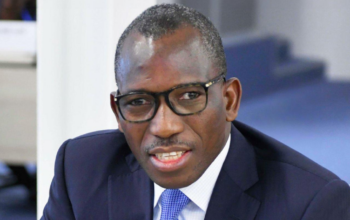
In Senegal, the dynamic between Prime Minister Al Aminou Lo and ruling party leader Ousmane Sonko has become a focal point of political discourse. During a publicly reported address, the head of government delivered a Wolof phrase, « Gatt xèl weessu wul », translating to a call for patience and long-term vision. The remark, directed at Sonko, serves as a subtle yet deliberate pushback in a climate where every statement carries weight.
Public criticism challenges official unity
The Prime Minister’s approach diverges sharply from the typical communication restraint seen in presidential circles. By employing a widely understood proverb, Al Aminou Lo grounds his message in everyday language while directly addressing the most influential figure in the majority coalition. This tactic is far from coincidental—it reflects an assertion of political agency against a party leader whose influence extends far beyond formal roles.
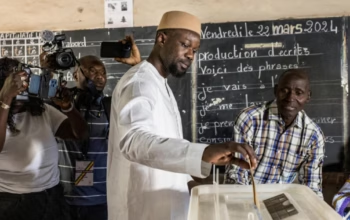
Ousmane Sonko, leader of the Pastef party, remains the driving force behind the 2024 political shift. His statements carry significant weight on economic, diplomatic, and security policies. Any hint of divergence from a government member is immediately interpreted as a political signal. The Prime Minister’s carefully chosen words, rooted in popular wisdom, aim to de-escalate confrontation while subtly asserting a distinct approach to governance.
What Al Aminou Lo’s language reveals about power dynamics
The Wolof proverb used by the Prime Minister embodies a contrast between thoughtful reflection and hasty judgment. In a period marked by pressing issues—from fiscal adjustments to negotiations with international partners—this intervention hints at differing views on policy execution and timing. The technocratic background of Al Aminou Lo, a former senior official at the Central Bank of West African States (BCEAO), contrasts sharply with the more confrontational style of the militant sphere.
This duality lies at the core of the post-2024 government structure. On one side, a party leader known for his disruptive rhetoric and mass appeal; on the other, an executive team navigating the constraints of global markets, the International Monetary Fund, and bilateral lenders. The Prime Minister’s statement may signal a defense of procedural rigor at a time when Senegal’s financial credibility faces scrutiny following revelations of accounting irregularities in public debt.
Market signals and internal power struggles
For investors and diplomatic missions, this public display of divergence carries implications beyond internal party politics. It suggests that Senegal’s government is not a monolithic bloc, with internal checks and balances at play. The stability of economic policies hinges partly on the Prime Minister’s ability to enforce a technical framework, which requires a degree of independence from the majority party’s impulses.
Yet, the power imbalance remains evident. Ousmane Sonko retains direct electoral legitimacy from his militant base and unparalleled influence within state institutions. Al Aminou Lo’s room for maneuver will depend heavily on presidential backing and tangible economic progress—such as improved budget transparency, reduced tensions with foreign partners, or a more favorable business environment. Without visible results, the episode risks deepening rifts within the ruling coalition.
In the short term, this incident reshapes perceptions of power in Dakar. Observers will closely watch the President’s response, as he remains the ultimate arbiter in any dispute between the Prime Minister and the majority leader. The trajectory of this relationship will hinge on whether both figures can publicly align on key priorities; otherwise, the episode may herald a more turbulent phase for the governing alliance.