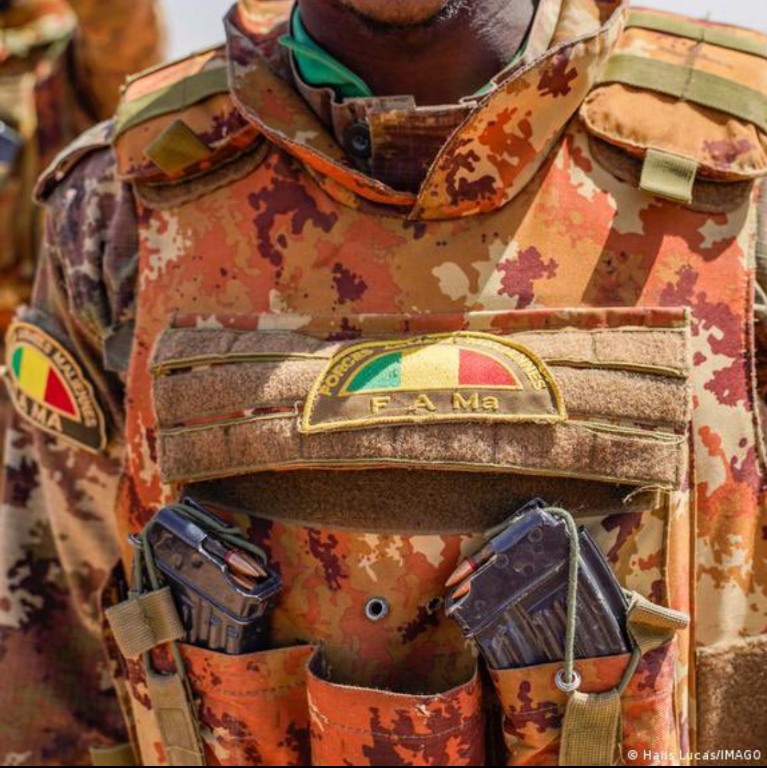
On July 19, the Mopti region in central Mali became the latest battleground in a series of coordinated assaults claimed by the Group for the Support of Islam and Muslims (JNIM), an Al-Qaeda affiliate. The group targeted Malian armed forces (FAMa), Russian mercenaries from Africa Corps, and local self-defense militias in four simultaneous attacks, showcasing its operational reach and resilience. Five years after the coup led by Assimi Goïta, these incidents underscore the widening gap between Bamako’s territorial restoration promises and the harsh security realities on the ground.
Central Mali under siege: a day of coordinated terror
The July 19 offensive highlighted the worsening security crisis in central Mali, where the JNIM executed four distinct assaults with precision. In the Douentza area, three improvised explosive devices (IEDs) detonated along key routes, striking a military convoy, a supply truck, and a motorcycle detachment. These attacks, aimed at both Malian troops and Russian mercenaries from Africa Corps (formerly Wagner Group), demonstrated the group’s ability to disrupt military movements. Meanwhile, near Kansila, fighters launched a direct assault on a Dozo militia unit—a traditional hunter group often mobilized by the government—resulting in three fatalities among the militia members.
Goïta’s regime: statistics that tell a grim story
When Colonel Assimi Goïta seized power in 2019, his junta vowed to reclaim Mali’s entire territory and restore security, blaming democratic forces and Western partners like the Barkhane operation for prior failures. Yet five years later, conflict data reveals a stark contrast. Reports indicate a doubling or tripling in deaths from political violence and terrorist attacks across many provinces compared to the pre-coup era. The conflict has also fragmented further, with the emergence of Africa Corps and targeted assaults on specific communities exacerbating ethnic tensions and fueling jihadist recruitment. Daily IED attacks and ambushes, such as those on July 19, have become routine, crippling major road networks and paralyzing civilian life.
Vanishing state control and silent humanitarian collapse
Despite Bamako’s claims of military progress—including symbolic victories like the retaking of Kidal in late 2023—the reality is far grimmer. Large swathes of northern and central Mali are now lawless zones where state institutions have collapsed. The United Nations reports that over 400,000 Malians are internally displaced, fleeing both jihadist violence and the collateral damage of military operations. Blockades imposed by groups like the JNIM and the Islamic State in the Greater Sahara (EIGS) have plunged entire regions into acute food shortages, as aid deliveries grind to a halt due to unsecured roads.
The humanitarian crisis, once overshadowed by security concerns, has become a silent catastrophe—one where families are trapped between insurgent brutality and the state’s inability to protect them.
Africa Corps: a Russian gamble that backfired
To fill the void left by France’s withdrawal and the UN’s MINUSMA mission, Mali’s junta turned to Moscow, first through Wagner Group and later via Africa Corps, a unit directly tied to Russia’s defense ministry. However, this partnership has yielded little beyond controversy. Russian mercenaries, known for their brutal tactics, face repeated allegations of civilian abuses—such as the notorious Moura massacre—driving locals into the arms of insurgents who position themselves as protectors. Militarily, Africa Corps has failed to curb the jihadist threat, suffering heavy losses and lacking the manpower for effective counterinsurgency across Mali’s vast terrain.
The aerial illusion: drones and helicopters falter under pressure
With ground forces stretched thin, Bamako has heavily invested in air power, purchasing attack helicopters and drones (including Turkish Bayraktar TB2s) to compensate. Initially, these assets enabled large-scale strikes, but their effectiveness is now waning. Maintenance challenges—exacerbated by the high cost and logistical hurdles of Russian spare parts—have grounded several aircraft, including Albatros L-39 jets and Mi-24 helicopters, lost to technical failures or rebel fire. Meanwhile, jihadist groups have adapted, shifting to smaller, dispersed units that exploit vegetation or blend into civilian populations, rendering aerial strikes less precise and more prone to civilian casualties.
A dead-end military-first strategy
The July 19 attacks in Mopti are not isolated incidents but symptoms of a systemic failure. Bamako’s military-only approach has proven unsustainable, alienating regional and international partners while tying the country’s fate to Russian mercenaries who prioritize resource extraction over stabilization. Without a holistic political strategy—one that restores governance, reopens essential services, and protects civilians—the Mali’s territorial integrity will continue to erode under the relentless pressure of a resurgent Sahelian jihadism.