The deepening military cooperation between Madagascar and Russia has raised eyebrows in Washington, where officials warn that replicating Moscow’s Sahel security model could destabilize the Indian Ocean region. Through the lens of a behind-the-scenes analysis, this investigation uncovers the strategic tensions and unspoken risks shaping Antananarivo’s foreign policy choices during a period of global realignment.
The US warning: beyond rhetoric, what’s really driving Washington’s concern
Publicly framed as a cautionary note, the statements by senior US military leadership reveal deeper strategic discomfort. Lieutenant General John Brennan, deputy commander of US Africa Command (AFRICOM), explicitly highlighted during a press briefing on November 10, 2026, that the Russian security model tested across Mali, Burkina Faso, and Niger has failed to deliver long-term stability. Rather than dismissing the partnership between Antananarivo and Moscow as mere geopolitical maneuvering, Washington’s position reflects a calculated assessment of risks tied to regional security architectures and maritime corridors of critical importance.
Why the Sahel precedent looms large in US calculations
The region’s trajectory since 2020—marked by military coups and a pivot toward Moscow—has exposed the limitations of Russia’s security framework. Despite increased military support and the deployment of Africa Corps (successor to Wagner Group operations), jihadist violence persists across vast territories in the Sahel. For US strategists, this underscores a fundamental contradiction: an approach that provides short-term security assistance but ultimately fails to address root causes of instability.
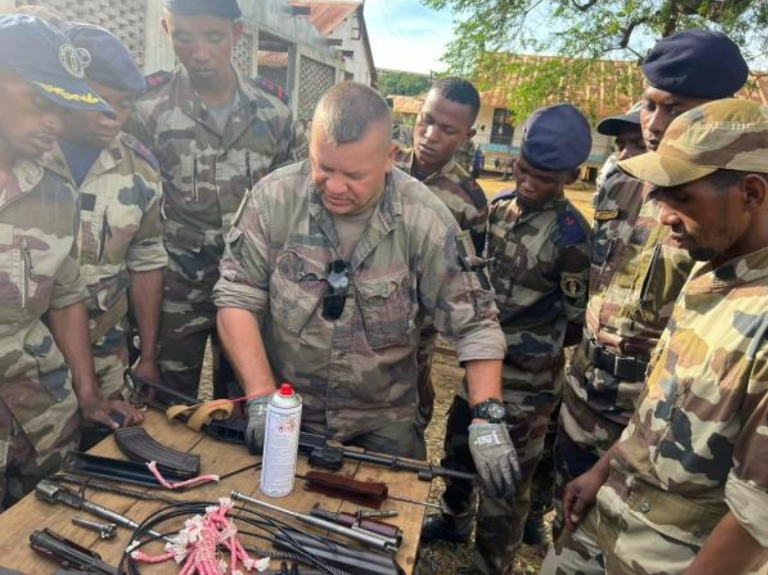
The deployment of Russian military instructors, the transfer of small arms, and logistical support have reshaped local security dynamics. Yet insurgent groups continue to exploit governance vacuums, fueling transnational threats. The US sees Madagascar as a potential test case—one where a similar model could entrench instability across vital maritime trade routes.
The rising Russia-Madagascar alliance: from diplomacy to defense collaboration
Since Colonel Michaël Randrianirina assumed power in 2025, Madagascar has cultivated stronger ties with the Kremlin. Military cooperation has intensified, with deliveries of unmanned aerial vehicles, small arms, and training support from Russian defense personnel. A high-level summit in February 2026 saw Randrianirina meet President Vladimir Putin in Moscow, signaling a new chapter in bilateral relations that spans defense, energy, and infrastructure development.
The momentum culminated at the Russia-Africa Summit in October 2026, where multiple bilateral agreements were signed—including new defense cooperation frameworks. While Moscow positions itself as a partner free from historical colonial baggage, the US interprets this engagement through the prism of power projection: a strategy aimed at consolidating influence beyond Africa’s western flank and into the Indian Ocean basin.
Infrastructure, influence, and the shadow of Wagner’s legacy
The rise of Africa Corps across the Sahel has blurred the lines between state-supported military cooperation and private paramilitary operations. Though officially dissolved, Wagner Group’s operational footprint lingers in the form of personnel and logistics networks. For Madagascar, such engagement carries reputational risks and potential legal exposure under international sanctions. The US has made it clear: while countries retain sovereign choice, participation in Russian-backed security models—especially those historically linked to mercenary groups—could trigger broader geopolitical consequences.
The Indian Ocean: where maritime security meets great-power rivalry
Madagascar’s pivotal location in the Mozambique Channel transforms it into a flashpoint for competing interests. This 460-kilometer-wide maritime corridor channels over 30% of global LNG shipments and is a vital artery for European and Asian trade. The US has repeatedly flagged the growing threat posed by ISIS-affiliated militant factions in northern Mozambique, which have begun adapting tactics to target commercial shipping and onshore energy infrastructure.
In response, Washington has proposed enhanced maritime surveillance partnerships, intelligence-sharing mechanisms, and training programs for local naval forces. The November 2026 AFRICOM visit to Antananarivo was not merely diplomatic—it was a strategic overture aimed at reinforcing US presence in waters where Russian influence is quietly expanding through defense contracts and logistical agreements.
The Mozambique factor: a regional security domino effect
The deteriorating situation in Cabo Delgado, with repeated hostage-seizures and attacks on gas facilities, underscores a broader regional crisis. The US suspects that Russian-backed security contractors—rebranded as Africa Corps—may be contributing to localized stability efforts, but with limited long-term impact. This raises a critical question: if Madagascar follows a similar path, could it inadvertently become a staging ground for militant groups shifting tactics from land-based insurgencies to maritime sabotage?
Antananarivo at the crossroads: sovereignty, security, and the cost of alignment
Despite pressure from Washington, Madagascar is not a passive actor. The government faces a complex calculus: balancing historical ties with Moscow, leveraging new defense partnerships to modernize the armed forces, and preserving strategic autonomy. While no overt sanctions have been threatened, US diplomats have subtly signaled that deeper collaboration with Russian security entities could complicate future engagements with Western financial institutions and development partners.
The real cost may lie not in immediate sanctions but in the erosion of donor confidence. Multilateral lenders like the World Bank and IMF increasingly scrutinize military engagements that involve non-transparent actors. Should Madagascar deepen its reliance on Russian security advisors, it risks limiting access to concessional funding essential for post-pandemic recovery and climate adaptation.
Navigating the power vacuum: lessons from the Sahel’s unresolved equation
The Sahel’s experience offers a cautionary tale. Governments that severed ties with Western partners in favor of Russian security support found themselves trapped in a cycle of dependency. Without addressing underlying drivers—including weak governance, illicit trafficking, and climate-induced migration—the military gains proved temporary. For Madagascar, the risk is clear: a short-term boost in operational capacity could come at the expense of long-term stability and sovereignty.
What comes next: deterrence or dialogue?
For now, US strategy appears focused on deterrence—signaling potential consequences without immediate coercive action. AFRICOM’s engagement in Antananarivo suggests a preference for dialogue over confrontation, but the message is unambiguous: replicating the Sahel model in the Indian Ocean is unacceptable. Whether Madagascar responds with strategic recalibration or solidifies its partnership with Russia may determine the future trajectory of the region’s security architecture.
The stakes go beyond bilateral relations. In a global context where maritime corridors and resource-rich zones increasingly become battlegrounds for influence, Madagascar’s choices will echo across the Indian Ocean—and potentially reshape alliances for years to come.