Niger’s capital, Niamey, is hosting a landmark meeting this week: the first education ministers’ conference for the Alliance of Sahel States (AES). The gathering comes as the region’s education systems face an unprecedented convergence of crises — teacher shortages, school closures due to armed violence, and mass population displacements — threatening the very fabric of sovereignty across three nations.
The two-day opening ceremony, led by Niger’s Prime Minister Ali Mahamane Lamine Zeine and attended by senior officials including the National Council for the Safeguard of the Homeland (CNSP), diplomats, and delegations from Mali and Burkina Faso, signals more than political symbolism. It reflects a quiet but urgent reckoning: can the AES build sovereign education systems when thousands of classrooms stand empty and qualified teachers are in critically short supply?
From classrooms to crumbling systems: why the teacher gap is the hidden engine of the crisis
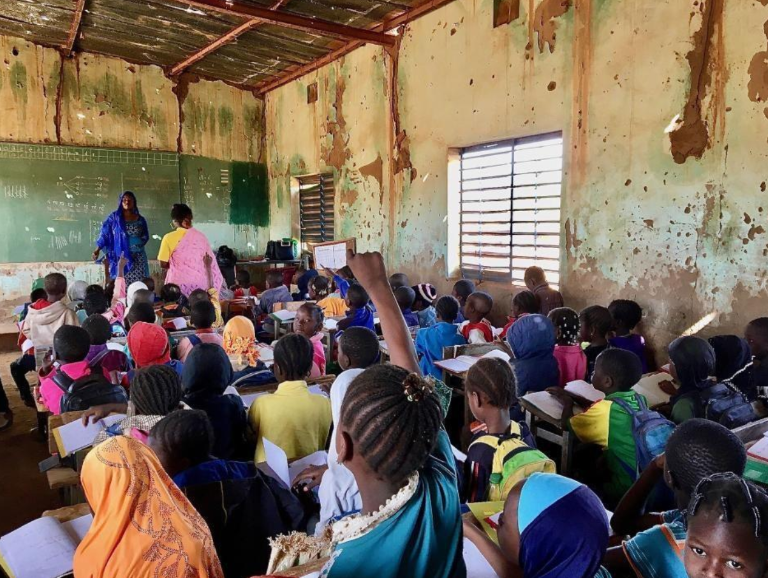
The numbers tell a stark story. In Niger’s 2023–2024 school year, the education ministry reported just 69,636 primary school teachers for over 3 million pupils — an average of 43 students per teacher. The strain is not only numerical. Many instructors lack formal pedagogical training. Minister Élisabeth Shérif acknowledged in mid-2026 that up to 78.5% of public teachers were contract hires, some without any prior teaching credentials at all.
This systemic fragility has roots stretching back years. A 2017 UNESCO assessment found that in Niger, 78.5% of 70,491 public school teachers were classified as contract workers, with a notable proportion operating without teacher training. The result? A system where instruction quality is uneven, morale is low, and teachers are increasingly reluctant to serve in remote or high-risk zones.
The ripple effects are visible across the AES bloc:
- Burkina Faso: Over 5,300 schools closed as of February 2024, displacing 820,000 students and 24,000 teachers.
- Mali: 2,444 schools still non-functional in June 2026, cutting off 733,200 children and 14,604 teachers from learning.
- Niger: By late 2025, 1,097 schools remained shuttered due to insecurity, impacting 93,676 students — nearly half of them girls — with the Tillabéri region alone accounting for 1,032 affected schools.
Violence, displacement, and the silent dismantling of childhood education
School closures are only the most visible symptom. Armed conflict has pushed over 2 million people into internal displacement in Burkina Faso, 414,524 in Mali, and 548,386 in Niger as of 2026. Families fleeing violence abandon homes, livelihoods, and schools alike, often leaving education trajectories broken for years.
In displacement camps, overwhelmed host communities struggle to absorb new students without additional classrooms or trained educators. Children face prolonged absences or permanent dropout, especially girls, who are disproportionately affected by early marriage and labor pressures during displacement.
“Every closed classroom is a generation lost,” noted one regional education official. “We’re not just losing buildings — we’re losing the future of the Sahel.”
Building resilience: what a sovereign school agenda must deliver
The Niamey conference is not just a talk shop. It’s a platform to move beyond declarations and into coordinated action. Key pillars being discussed include:
- Harmonized curricula: Aligning teaching standards across AES countries to ensure mobility and equity.
- Shared teacher training programs: Expanding normal schools and continuous professional development, prioritizing teachers in conflict zones.
- Emergency learning pathways: Accelerated catch-up classes, mobile schools, and digital platforms for displaced children.
- School safety protocols: Reinforcing infrastructure in high-risk areas and deploying rapid response teams to reopen closed schools.
- Diploma recognition: Creating a regional framework to validate learning acquired in temporary or informal settings.
The stakes couldn’t be higher. Niger alone reports nearly five million children still out of school. The AES’s ambition to build a “sovereign school” is not merely aspirational — it is existential. A region’s claim to sovereignty is measured not by declarations, but by whether its children can read, write, and thrive in safe, well-taught classrooms.
Beyond rhetoric: turning policy into classroom reality
As delegates settle into Niamey’s conference halls, the real work begins outside the meeting rooms. Teachers must be recruited, trained, and retained — especially in remote and volatile regions. Schools need to reopen, and children need to be brought back — not in rhetoric, but in daily action.
The AES’s education summit is more than a diplomatic milestone. It’s a test of whether the alliance can transform crisis into capacity — not just on paper, but in the lives of Sahelian children who have known little but disruption. The future of sovereignty, after all, is written in the classrooms of today.