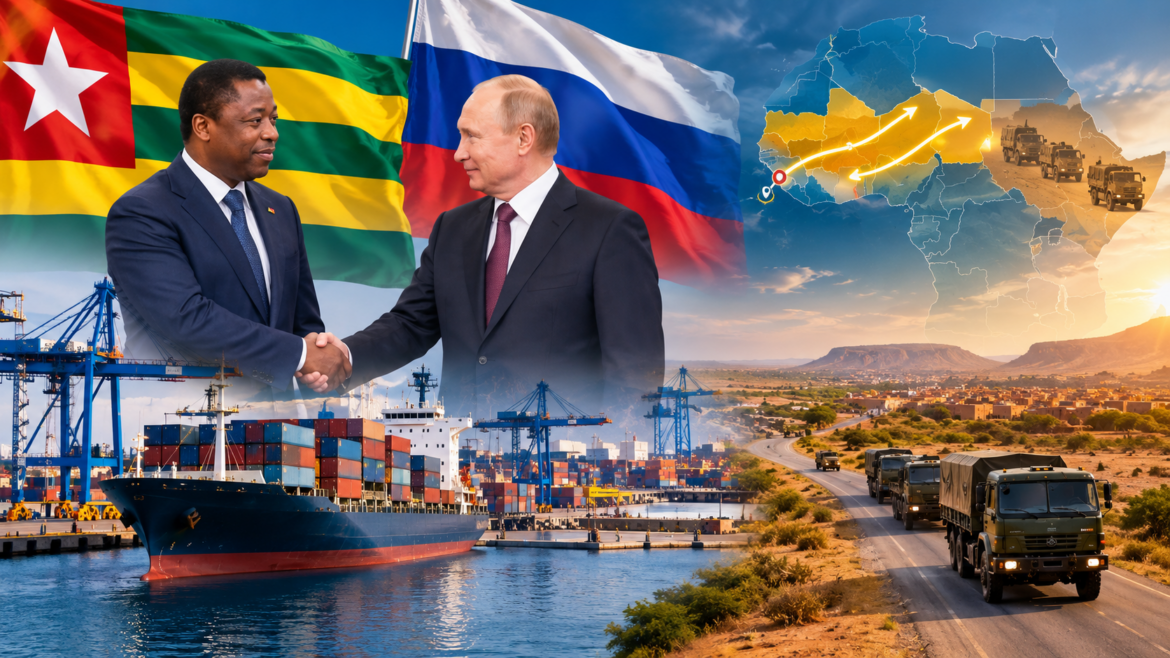
Recent developments between Lomé and Moscow signal a deeper strategic alignment than previously acknowledged. Behind the announced plan to use the Port of Lomé as a transit hub for Russian goods destined for West Africa and the Sahel, a reconfiguration of regional trade, logistics, and geopolitical pathways is unfolding. This shift isn’t merely commercial it reflects a calculated move to embed Togo within a broader logistical framework that connects maritime routes to Sahelian hinterlands.
From diplomacy to operational cooperation
The October 2026 intergovernmental talks in Lomé, led by Russian Deputy Transport Minister Alexei Shilo, marked a turning point. While framed as an economic and logistics initiative, the discussions extended beyond routine trade agreements. A Russian delegation of 29 officials engaged with Togolese counterparts on infrastructure optimization, cost efficiencies, and timing indicators that this corridor is being designed for long-term functionality rather than short-term gains.
Notably, the delegation toured critical Togolese sites: the Autonomous Port of Lomé, Gnassingbé Eyadéma International Airport, and the Adétikopé Industrial Platform (PIA). These facilities are not isolated they form a chain capable of handling cargo from arrival to redistribution, hinting at a system designed for scalability. The inclusion of the PIA, in particular, suggests potential for value-added activities beyond transit, such as storage, manufacturing, or regional redistribution.
The Mikhail Britnev precedent: a glimpse into Russian logistics
The case of the Mikhail Britnev a Russian cargo ship sanctioned by the U.S. since 2024 exemplifies Lomé’s evolving role. On July 9, 2026, the vessel docked in Lomé despite sanctions, before a convoy of military vehicles was later observed en route to Bamako, Mali. Analysis by independent maritime tracking and satellite imagery specialists confirmed the ship’s cargo: troop transport vehicles and armored personnel carriers destined for the Wagner Group’s Africa Corps in Mali, transiting through Togo and Burkina Faso.
This incident reveals three critical insights:
A tested route: The Lomé–Bamako corridor is already operational, linking maritime entry points to Sahelian destinations.
Dual-use infrastructure: While commercial in theory, the port and associated logistics networks can accommodate military logistics without structural changes.
Regional implications: The route bypasses traditional trade paths disrupted by regional geopolitical shifts, such as the closure of the Benin–Niger border, which has shifted transit pressure to Lomé.
Moscow’s broader ambitions: beyond trade, toward logistical influence
Russia’s focus extends beyond simple market access. The Kremlin’s strategy appears to target four interconnected pillars: energy partnerships, transport corridors, industrial investments, and security logistics. High-level engagements, including Faure Gnassingbé’s November 2025 meeting with Vladimir Putin in Moscow, underscore this shift from diplomatic posturing to concrete infrastructure projects.
The framework outlined in the 2025 discussions covering energy, transport, and defense has since materialized into operational plans. This indicates a deliberate effort to position Togo as a regional hub, not just for goods but for logistical control. The presence of Russian military personnel in Togo, as noted in bilateral agreements, further complicates the picture, blurring the line between economic cooperation and security partnerships.
Togo as a geopolitical lever in West Africa
For Togo, the stakes are high. The country sits at a crossroads: its stable governance, strategic port, and expanding industrial zones offer Moscow a reliable foothold in West Africa. Yet, this alignment carries risks. By hosting Russian military assets and facilitating cargo flows to conflict zones, Lomé could become entangled in regional disputes or face international scrutiny over sanctions violations.
The Adétikopé Industrial Platform’s inclusion in Russian assessments highlights another dimension economic integration. If Russian companies invest in local processing or storage, Togo could evolve from a transit point into a value-added intermediary, reshaping its role in regional trade. However, this would require balancing foreign strategic interests with domestic economic priorities, a challenge compounded by Togo’s non-aligned status and the fluid alliances in the Sahel.
The strategic calculus: who benefits and who controls?
The competition for West African corridors is intensifying. With Benin’s border closure disrupting traditional routes, ports like Lomé, Dakar, and Abidjan are vying for dominance. Russia’s entry adds a new variable: a corridor that merges commercial, logistical, and potential military advantages. The question is no longer which port will handle Russian goods, but which states will dictate the terms of access.
Lomé’s advantages are clear: deep-water port capacity, rail and road links to the Sahel, and a government amenable to foreign infrastructure investments. Yet, the Mikhail Britnev case demonstrates that logistical routes can be repurposed quickly. The challenge for African nations is to ensure these corridors serve broader regional development rather than becoming tools for external powers.
What’s next for the Lomé–Sahel corridor?
As of now, no definitive timeline has been set for the full implementation of the corridor. However, the trajectory is clear: Togo is transitioning from a diplomatic partner to an operational node in Russia’s African strategy. The interplay between economic incentives, infrastructure development, and security cooperation will determine whether Lomé becomes a neutral transit hub or a contested strategic asset.
One thing is certain: in a Sahel where alliances are increasingly fluid, the Port of Lomé is poised to play a pivotal and potentially decisive role in shaping the region’s economic and logistical future.
By Claire Mvondo — Journalist