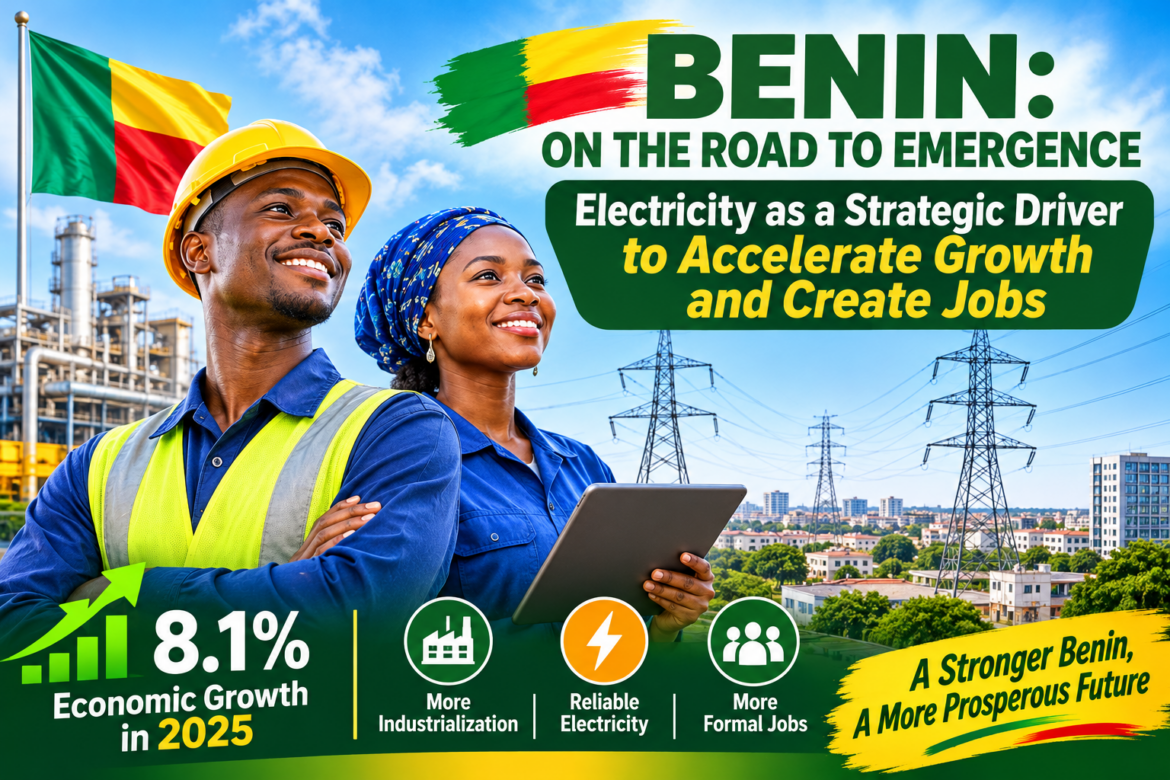
With a robust 8.1% economic growth in 2025, Benin stands out as one of West Africa’s fastest-growing economies. Over the past five years, the country has averaged 7.1% annual growth, driven by significant investments in infrastructure, industrialization, and economic modernization. Yet beneath these positive indicators lies a persistent challenge: the growth engine has failed to translate into meaningful job creation.
This disconnect between economic expansion and employment opportunities was highlighted in a recent economic outlook report. Despite the country’s strong performance, 96.3% of workers remained in the informal sector in 2022, with 80% of new jobs created being self-employment roles. By 2024, only 19.8% of workers held salaried positions a figure that drops to just 9% among young adults. These statistics reveal a critical issue: Benin’s growth is not yet producing stable, high-productivity jobs, particularly for its youth.
The invisible cost of unreliable electricity
The paradox is stark while Benin’s economy expands, the lack of reliable electricity undermines the very foundation of job creation and industrial growth. Nearly half of businesses cite electricity access as a major operational hurdle, and 86.1% report frequent power outages. These disruptions have tangible consequences: production halts, lost raw materials, delayed orders, and increased costs from reliance on expensive backup generators.
Technical failures exacerbate the problem. In 2024, power losses on the national grid reached 24.7%, while half of transmission lines and substations were over 25 years old. Supply constraints, including limited natural gas availability, force many industries to rely on expensive heavy fuel oil, further squeezing profit margins and competitiveness.
The energy crisis is not merely a production issue it is a systemic constraint on economic transformation. For small workshops, agricultural processors, and young entrepreneurs, unreliable power is not just an inconvenience; it is a barrier to scaling up, hiring staff, and competing in regional markets.
Industrial zones as job engines with limits
Despite these challenges, targeted industrial projects are proving that high-growth sectors can create meaningful employment. The Glo-Djigbé Industrial Zone (GDIZ), for example, employed 22,798 workers in 2025 a 28.8% increase from the previous year. The zone’s expansion in textiles, agro-processing, and manufacturing demonstrates that industrialization can be a catalyst for formal job creation.
However, the potential of such zones is constrained by the broader energy deficit. Expanding industrial output requires not just more power, but more reliable, affordable, and accessible electricity. Without this, even the most promising industrial initiatives risk underperforming, leaving a significant portion of the workforce in precarious, low-productivity employment.
The Mission 300 initiative: a pathway to change
Recognizing the centrality of energy to economic transformation, Benin has partnered with development institutions to launch the Mission 300 initiative a program aimed at connecting 300 million additional Africans to reliable electricity by 2030. The country’s associated energy pact focuses on three key areas: expanding generation capacity, modernizing transmission and distribution networks, and mobilizing private investment.
Several projects are already underway, including four solar plants in Natitingou, Djougou, Bohicon, and Parakou, with a combined capacity of 50 MW. A new 128 MW thermal plant in Onigbolo is also in development, designed to diversify the energy mix and reduce reliance on volatile fuel sources. These efforts are part of a broader strategy to double down on renewable and hybrid solutions while strengthening grid stability.
The ultimate goal? To unlock the potential for 159,000 new or improved jobs by 2030. These opportunities span manufacturing, agro-processing, and small business growth sectors where reliable electricity is not just a utility, but a foundation for scalability and innovation.
From potential to reality: the governance test
Yet ambition alone will not suffice. The success of Benin’s energy and industrial strategy depends on overcoming long-standing structural hurdles. Reducing technical and commercial power losses, accelerating grid modernization, securing competitive energy inputs, and streamlining business registration processes are all critical steps. Equally important is ensuring that small and medium-sized enterprises not just large industrial players can access the benefits of a more stable grid.
For young entrepreneurs, electricity reliability means more than just keeping the lights on it means the difference between surviving as a micro-business and growing into a sustainable employer. For agricultural processors, it means minimizing waste and meeting export deadlines. For industrial zones, it means unlocking economies of scale and attracting foreign investment.
The challenge now is clear: Benin’s future prosperity hinges not only on maintaining economic growth, but on converting that growth into tangible opportunities jobs that pay, industries that compete, and a workforce that can thrive in a modern economy. The energy deficit is not just an infrastructure problem; it is a barrier to inclusive development. Closing that gap is the next frontier in Benin’s economic odyssey.
Key indicators to watch
Employment quality: Track the share of salaried jobs, especially among youth.
Energy reliability: Monitor power outage frequency and total grid losses.
Industrial output: Assess productivity gains in sectors like textiles and agro-processing.
Investment diversification: Evaluate the rise of small and medium-sized enterprises in energy-intensive industries.
What success looks like
A future where Benin’s GDP growth aligns with job creation, where factories run without fear of blackouts, and where young graduates can find stable employment beyond informal trade. This is not just an energy transition it is an economic transformation in the making.
By Claire Mvondo — Journalist