The unearthing of an expansive, covert oil processing facility in Nigeria’s Ogun State has peeled back another layer of the country’s longstanding struggle to govern its hydrocarbon wealth. Behind the dramatic discovery of this illegal refinery—operated by foreign nationals—lies a web of systemic gaps, unregulated supply chains, and weakened oversight mechanisms that have allowed illicit activity to thrive.
Beneath the surface: what the illegal refinery reveals about Nigeria’s oil governance
What began as a routine raid by Nigeria’s Economic and Financial Crimes Commission (EFCC) in the Ogere area of Ogun State soon escalated into an investigation exposing a well-organised black-market oil refining network. This clandestine operation did not emerge in isolation; it is the latest symptom of deeper structural weaknesses in Nigeria’s oil sector governance.
Unlike legitimate refineries subject to rigorous environmental and operational standards, this facility operated under total darkness—literally and figuratively. Investigators found no operational staff on site during the raid, suggesting a sophisticated command-and-control system that allowed operators to vanish at a moment’s notice, leaving behind only the footprint of industrial activity.
The anatomy of a hidden operation
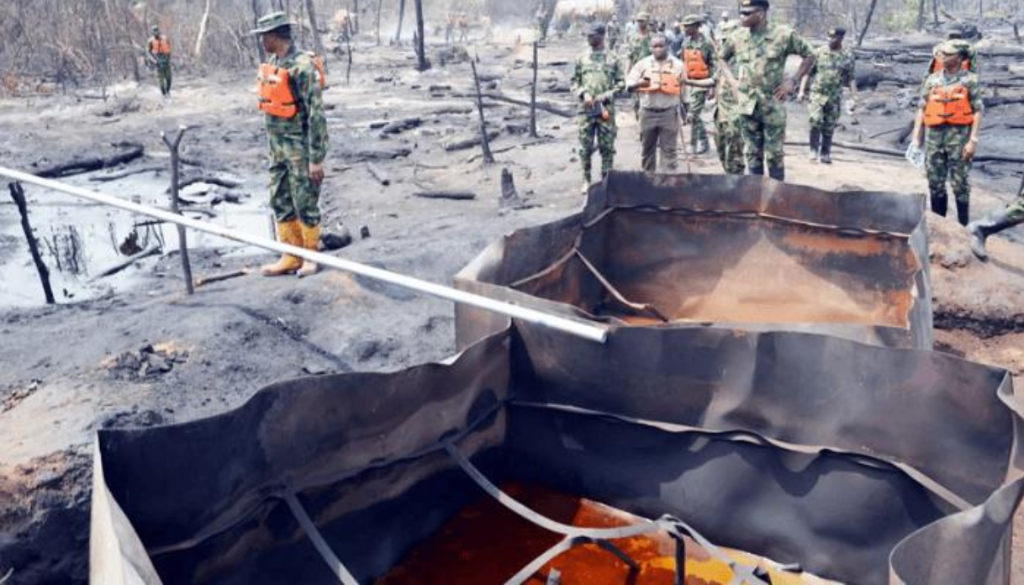
The facility, sprawling over three hectares, was equipped with underground storage tanks, heat exchangers, separation units, and cooling systems—indicative of a level of technical sophistication rarely associated with artisanal refining. One storage tank alone held an estimated 90,000 litres of feedstock, confirming the scale of illegal processing occurring within the state’s borders.
The contraband raw material—known locally as “black sludge”—was reportedly transported from major oil hubs in Warri (Delta State) and Port Harcourt (Rivers State), over distances exceeding 400 kilometres. This long-distance supply chain implies coordination across multiple intermediaries, logistics providers, and possibly local facilitators—each playing a role in sustaining the illicit trade.
An unregulated market thrives in the shadows
Unauthorised refining does not operate in a vacuum. It relies on porous borders, weak regulatory enforcement, and gaps in supply chain visibility. Of particular concern is the procurement of feedstock: where did the thousands of litres of “black sludge” originate? Through which channels was it purchased? And who benefited from the final sale of the refined product, often labelled as automotive gas oil (AGO) in Nigerian markets?
The absence of binding oversight—whether in transit, storage, or end-use—enables such networks to persist. Without robust tracking systems or mandatory certification, it becomes nearly impossible for authorities to trace fuel from source to pump, leaving consumers vulnerable to substandard, potentially hazardous products.
The ripple effect: environmental and economic fallout
The consequences of such illegal refining extend far beyond economic loss. Environmentally, the uncontrolled heating and separation of heavy crude residues release toxic fumes, contaminate soil, and jeopardise groundwater resources in surrounding communities.
Industrially, the lack of safety protocols increases the risk of fire, explosions, and exposure to carcinogenic compounds. Health studies have linked proximity to informal refineries to respiratory illnesses, skin disorders, and long-term ecological damage.
Economically, Nigeria’s federal and state governments forfeit critical tax revenue and royalties that could fund infrastructure, education, and public health. Proceeds from illegal refining also distort the market by undercutting legitimate fuel distributors who comply with regulation—eroding fair competition and investor confidence.
Foreign involvement: interpreting the narrative without bias
The revelation that foreign nationals—alleged to be Chinese—were involved in this operation has reignited broader questions about the role of international actors in Nigeria’s resource sectors. While China remains one of Africa’s largest trading partners, with significant investments in mining, infrastructure, and manufacturing, this case cannot be conflated with an official policy stance from Beijing.
Independent investigations have not uncovered evidence linking this clandestine refinery to a state-backed entity. Rather, it underscores a shared challenge: the transnational nature of illicit trade demands stronger international cooperation in tracking financial flows, preventing technology transfers to unauthorised actors, and harmonising regulatory standards across borders.
The focus, for Nigerian authorities, must remain on strengthening domestic enforcement—not on attributing blame based on nationality. A robust legal framework must apply equally to all actors, regardless of origin.
Beyond the raid: what Nigeria must do to reclaim control
Dismantling this illegal refinery is only the beginning. To prevent recurrence, Nigeria needs a multi-layered response that addresses the root causes of clandestine refining.
- Enhanced surveillance: utilise satellite monitoring, aerial patrols, and real-time fuel tracking in high-risk zones to detect illicit activity early.
- Strengthened penalties: impose stricter penalties for illegal refining, including asset forfeiture, corporate sanctions, and lifetime bans for repeat offenders.
- Local community engagement: educate residents on the dangers of illegal refining and incentivise reporting of suspicious behaviour.
- Cross-agency coordination: foster collaboration between the EFCC, Nigerian National Petroleum Corporation (NNPC), Nigeria Customs, and state environmental agencies to close enforcement gaps.
- Alternative livelihoods: invest in vocational training and micro-enterprise programmes for communities historically dependent on artisanal refining.
Ultimately, the discovery in Ogun State is not just about one illegal facility. It is a mirror reflecting Nigeria’s broader challenge: to transform its vast natural endowment into sustainable, inclusive wealth. Without decisive action, the black market will continue to erode the country’s sovereignty, environment, and economic potential.
Conclusion: from clandestine refinery to national reckoning
Nigeria stands at a crossroads. The existence of a large-scale, foreign-linked illegal refinery—operating undetected for months—exposes not only the ingenuity of black-market operators but also the fragility of state control over its most strategic resource. Addressing this crisis demands more than enforcement. It requires a cultural shift toward accountability, transparency, and long-term strategic foresight.
In Ogun State and across the Niger Delta, the real battle is not against China or any single foreign actor—it is against the systemic failures that allow illicit wealth extraction to flourish. Until these weaknesses are confronted, Nigeria’s oil may continue to flow—but not where the nation needs it most.