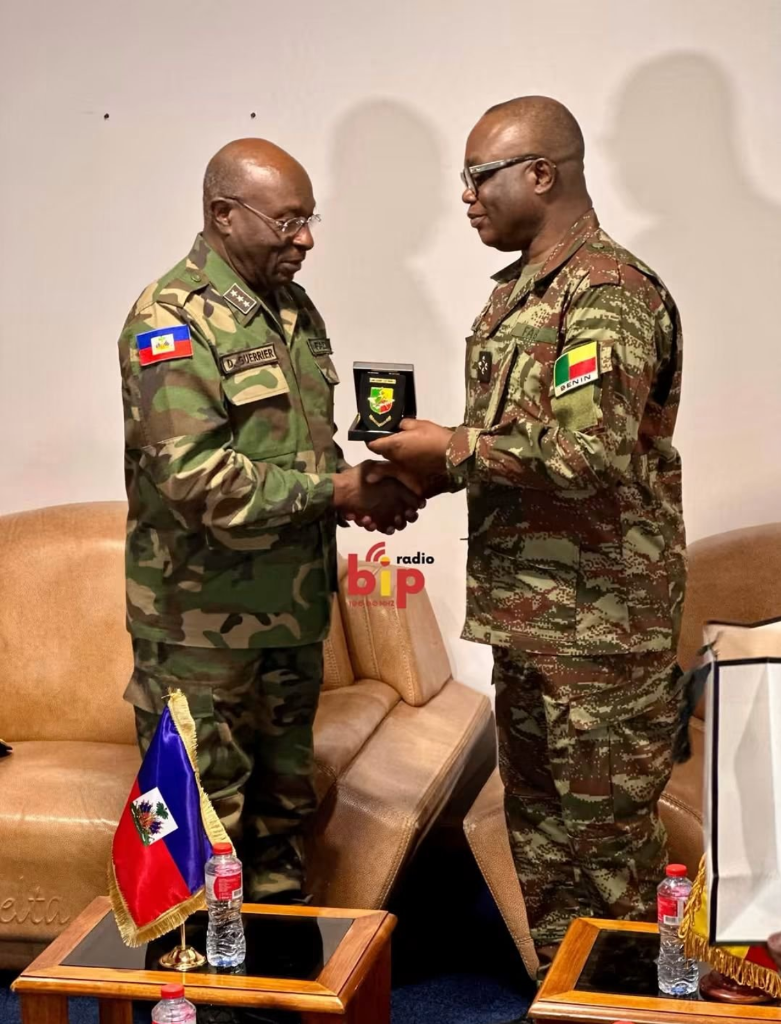
The question now on many military analysts’ minds is whether the current dialogue between Haiti and Benin signals a turning point in regional security dynamics. The official visit of Haiti’s top military leader, Lieutenant-General Derby Guerrier, to Cotonou on November 3, 2026, arrives at a critical juncture—one where Haiti’s persistent security crisis intersects with Benin’s declared willingness to engage in multilateral stabilization efforts.
Behind closed doors: what’s driving this military summit in Cotonou
The encounter at the Beninese Armed Forces’ headquarters between Lieutenant-General Derby Guerrier and Chief of Staff General Fructueux Gbaguidi was far from a routine diplomatic protocol. It followed months of internal deliberations in both countries, particularly regarding Haiti’s escalating violence and Benin’s earlier pledge to contribute to UN-backed security missions.
Since early 2024, Benin has maintained a high-profile commitment to supporting Haiti’s security—offering 1,500 troops, potentially expanding to 2,000—under the United Nations Multinational Security Support Mission (MSS). But implementation stalled due to unresolved operational and strategic concerns, particularly around command structure and funding.
Why the 2024 offer didn’t lead to deployment
The proposed Beninese contingent was meant to operate under Kenyan-led command within the MSS framework. However, Beninese authorities raised critical concerns: the absence of a military chain of command in a mission under police leadership, ambiguities in operational oversight, and questions over long-term financial sustainability. These unresolved issues temporarily shelved the deployment plan.
Now, as General Guerrier arrives in Cotonou, both nations are revisiting those very same questions—not from scratch, but with the benefit of two years of global security evolution and regional military reforms.
What’s on the table: exchange of expertise and strategic alignment
The focus of the talks has shifted beyond Haiti’s immediate crisis. Today’s discussions are centered on mutual learning and institutional strengthening. Benin brings hard-earned experience in countering jihadist expansion across its northern regions—a threat landscape growing increasingly similar to Haiti’s urban gang violence.
Key areas of cooperation under review include:
- Military training and doctrine: Benin’s rigorous counter-insurgency programs among the highest-ranked in West Africa, particularly in urban terrain operations.
- Intelligence and surveillance: Benin’s deployment of drone and satellite-based monitoring systems in the Sahel, a model Haiti may seek to adapt.
- Logistical capacity and rapid response: lessons in mobilizing reserves and sustaining frontline units during prolonged crises.
- Civil-military coordination: strategies for safeguarding civilian leadership and preventing mission drift during foreign interventions.
From promise to practice: what’s next for Haiti-Benin military collaboration
Despite the historic 2024 offer, no formal decision to deploy has been announced following this meeting. No communiqué or joint statement has confirmed troop movement or a revised command structure. Yet, the symbolic value of the visit remains significant—it signals a recognition that Haiti’s security crisis demands fresh solutions.
A Beninese defense official close to the talks noted the shift: “This is no longer about whether we can help. It’s about how we can help effectively, within a framework that respects both our operational realities and Haiti’s sovereignty.”
The role of regional South-South solidarity
Haiti’s centuries-long ties to Africa—rooted in shared African heritage and Francophone identity—are now being leveraged diplomatically. Benin, positioned as a neutral but engaged voice in West African security architecture, offers a bridge between Haitian needs and African military expertise.
For Haiti, this partnership could mean access to battle-tested tactics without the geopolitical entanglements of Western-led missions. For Benin, it reinforces its leadership role in regional security networks outside the traditional francophone bloc.
The bottom line: will this visit change Haiti’s security landscape?
The true measure of this trip won’t be found in headlines or press releases. It will emerge in the implementation of tangible agreements: joint training modules, shared logistics support, or even a phased deployment under revised operational terms.
What is clear is that the dialogue has moved from possibility to credibility. The presence of Haiti’s top military leader in Cotonou reflects a rare convergence of intent: a crisis-stricken nation looking outward, and a capable African military state redefining its global role. Whether that results in boots on the ground remains uncertain. But the foundations for cooperation are being laid—one negotiation, one strategy session, and one carefully calibrated trust-building step at a time.