The political fractures within Senegal’s ruling coalition are no longer theoretical—they are reshaping the country’s institutional landscape. Behind the routine vote on Tuesday, November 3, 2024, lay a fundamental realignment of power: the National Assembly’s rejection of the 2026 supplementary budget law exposed not just a policy dispute, but the collapse of automatic executive support within the very party that brought it to power.
From shared struggle to institutional standoff
President Bassirou Diomaye Faye leads the executive branch, while former prime minister Ousmane Sonko, now Speaker of the National Assembly, presides over the ruling Pastef party’s parliamentary majority. Once united in opposition, their visions have diverged sharply since Sonko left office in May 2024, creating an unprecedented dynamic: a government facing a parliamentary bloc that shares its origins but no longer its priorities.
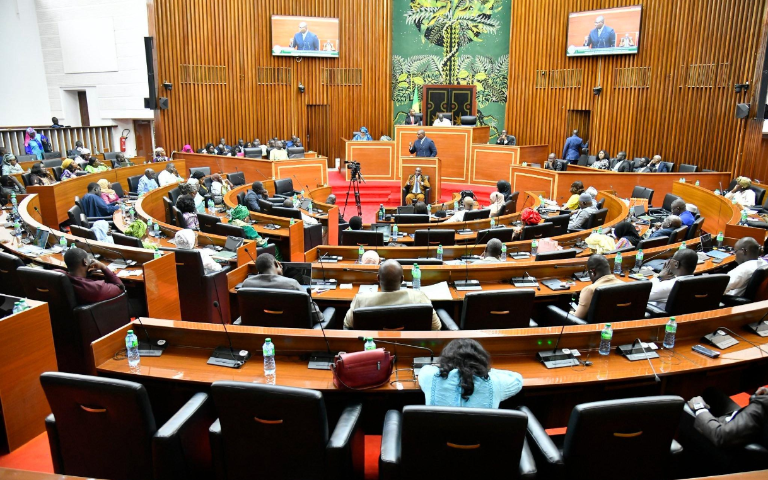
The November 3 vote—109 in favor of rejecting the bill, 20 against, and 3 abstentions—was triggered by a procedural motion introduced by Pastef lawmaker Amadou Ba, effectively ending debate before substantive discussion could begin. This procedural defeat underscores a deeper strategic shift: where once there was discipline, now there is scrutiny.
The budget as battleground: numbers behind the conflict
The supplementary budget framework sought to adjust projected revenues downward from 6,188.8 billion CFA francs to 5,848.7 billion, while increasing expenditures to 7,583.9 billion, widening the fiscal deficit to 7.6% of GDP from an initial 5.4%. Among the most contentious cuts was a 555 billion CFA franc reduction in investment credits—funds earmarked for critical infrastructure projects across energy, transportation, and social services.
Pastef lawmakers argue the government’s fiscal assumptions lack transparency, particularly regarding energy subsidies and social safety net allocations. The Ministry of Economy and Finance, led by Cheikh Diba, maintains it met all parliamentary information requests, including a late-October communiqué asserting compliance with legislative demands on family security bursaries and energy support mechanisms.
At its core: two competing interpretations of fiscal responsibility. The executive insists on rapid adjustments to changing economic conditions. Parliament insists on exercising oversight over how public funds are allocated—even when those funds originate from their own political movement.
Economic ripple effects beyond the assembly floor
The implications extend far beyond parliamentary walls. Senegal remains engaged in negotiations with the International Monetary Fund for a new financing program, and the approval of a revised budget law was viewed as a prerequisite for maintaining credibility with international creditors—especially amid concerns over public debt sustainability and macroeconomic stability.
A delayed or altered budget pathway risks undermining investor confidence, complicating foreign exchange access, and delaying disbursements for critical social and infrastructure programs. Domestic liquidity strains could further delay payments to contractors, suppliers, and key service providers, creating bottlenecks in construction, healthcare, and energy sectors already operating under tight margins.
A de facto cohabitation without the legal framework
Senegal is edging into uncharted constitutional territory. While not a formal cohabitation—the president retains full authority over the government—the National Assembly’s refusal to endorse the budget represents a functional cohabitation: a head of state governing with a majority that no longer offers blind support, even on flagship economic initiatives.
This raises a critical question: how far can the rupture within a single political movement extend before institutional paralysis sets in? With no clear consensus emerging, the government must now navigate alternative legislative paths—possibly through constitutional amendments, special sessions, or targeted amendments to regain parliamentary trust—while Pastef legislators show no sign of softening their oversight demands.
The political cost of institutional gridlock
More than a budgetary failure, the November 3 vote signals a political inflection point. It is not merely a clash between two individuals—it is the institutionalization of a new power balance within the ruling coalition. The rejection of the LFR 2026 is not an isolated event; it is a symptom of a deeper reconfiguration in Senegal’s political architecture, where shared history no longer guarantees shared governance.
As fiscal uncertainty lingers and institutional trust erodes, the real stakes become clear: the ability of the Senegalese state to finance its priorities, sustain public trust, and uphold democratic stability in the face of growing internal division.
One fact is undeniable: the 2026 supplemental budget vote has rewritten the rules of engagement between Faye and Sonko—and with it, the future of Senegalese governance.