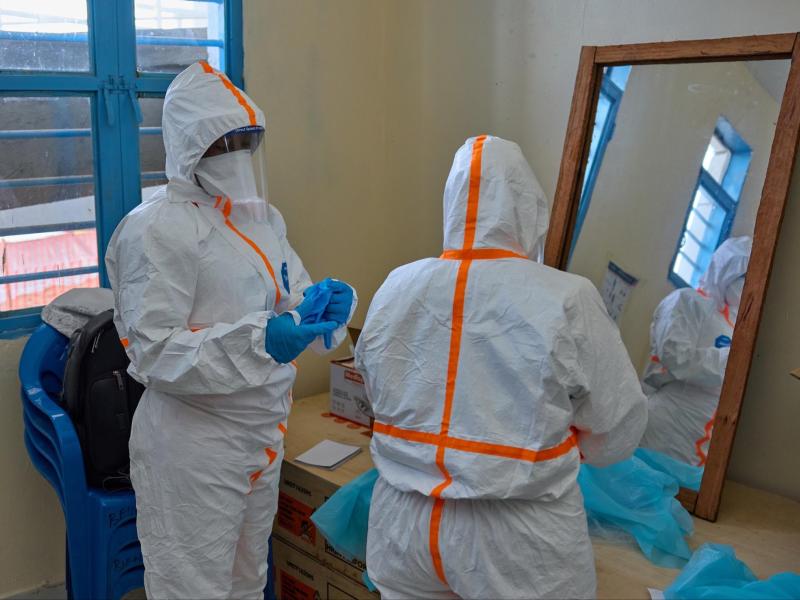
Five weeks after it was declared, the Bundibugyo Ebola epidemic in the Democratic Republic of Congo remains uncontrolled. Although the response has undeniably intensified, it still struggles to gain the upper hand against a virus that continues to spread, cross borders, and claim lives.
Scaling up is not enough
Real efforts have been made. Patient bed capacity has soared from fewer than 10 to over 500 across 19 health centers in affected areas. Testing has followed a similar trajectory: from 30 daily tests at the outbreak’s start, the DRC can now perform more than 2,000 per day in nine laboratories spanning three provinces. More than 100 recoveries have also been recorded, a reminder that early care can be the difference between life and death.
Yet the overall toll remains heavy: 1,094 confirmed cases and 277 deaths to date. According to WHO Director-General Tedros Adhanom Ghebreyesus, the epidemic continues to outpace the response. Contact tracing is insufficient, isolation capacity still falls short of needs, and safe burials remain a daily challenge in communities that are often distrustful or hard to reach.
A virus that knows no borders
The epidemic has now spilled well beyond the Congolese provinces of Ituri, North Kivu, and South Kivu. Neighboring Uganda has 20 confirmed cases and two deaths, all linked to the Congolese strain. Even more worrying, France reported its first case on European soil this Wednesday: a humanitarian doctor from the NGO ALIMA, returning from a mission in the DRC, tested positive for the Bundibugyo Ebola virus. He is being treated in a specialized facility and is in stable condition. An epidemiological investigation is underway to identify and monitor his contacts.
This case is a stark reminder of the price paid by frontline healthcare workers. Nearly 80 health workers have been infected since the crisis began, prompting the WHO to urge states to guarantee secure deployment conditions for their humanitarian personnel, including the possibility of rapid medical evacuation in the event of contamination.
Response hampered, funding insufficient
Beyond health obstacles, the response faces structural constraints that complicate every intervention. Border closures impede the movement of teams and equipment. Security incidents are multiplying in a region plagued by decades of armed conflict. And funding is slow to materialize, even though the WHO and Africa CDC have launched a continental plan costing $518 million.
However, there is a glimmer of hope: a clinical trial evaluating two antivirals, MBP134 and remdesivir, is set to start next week in the DRC. Led by a consortium including the Congolese National Institute for Biomedical Research, the NGO ALIMA, the University of Oxford, and the WHO, and supported by donations from the United States and Gilead Sciences, this trial could mark a decisive turning point in the fight against an epidemic that, five weeks after its onset, is far from contained.
You may also like
Can Ibrahim Traoré’s 300 armored vehicles claim survive scrutiny? Inside Faso Armored’s made-in-Burkina Faso gamble
Can Washington force third-country deportations? Ivory Coast’s refusal raises the stakes
Will Benin’s AEO exporters finally crack the Chinese market?
Northern Niger’s unanswered question: can Tiani’s government deliver water and power where it matters most?
Can Air Sénégal survive the Interpol smuggling probe? The stakes for crew, passengers and the airline’s future