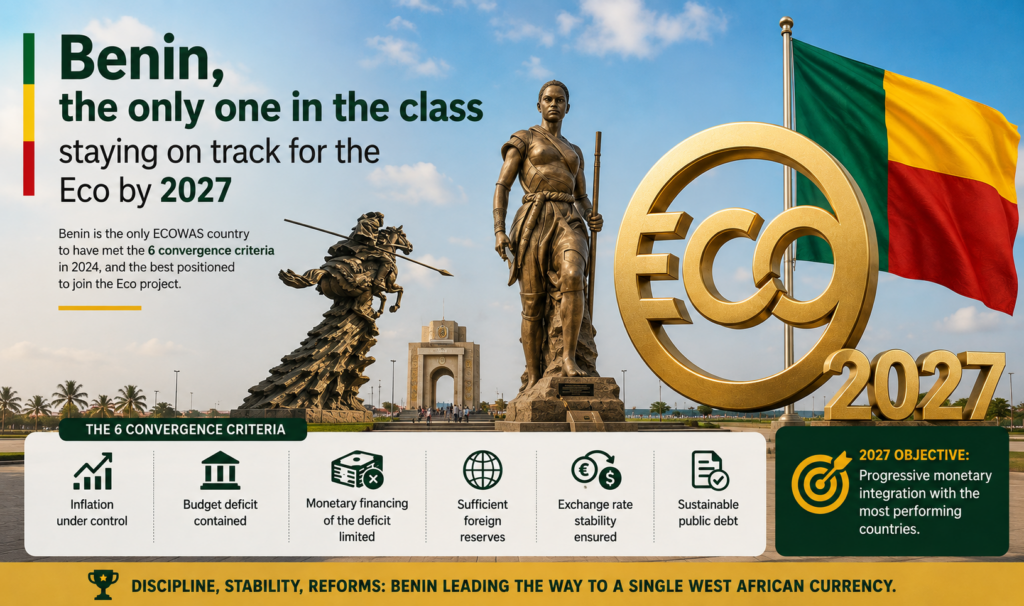
The Economic Community of West African States (ECOWAS) remains committed to launching the Eco by 2027, yet the diverse economic realities across member states suggest that not all countries will progress at the same pace. In this evolving landscape, Bénin stands out as one of the most promising candidates for inclusion in the initial phase of monetary integration.
The concept of a unified West African currency has long been a cornerstone of ECOWAS’s economic integration agenda. However, the path to this goal is fraught with challenges, including inflation, public deficits, debt levels, foreign reserves, monetary stability, and disparities between national economies. Against this backdrop, 2027 may mark the beginning of a phased approach, where the most prepared countries join first while others continue working toward convergence.
Bénin’s strong macroeconomic foundation
Bénin has distinguished itself as a regional leader in macroeconomic convergence. In 2024, it became the only ECOWAS member to meet all six convergence criteria established for monetary integration. This achievement is particularly significant because these criteria encompass multiple dimensions of economic stability, including inflation control, budgetary discipline, monetary financing limits, foreign reserve adequacy, exchange rate stability, and sustainable debt levels.
The simultaneous fulfillment of these benchmarks reflects a coherent and disciplined economic policy framework. For Cotonou, this is not merely a matter of short-term performance but the result of sustained efforts to build a credible foundation for future monetary union participation.
The six convergence criteria and their role
The convergence criteria serve as the technical backbone of the Eco project, designed to prevent a common currency from being undermined by divergent national economic policies. Key indicators include:
Inflation control: Keeping price increases within sustainable limits to preserve purchasing power and monetary stability.
Budgetary deficit management: Ensuring public spending adheres to regional fiscal rules.
Limits on monetary financing: Preventing excessive money supply growth to finance government deficits.
Adequate foreign reserves: Maintaining reserves sufficient to cover multiple months of imports.
Nominal exchange rate stability: A prerequisite for credible monetary integration.
Sustainable public debt: Keeping debt levels within manageable thresholds.
These standards aim to establish a minimum level of economic discipline before adopting a shared currency. Without such alignment, an economic union risks collapse if some member states accumulate severe imbalances while others maintain fiscal rigor.
A deliberate path to economic stability
Bénin’s convergence success follows years of deliberate economic and fiscal reforms. The country has prioritized revenue mobilization, improved public financial management, and maintained high levels of investment in infrastructure and essential services. However, achieving this balance required difficult trade-offs, particularly in sustaining fiscal discipline amid competing priorities such as social programs and infrastructure development.
The next critical challenge for Cotonou will be to transform this one-time achievement into a lasting trend. While meeting the criteria in a single year sends a positive signal, consistent compliance over multiple years would significantly bolster the country’s credibility in the Eco framework.
Uneven progress and the reality of phased adoption
The primary obstacle to a uniform launch of the Eco lies in the economic heterogeneity among ECOWAS members. Differences in debt burdens, fiscal flexibility, inflation rates, and public finance conditions are compounded by security crises, geopolitical tensions, and disruptions in regional trade. Under these circumstances, a staggered implementation where only the most prepared countries proceed first may prove more viable than a synchronized transition across all states.
Rather than mandating that all members adopt the Eco simultaneously, the approach could prioritize those that meet the convergence criteria, allowing them to take the lead. In this scenario, Bénin is well-positioned to be among the first to integrate.
The strategic implications of early inclusion
Should the phased approach materialize and Bénin maintain its macroeconomic performance, the country could gain a strategic advantage in regional economic discussions. Adopting a common currency extends beyond currency exchange it demands closer coordination in fiscal, financial, and economic policies. For Cotonou, being among the first compliant countries could enhance its economic attractiveness, financial credibility, and trade integration potential.
Yet, the road to 2027 remains uncertain. The timeline depends not only on economic performance but also on collective political decisions by member states. Key considerations include the governance structure of the future currency, the role of regional institutions, monetary policy frameworks, and mechanisms for fiscal solidarity among states. The withdrawal of several countries from the ECOWAS bloc particularly those in the Sahel Alliance further complicates the regional integration landscape, reshaping the conditions under which the Eco was originally envisioned.
Consolidating an advantage through sustained reforms
Bénin’s current lead in meeting convergence criteria is a significant achievement, but it is not a guarantee of future success. The country must now focus on preserving macroeconomic stability, managing debt levels, controlling inflation, and advancing structural reforms all while sustaining the investments required for development.
As 2027 approaches, the real test will not be whether Bénin is the first to meet the criteria but whether it can maintain its position at the forefront when the Eco transitions from a political vision to an economic reality. If the currency is introduced in phases, Cotonou could emerge as a frontrunner, having already overcome many of the technical hurdles necessary for West African monetary integration.
You may also like
Senegal’s December 2, 2026: will Diomaye Faye dissolve parliament or play the long game?
Senegal’s 2026 budget revision: can Dakar still rescue its growth and investment agenda?
Senegal’s 2026 revised budget: a trap vote for Pastef or a necessary evil?
As donor fatigue spreads, can Benin’s €544,042 UNAIDS pledge keep the HIV response on track?
Burkina Faso’s armored vehicles: can Faso Armored’s 300-unit claim survive the scrutiny?