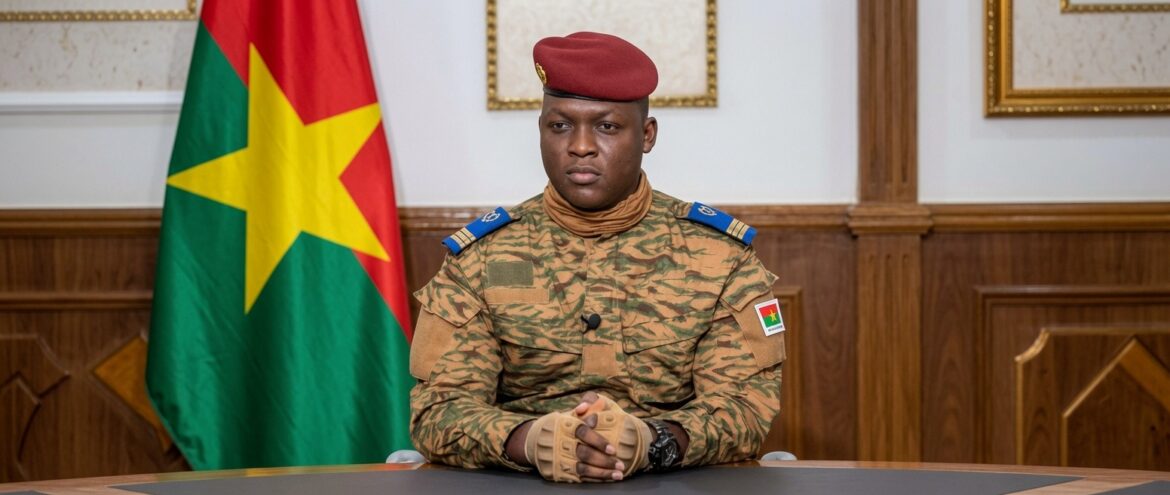
As Ouagadougou glows with the banners of the National Days of Patriotic Commitment and Citizen Participation, the transitional government pulls out all the stops in its communication machine. The “Allée des services au peuple” stands as the perfect showcase for the ruling Popular Progressive Revolution: online criminal records, digital nationality certificates, the computerization of Universal Health Insurance. Everything is staged to project the image of a modern, connected, efficient state.
Yet behind this technological veneer and the triumphant figures brandished at ministerial gatherings, the country’s reality tells a far harsher story. This frenzy of administrative dematerialization looks like a communication gadget built by and for urban elites, while the very foundation of the nation crumbles.
A digital showcase disconnected from everyday life
Administrative dematerialization is not without merit on paper. Extending online criminal records or digitizing legal documents are genuine technical advances. But who are these tools really designed for?
With internet penetration struggling to cross the 20% mark and 4G coverage largely confined to major urban centers, digital administration is a mirage for the vast majority of the population. Presenting online enrollment in Universal Health Insurance as a major success when it reaches only about 1.3% of the population is misleading political framing.
Worse still, this strategy deepens a violent social divide: on one side, a connected urban minority able to request documents in a few clicks; on the other, millions of invisible citizens, deprived of the most basic mobile network and ignored by this two-speed modernization.
The nation’s real priorities
For a state’s digitalization to make sense, the population must first have the minimum conditions of existence and the cognitive and material capacities to benefit from it. The order of national priorities needs to be reorganized around two absolute emergencies.
Security: the indispensable precondition for any citizenship
No dematerialization can flourish on a territory fractured by insecurity. With more than two million internally displaced people who have fled terrorist violence, the urgent need of the Burkinabè population is not to obtain a civil status document from a smartphone, but to survive, find shelter and recover their land.
- Physical access before digital access: public services cannot be digitized in a commune under terrorist control or whose telecommunications infrastructure has been sabotaged.
- The right to life before the right to an e-service: the absolute vital priority remains restoring territorial sovereignty and securing people and property. Without security, the dematerialized state is a mere specter with no territorial anchor.
Education: the sine qua non of digital inclusion
Even assuming security is restored and internet coverage is deployed across the entire territory, access to dematerialization hits an insurmountable wall: illiteracy.
- The literacy divide: a major share of the population masters neither reading nor writing, let alone computer tools. Offering complex web platforms to citizens who have had no access to basic education is a systemic aberration.
- The schooling emergency: thousands of schools remain closed because of the conflict. Pouring massive financial and human resources into servers and virtual platforms while generations of Burkinabè children are deprived of school is a genuine strategic contradiction.
Rethinking ambitions to build on solid foundations
Wanting to digitize the administration before securing the country and educating its citizens is like painting the facade of a house whose foundations are collapsing.
The logical sequence of development first requires restoring security so people can live and produce on their land. It then demands a massive educational effort to give citizens the ability to read, understand and interact with modern society. Only once this fundamental base is consolidated can dematerialization unfold its full potential and become a universally accessible service.
For technological progress to remain more than an urban privilege or a political communication tool, Burkina Faso must reinvest in the core of its sovereign missions: securing the territory to bring back peace, then educating the population to give it the means for autonomy.