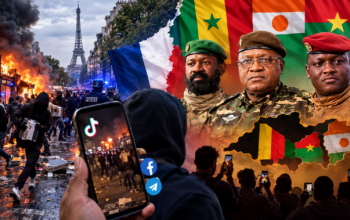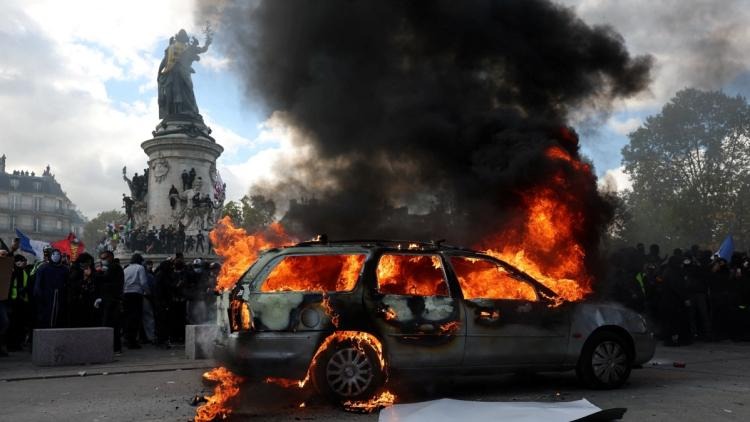
The images have become unmistakable: shattered storefronts, police baton charges, flaming dumpsters, and clouds of tear gas. Each surge of protest in France is instantly mirrored on social media feeds in Bamako, Ouagadougou, and Niamey. Yet beyond the immediate spectacle of civil disorder, these scenes have evolved into something far more potent for the military-led governments of the Alliance of Sahel States (AES).
What Western audiences perceive as a political or social crisis is being repurposed in Sahel capitals as living proof of the West’s moral decay—and a justification for the very regimes seizing power in the name of national sovereignty.
The collapse of France’s moral authority and its geopolitical cost
Scroll through trending topics in Bamako, Ouagadougou, or Niamey after another round of protests in Paris, and a clear pattern emerges. State-aligned media outlets and pro-junta influencers don’t just report on the unrest—they celebrate it. Official narratives frame every tear-gas canister and burning barricade as divine retribution for decades of French paternalism and interventionism in Africa.
Assimi Goïta in Mali, Ibrahim Traoré in Burkina Faso, and Abdourahamane Tiani in Niger did not come to power through popular elections. Their rise was preceded—or enabled—by a shared conviction: that France’s democratic demands were a double standard, draped in hypocrisy. And now, they claim, history is delivering its verdict.
For years, Paris positioned itself as the guardian of liberal democracy, human rights, and freedom of assembly across the Sahel. Yet today, its own streets are filled with protesters facing baton blows, water cannons, and emergency parliamentary measures to curb dissent. That dissonance has been weaponized, dismantling France’s once-unassailable image and empowering Sahelian juntas to recast their military rule as the only true guardians of national sovereignty.
How propaganda turns crisis into political currency
The strategic benefits of exploiting French turmoil are not merely rhetorical. They serve three core objectives within the AES strategy:
- Undermining democratic legitimacy: By depicting liberal democracy as a failing, unstable system prone to chaos, junta-aligned media reinforce the idea that only strongman rule can restore order and protect African dignity.
- Distracting from domestic failures: When public anger shifts to France’s troubles, attention is diverted from worsening local crises—rising insecurity, crippling inflation, chronic power cuts, and collapsing public services.
- Legitimizing a geopolitical pivot: Amplified through tightly controlled media networks and pro-Kremlin narratives, these images fuel the narrative of Western decline, justifying new alliances with Moscow, Ankara, and Tehran—partners willing to respect Sahelian governments without moral conditions.
This is not spontaneous outrage—it is orchestrated. State television in Mali, Burkina Faso, and Niger now features daily segments comparing French police brutality with the alleged benevolence of their own governments. Viral clips of Parisian unrest are clipped, subtitled, and distributed alongside anti-French slogans, ensuring that every protest becomes a propaganda asset.
Democracy’s paradox: when protest becomes a paradoxical strength
Despite these propaganda victories, critical observers note a glaring contradiction. While junta supporters point to France’s unrest as proof of democratic failure, they overlook a fundamental truth: the very freedom to protest, strike, and openly criticize public officials remains a hallmark of open societies—one that has all but vanished beneath Sahelian military rule.
Independent analysts argue that these comparisons reveal a deeper cognitive disconnect. The Sahel’s military regimes suppress dissent at home, branding any opposition as “subversive” or “terrorist.” Yet they shamelessly amplify images of dissent abroad to delegitimize their former colonizer and consolidate their own power.
The result is a fractured image of France. No longer seen as a model of stability or democratic virtue, it is now portrayed as a declining power, morally and politically bankrupt. With every image of Paris under siege, the diplomatic capital Paris once held south of the Sahara erodes further—handing the juntas an unexpected but invaluable propaganda tool.
The long shadow of France’s “lesson-giver” past
For decades, Paris dictated political conditions in the Sahel under the banner of democracy promotion. It suspended aid, isolated coups, and demanded transparency. Today, those demands have been turned against it. The very crises that once discredited African leaders now discredit the institutions that once condemned them.
The AES juntas have seized the moment. By weaponizing French unrest, they are not only reshaping the region’s media landscape—they are redefining the rules of the geopolitical game. What began as a domestic crisis in France has become a strategic asset, cementing their legitimacy and accelerating their break from the West.
In the court of African public opinion, France’s streets have become a stage—and the juntas are the only ones clapping.