The social contract of education: when digital promises overshadow classroom realities
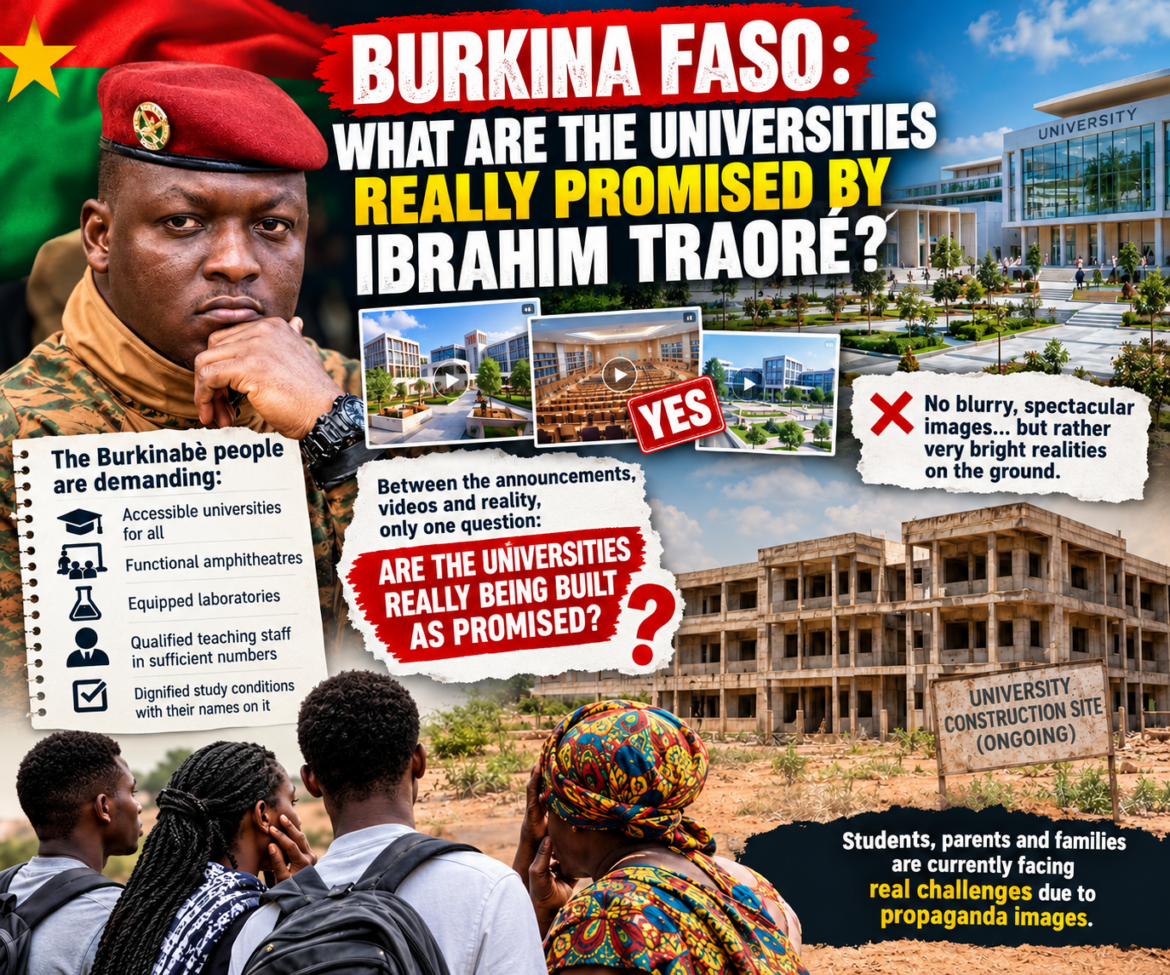
Behind the polished images flooding Burkina Faso’s cyberspace portraying gleaming university campuses and state-of-the-art facilities lies a critical question one rarely hears in the official narrative: how much of what has been announced has actually materialized for students and families?
The contrast between the government’s digital showcase and the lived experience of higher education in the country raises concerns about transparency, accountability, and the true priorities of public policy. What begins as a legitimate attempt to modernize education often ends up mired in partisan communication tactics that blur the line between progress and political manipulation.
The illusion of progress: when digital content distorts public perception
Digital manipulation has become a powerful tool in Burkina Faso’s political discourse. Several widely circulated videos purportedly showing new university buildings have later been traced to unrelated construction projects in Algeria or generated using artificial intelligence. These instances are not anomalies; they reflect a troubling pattern in which visual content is weaponized to shape public opinion.
While a handful of these videos were debunked by independent fact-checkers, their impact lingers. They create a false impression of achievement, one that resonates deeply in a society where parents invest life savings in the hope of a better future for their children through education.
It is not enough to dismiss these fabrications as isolated cases. When state communication relies on unverified, digitally altered content, it undermines public trust and erodes the very foundation of credible governance.
Why the source matters
The danger lies not only in the falsity of the content but in the context of its creation and dissemination. Some videos circulating online mimic authentic construction footage, complete with Burkinabè flags and patriotic narration. Yet behind the montage lies no real university, no working laboratories, no functioning learning spaces only an illusion designed to reinforce political legitimacy.
While the government has celebrated the inauguration of new facilities such as the expanded complex at Nazi-Boni University in Bobo-Dioulasso it has provided little public documentation of their daily operations. Are these buildings staffed? Are they accessible to students? Are they equipped for teaching and research?
From announcements to accountability: the long road from promise to delivery
Announcing a university is one thing. Delivering one is another. The process involves securing funding, hiring faculty, outfitting laboratories, and ensuring accessibility. Yet in Burkina Faso, the gap between political announcements and educational reality remains vast.
Announced projects vs. completed buildings: A university may be announced, a foundation stone laid, and a ribbon cut but the facility may sit unused for months or even years due to incomplete infrastructure or lack of staff.
Equipped labs vs. empty promises: High-tech laboratories promised in videos often lack basic equipment, reliable electricity, or qualified technicians.
Accessibility barriers: Remote locations, high fees, or limited enrollment capacity mean many students never benefit from announced facilities.
This is not mere speculation. Student testimonials and independent reports consistently reveal crowded classrooms, outdated libraries, and poorly maintained dormitories despite the presence of modern-looking structures promoted online.
The cost of unmet expectations
Families who have mortgaged homes or borrowed heavily to send their children to university feel betrayed when promised institutions fail to deliver. They are not asking for perfection, but for honesty. They deserve to know whether their children will study in buildings that exist in reality not just in pixels.
The issue, therefore, is not whether progress has been made, but whether the communication surrounding it is honest, accurate, and verifiable.
The role of leadership: integrity in public communication
A government’s credibility is measured not by the number of viral videos it produces, but by its willingness to subject its claims to scrutiny. When political messaging overrides factual reporting, the entire education system and the trust of the people suffers.
Accountability requires more than glossy launches. It demands transparency: open access to construction data, independent verification of facilities, and public reports on enrollment, graduation rates, and teaching quality.
Without such mechanisms, the digital spectacle becomes a form of governance in itself one in which perception replaces performance, and outcomes are obscured by optics.
What students truly need: evidence, not aesthetics
At the heart of the debate is a fundamental right: the right to truth in public service delivery. Students do not need another viral video extolling new universities; they need campuses that function. They do not need more announcements; they need transparent budgets, functioning libraries, and faculty paid on time.
Until the government provides verifiable proof of progress not just compelling visuals its education policy will remain a work in progress, both on the ground and in the public imagination.
A call for clarity and action
The question remains: where are the universities promised to Burkina Faso’s youth? The answer must come not from retouched images, but from open, honest reporting. Only then can the nation move beyond the fantasy of digital PR and toward a reality of accessible, high-quality education for all.
By Claire Mvondo — Journalist