When Burkinabè Foreign Minister Karamoko Jean-Marie Traoré arrived in Brussels on November 4-5, 2026, his mission was clear: secure financial commitments to support Ouagadougou’s post-2027 development agenda. What he obtained was a €40 million pledge from Belgium—a move that, while modest, carries significant geopolitical implications.
Against the backdrop of strained relations with several Western nations, this Belgian commitment raises a critical question: Can the Burkina Faso-Belgium partnership withstand political friction while adapting to shifting global alliances?
Belgium’s €40 million offer: continuity or calculated risk?
The pledge, confirmed through Belgium’s international development agency Enabel, extends cooperation beyond 2027. Totaling €40 million, this commitment builds on the previous seven-year program (2023–2027), valued at €34.5 million, which focused on sustainable development and humanitarian assistance.
Crucially, the €40 million is not an immediate disbursement but a forward-looking pledge—a signal of intent rather than financial closure. Its timing coincides with Burkina Faso’s urgent need for external support amid economic instability, social upheaval, and escalating security threats.
For Belgium, this commitment is not just financial. It reflects Brussels’ strategic decision to maintain influence in a volatile Sahel region where long-standing partnerships are being reevaluated.
Diplomatic choreography: Traoré’s Brussels agenda
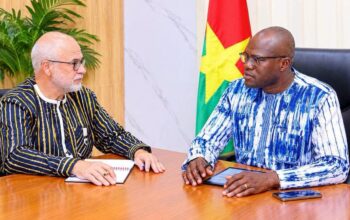
Traoré’s visit was more than a financial negotiation—it was a carefully staged diplomatic overture. On November 4, he met with Kaja Kallas, the European Union’s High Representative for Foreign Affairs and Security Policy, to discuss EU-Burkina Faso relations and Ouagadougou’s vision for international partnerships.
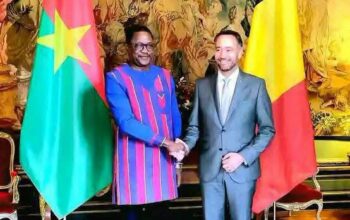
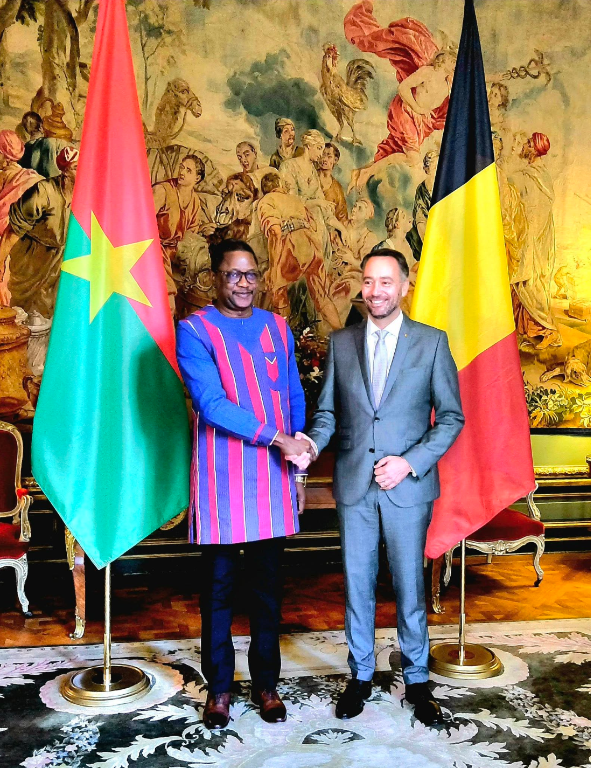
The following day, discussions with Belgian Deputy Prime Minister Maxime Prévot centered on bilateral cooperation, regional challenges, and future collaboration frameworks. Though tense in recent years, diplomatic channels between Ouagadougou and Brussels remain partially open—a reflection of pragmatic resilience.
Ibrahim Traoré’s balancing act: sovereignty vs. necessity
Since coming to power in September 2022, President Ibrahim Traoré has consistently championed national sovereignty, criticizing Western interference and reorienting Burkina Faso’s alliances toward Moscow and Ankara. Yet the €40 million Belgian aid underscores a nuanced reality: asserting independence does not always mean severing ties.
This paradox reveals a subtle diplomatic strategy—one that distinguishes between political rejection of Western influence and practical engagement to secure resources. Traoré’s government may reject colonial-era legacies but still leverages Western aid when it serves domestic priorities.
The role of diversification in Burkina Faso’s foreign policy
Burkina Faso’s pivot toward non-Western partners—particularly Russia—has reshaped its global positioning. Yet this realignment is not absolute. The Burkinabè government simultaneously maintains channels with traditional donors like Belgium, ensuring access to development funding and institutional collaboration.
This dual approach suggests a nuanced foreign policy: one that prioritizes national interests over ideological alignment. Brussels’ €40 million pledge may be seen as tacit acceptance of Ouagadougou’s shifting diplomacy—a sign that pragmatic cooperation can persist despite political divergences.
What the €40 million tells us about Burkina Faso’s diplomatic future
The financial pledge is more than a transaction. It is a diplomatic message—one that signals Brussels’ willingness to engage despite misalignment with Ouagadougou’s political rhetoric. For Traoré, it represents a carefully managed balancing act: asserting sovereignty while securing external support.
Whether this signals a long-term realignment toward Europe or merely a tactical pause remains unclear. What is evident, however, is that Burkina Faso’s diplomacy under Traoré operates in a grey zone—where sovereignty is loudly proclaimed, but pragmatism quietly prevails.
The €40 million aid is not a return to Western orbit. It is evidence that diplomacy rarely demands absolute choices. In a region where alliances are fluid, Ouagadougou and Brussels are learning to coexist—even when their visions do not align.