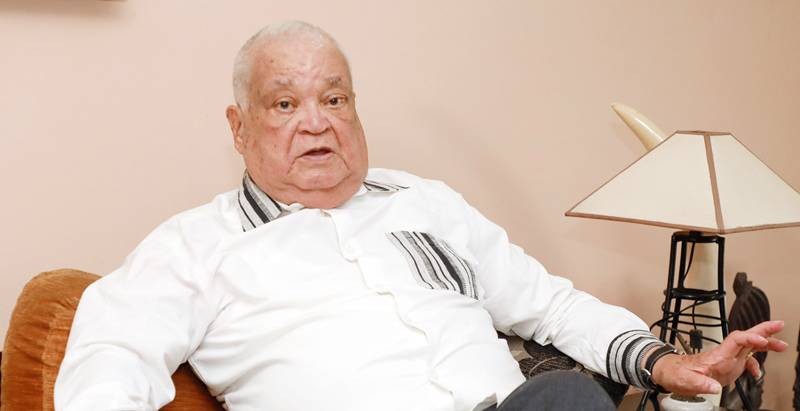
Former Ivorian Minister of Communication Auguste Miremont, now 85, has spent a lifetime observing and shaping the political landscape of Côte d’Ivoire. As the first head of the country’s Information Ministry (then called the Ministry of Communication) from 1989 to 1993, and later as Director-General of Fraternité Matin, he has witnessed decades of national history unfold. Now, a new book, « Auguste Miremont: From Houphouët to Ouattara, in Full Freedom », captures his reflections on the country’s evolution—offering a rare glimpse into the minds of two of Côte d’Ivoire’s most influential leaders.
Mr. Miremont recently opened up about his journey, his admiration for President Félix Houphouët-Boigny, and his evolving perspective on President Alassane Ouattara, whom he believes has absorbed the most from the late founding president’s leadership style.
a legacy of stability and crisis: houphouët-boigny’s era
The political career of Auguste Miremont began under the long presidency of Félix Houphouët-Boigny, a period marked by both stability and turbulence. While the country enjoyed relative peace and international respect, its stability was repeatedly tested by crises—mutinies, social unrest, and regional tensions. Yet, Houphouët-Boigny’s political genius lay in his ability to listen, delay, mediate, and act decisively when necessary. His leadership style was rooted in patience and foresight, qualities that helped Côte d’Ivoire weather many storms.
Mr. Miremont, who served as Houphouët-Boigny’s Minister of Communication and head of the national newspaper Fraternité Matin, recalls a leader who valued open dialogue but tolerated no compromise on national unity. “He respected me,” Miremont says, “because I never sought personal gain, and I spoke my mind—even to him.”
Despite rumors suggesting otherwise, Houphouët-Boigny did not treat Miremont differently because of his French heritage. “He simply called me ‘De Miremont’,” the former minister recalls with a smile. “It wasn’t a title of nobility—it was his way of recognizing a shared history and respect for the land.”
the painful descent: coups and conflict
The transition from Houphouët-Boigny to subsequent leaders was far from smooth. The 1999 coup d’état against President Henri Konan Bédié marked a turning point—one that Miremont describes as deeply painful. “I was presiding over a strong parliamentary group with the PDCI,” he recalls. “To see the country plunge into chaos was heartbreaking.”
What followed—a cycle of violence under Generals Robert Guéï and Laurent Gbagbo—further eroded the image of Côte d’Ivoire as a stable, respected nation. “We had been a model in West Africa,” Miremont reflects. “We hosted refugees, intervened in regional crises, and were seen as a beacon of hope. Suddenly, we were the subject of international scorn. For someone who had built this country alongside Houphouët-Boigny, it was unbearable.”
ouattara’s leadership: a student of houphouët’s wisdom
When asked which of Côte d’Ivoire’s modern leaders best embodied the wisdom of Houphouët-Boigny, Auguste Miremont points to President Alassane Ouattara. “He has learned the most from Houphouët—his patience, his listening skills, and his sense of timing,” Miremont observes. “Though I would say Ouattara is less rigid today than he was as Prime Minister. Back then, he demanded absolute loyalty and removed ministers at the slightest deviation. It was tough, but necessary for economic recovery.”
Miremont’s relationship with Ouattara dates back to their time together in government. “I had complete trust and loyalty in him,” he says. “He is courageous, persistent, and deeply courteous—a man who remembers even the smallest personal details of those who work with him.” He recalls instances where Ouattara, despite his busy schedule, would have his secretary call back within minutes to address an inquiry.
a nation in transition: progress amid challenges
Despite Côte d’Ivoire’s economic progress under Ouattara—visible in infrastructure like the Daloa boulevard, regional hospitals, and expanded universities—Miremont acknowledges the persistent social inequalities. “Yes, the economy is strong by international standards,” he admits, “but the cost of living is high, and poverty persists. Still, I give credit to the government for initiatives like social safety nets, vocational training programs, and the ‘Second Chance School’ project.”He highlights efforts in youth empowerment, including 25 vocational scholarships awarded in his home region, as evidence of a government committed to correcting imbalances. “It’s not perfect,” he says, “but it’s moving in the right direction.”
the road ahead: unity and responsibility
At 85, Auguste Miremont remains deeply invested in Côte d’Ivoire’s future. He rejects the idea of Ouattara’s imminent exit from politics, noting the president’s continued vigor and fresh mandate. “He’s just getting started,” Miremont insists. “His vision is clear: a united, prosperous, and dignified Côte d’Ivoire.”
The book, born from 30 hours of conversations over 18 months, is not a self-aggrandizing memoir but a testament to legacy and transmission. “It’s about sharing what we’ve learned,” he concludes. “The title says it all: ‘From Houphouët to Ouattara, in Full Freedom.’”